Dual Fuel Generators
Best Dual Fuel Generator
We research every product against its spec sheet, manuals and owner reports. When you buy through our links we may earn a commission, at no cost to you. How we score · Disclosure
The best dual fuel generator for most people in 2026 is the Westinghouse WGen9500DF Dual Fuel. The dual fuel generator to buy if you want real whole-house-adjacent output on either fuel and a 50-amp outlet ready for a proper hookup.
Six gas-and-propane generators ranked by what they actually make on propane, how they hook up to a house, and how long a tank lasts.
Buy a dual fuel generator for the propane, and judge it by its propane rating. The gasoline number on the box is the one you will use least once an outage runs past day two.
Our top picks at a glance
- 1
 View
- 2
 View
Best Value
Champion 9200-Watt Dual Fuel Portable Generator with CO Shield (201302)91/100 See current price
- 3
 View
- 4 GeneracView
- 5 WestinghouseView
Best Dual Fuel Inverter
Westinghouse iGen4500DF Dual Fuel Inverter Generator81/100 See current price
- 6
 View
Quick answer
the Westinghouse WGen9500DF Dual Fuel Portable Generator is our #1 pick (best overall). The dual fuel generator to buy if you want real whole-house-adjacent output on either fuel and a 50-amp outlet ready for a proper hookup.
On this page
- 1. The Short Answer: Who Should Buy a Dual Fuel Generator
- 2. The best dual fuel generators right now
- 3. Dual Fuel Generator Side by Side
- 4. Dual Fuel Generator Comparison
- 5. How Dual Fuel Works, and What Propane Costs You
- 6. Buying Guide: The Specs That Actually Matter
- 7. 30A vs 50A: Connecting a Dual Fuel Generator to the House
- 8. Planning Your Propane Supply
- 9. Dual Fuel vs Tri Fuel vs Dual Fuel Inverter
- 10. Carbon Monoxide Safety and Placement
- 11. Common Mistakes to Avoid
- 12. Frequently Asked Questions
1. The Short Answer: Who Should Buy a Dual Fuel Generator
A dual fuel generator runs on gasoline or propane, switching with a dial or a selector valve. For home backup that one feature solves the problem that sinks most outage plans: fuel. Gasoline goes stale in a few months without stabilizer, gas stations need electricity to pump, and after a hurricane or ice storm the lines at the ones that are open can run for hours. Propane keeps for years in a sealed cylinder, and a stack of filled 20 lb tanks in a shed is about the simplest fuel reserve a household can keep.
Our pick for most homes is the Westinghouse WGen9500DF. It loses only about a tenth of its output on propane, carries both a 30-amp and a 50-amp outlet for a transfer switch, and starts from a key fob. If you want carbon monoxide shutoff built in and a lower price, the Champion 9200-Watt Dual Fuel with CO Shield is the value pick. If you need the most watts on propane, the DuroMax XP13000EH rates close to 10,000 running watts on LP. Houses on a natural gas line should look at the tri fuel DuroMax XP13000HXT, and anyone who wants quiet over raw output should consider the Westinghouse iGen4500DF inverter.
This page is a deep dive on one decision inside the bigger question of what kind of home generator to buy for power outages. If you have not yet decided between a standby unit, a portable and a battery station, start there. If you have settled on a portable and want fuel flexibility, read on.
THE RULE
Size the generator on its propane rating, not the gasoline headline.
Every open-frame dual fuel generator makes less power on propane. If you plan to run on propane during a long outage, the propane running-watt figure is the number your load list has to fit under.
2. The best dual fuel generators right now
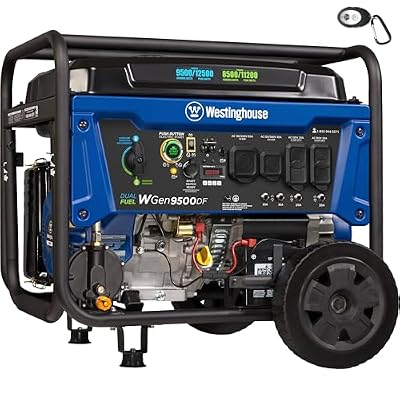
1. Westinghouse WGen9500DF Dual Fuel Portable Generator
See current price · Best for: Most buyers
- Running Watts (Gas / Propane)
- 9,500 / 8,500
- Peak Watts (Gas / Propane)
- 12,500 / 11,200
- Run Time at 50% Load
- 8 hr gas (6.6 gal) / 7 hr propane (20 lb)
- Outlets
- 2x 5-20R GFCI duplex, L14-30R 30A, 14-50R 50A
The WGen9500DF earns the top spot because it loses less on propane than most rivals. Westinghouse rates it at 9,500 running and 12,500 peak watts on gasoline, and 8,500 running and 11,200 peak on propane, a drop of roughly 10 percent where many open-frame units give up 15 percent or more. That matters, because the whole reason to buy dual fuel is to run on propane when gas stations are dark. The panel carries two GFCI duplex outlets, a 30-amp L14-30R and a 50-amp 14-50R, so it works with either a 30-amp manual transfer switch or a 50-amp inlet and interlock. Westinghouse lists run time at about 8 hours on gasoline and 7 hours on a 20 lb propane cylinder at half load, from a 6.6-gallon tank with a gauge. Electric start with a remote key fob is a real convenience. The trade-offs are 211 lb of dry weight and 74 dBA of noise. The standard model has no carbon monoxide shutoff; if that matters to you, and it should, look for the WGen9500DFc, which adds CO sensing.
Pros
- Smallest propane penalty in the big-portable class: 8,500 running watts on LP
- Both a 30A L14-30R and a 50A 14-50R, so it fits either size of transfer switch
- Remote key-fob start, handy in freezing rain
- Westinghouse lists it as transfer switch ready
- 6.6-gallon tank with a built-in fuel gauge
Cons
- The base WGen9500DF has no CO sensor; the WGen9500DFc version adds one
- 211 lb dry, so it lives on its wheels
- Rated at 74 dBA, which neighbors will hear

2. Champion 9200-Watt Dual Fuel Portable Generator with CO Shield (201302)
See current price · Best for: Value
- Running / Starting Watts (Gas)
- 9,200 / 11,500
- Run Time at 50% Load
- 10 hr gas / 5 hr propane
- Gas Tank
- 7.7 gal
- Outlets
- 2x 5-20R GFCI duplex, L14-30R 30A, 14-50R (38A max)
This is the dual fuel generator most people should price first, and it is the same 9,200-watt class Champion that our home outage guide ranks as its top portable. Champion rates it at 11,500 starting and 9,200 running watts on gasoline from a 459cc engine, enough for a refrigerator, a freezer, a sump pump, a gas furnace blower, lights and Wi-Fi together, with room for a window air conditioner if you stagger start-ups. Like every open-frame dual fuel unit, it makes less on propane, so build your load list from the propane figure on the label, not the headline number. The 7.7-gallon tank gives about 10 hours at half load on gasoline; on propane, Champion lists about 5 hours at half load, so plan on several 20 lb cylinders a day. CO Shield shuts the engine off if carbon monoxide accumulates around it, a backup to good placement rather than a substitute. The panel has GFCI household outlets, a 30-amp L14-30R and a 14-50R that Champion caps at 38 amps. Check the model number before you buy: Champion also sells gasoline-only 9200-watt units.
Pros
- CO Shield shuts the engine off if carbon monoxide builds up
- Longest gasoline run time here at half load, about 10 hours
- Fuel selector dial switches between gas and propane
- 30A and 50A outlets cover either transfer switch size
- Cold Start Technology for winter outages
Cons
- Propane output is lower than the gasoline rating; read the unit label
- About 5 hours per 20 lb cylinder at half load means a lot of tank swaps
- Its 50A outlet is limited to 38 amps

3. DuroMax XP13000EH Dual Fuel Portable Generator
See current price · Best for: 1.5 HP and Larger Pumps
- Running Watts (Gas / Propane)
- 10,500 / 9,975
- Peak Watts (Gas / Propane)
- 13,000 / 12,350
- Run Time at 50% Load
- 8.5 hr gas / 6.5 hr propane
- Outlets
- 2x 120V 20A GFCI, 120V 30A twist lock, 120/240V 30A twist lock, 120/240V 50A
The XP13000EH is as much generator as most homeowners can still call portable. DuroMax rates it at 13,000 peak and 10,500 running watts on gasoline, and 12,350 peak and 9,975 running watts on propane, the strongest propane numbers here by a clear margin. That makes it the pick for houses with a 240V well pump, an electric water heater you want to run in short bursts, or a smaller central air system, after an electrician checks its starting draw. The 500cc engine and copper windings are built for heavy loads, and the panel carries both 30-amp twist-lock outlets and a 120/240V 50-amp outlet, so it suits a 50-amp inlet and interlock. DuroMax lists about 8.5 hours on gasoline and 6.5 hours on propane at half load. The costs are physical. DuroMax lists it at 248 lb, it is rated at 74 dB, and at heavy load it burns through a 20 lb cylinder fast enough that a 100 lb tank or several 40 lb tanks make more sense. The EH has no CO shutoff; DuroMax sells CO Alert versions under other model numbers.
Pros
- Highest propane output on this list: 9,975 running watts
- 50A 120/240V outlet for a large inlet and interlock setup
- All-copper alternator windings and all-metal construction
- Enough surge for a 240V well pump alongside household loads
- Push-button electric start
Cons
- 248 lb; it needs a hard path to its operating spot
- No CO shutoff on the EH version
- Very thirsty at heavy load on either fuel
4. Generac GP7500E Dual Fuel Portable Generator with COsense
See current price · Best for: Mid-Size
- Running Watts (Gas / LP)
- 7,500 / 6,800
- Starting Watts (Gas / LP)
- 9,400 / 8,500
- Run Time at 50% Load
- 10 hr gas (7.9 gal) / 5 hr LP (20 lb)
- Outlets
- 2x 5-20R GFCI duplex, L14-30R 30A
Not every house needs 9,000-plus watts, and the GP7500E Dual Fuel is the pick for the many that do not. Generac rates it at 7,500 running and 9,400 starting watts on gasoline, and 6,800 running and 8,500 starting on LP. That is enough for a refrigerator, a freezer, a sump pump, a gas furnace blower, lights and a window air conditioner with sensible staggering. Generac's PowerRush feature is designed to boost starting capacity for motor loads, which helps with pumps and compressors. COsense monitors carbon monoxide around the unit and shuts it down if levels climb. Generac lists up to 10 hours at half load on gasoline from a 7.9-gallon tank, and 5 hours on a 20 lb LP cylinder. The panel has two GFCI duplex outlets and an L14-30R, and Generac describes it as transfer switch ready, so it matches a standard 30-amp manual transfer switch or 30-amp inlet. What you give up is the 50-amp outlet and the extra headroom of the 9,500-watt class, and it is still 204 lb. If your load list fits under about 6,500 watts on propane, it is the simpler buy.
Pros
- COsense shuts the engine down if carbon monoxide builds up
- PowerRush, which Generac says adds over 30% more starting capacity
- Fuel switches with a dial
- Transfer switch ready through the L14-30R
- Generac's large dealer and parts network
Cons
- No 50A outlet, so it pairs with a 30-amp switch or inlet only
- Still 204 lb despite the smaller output
- About 5 hours on a 20 lb LP cylinder at half load
5. Westinghouse iGen4500DF Dual Fuel Inverter Generator
See current price · Best for: Dual Fuel Inverter
- Running Watts (Gas / Propane)
- 3,700 / 3,330
- Peak Watts (Gas / Propane)
- 4,500 / 4,050
- Run Time at 25% Load
- 18 hr gas (3.4 gal) / 14 hr propane (20 lb)
- Outlets
- 1x 5-20R duplex, TT-30R 30A RV, 2x USB
If you want dual fuel without the noise of an open-frame engine, the iGen4500DF is the one to look at. Westinghouse rates it at 3,700 running and 4,500 peak watts on gasoline, and 3,330 running and 4,050 peak on propane. Because it is an inverter, the engine throttles down at light load, which is why the spec sheet lists 18 hours at quarter load on its 3.4-gallon tank and 14 hours on a standard 20 lb propane cylinder. That is the best propane economy on this list by a wide margin. Output is clean, with Westinghouse listing under 3 percent total harmonic distortion, and the operating noise is rated as low as 52 dBA. The limits are important. It is 120V only, with a 5-20R duplex, a TT-30R RV outlet and two USB ports, and Westinghouse's own sheet marks it as not transfer switch ready. So it is a run-extension-cords-to-essentials generator, or an RV generator, not a panel-feeding one. It weighs 98 lb dry. It can be paralleled with another iGen using Westinghouse's cord if you outgrow one.
Pros
- Clean inverter power, under 3% THD per Westinghouse
- Rated as low as 52 dBA, far quieter than open frames
- 14 hours on a 20 lb propane cylinder at quarter load
- Electric, remote fob and recoil start
- Parallel capable with another iGen
Cons
- 120V only, and Westinghouse lists it as not transfer switch ready
- Not enough output for a 240V well pump or central air
- 98 lb dry is heavy for a 3,700-watt unit
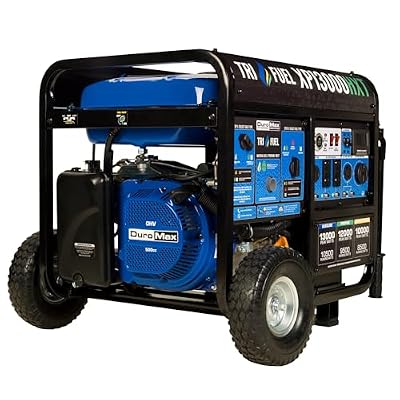
6. DuroMax XP13000HXT Tri Fuel Portable Generator with CO Alert
See current price · Best for: Tri Fuel
- Running Watts (Gas / Propane / NG)
- 10,500 / 9,500 / 8,500
- Peak Watts (Gas / Propane / NG)
- 13,000 / 12,000 / 10,000
- Run Time at 50% Load
- 8.5 hr gas / 6.5 hr propane
- Engine
- 500cc OHV
Tri fuel adds natural gas to gasoline and propane, and for houses already plumbed for gas it changes the math of a long outage completely. Instead of swapping cylinders every few hours, a properly installed quick-connect lets the generator run from the utility line for as long as gas pressure holds. DuroMax's spec sheet rates the XP13000HXT at 13,000 peak and 10,500 running watts on gasoline, 12,000 peak and 9,500 running on propane, and 10,000 peak and 8,500 running on natural gas. That natural gas figure is still enough for a large share of a house through a transfer switch. DuroMax lists half-load run time of 8.5 hours on gasoline and 6.5 hours on propane. The HXT adds DuroMax's CO Alert technology, which shuts the engine down if carbon monoxide accumulates, and push-button starting. The caveats: natural gas connection is plumbing work, and DuroMax specifies a supply pressure range that a long run of small pipe may not meet, so have a plumber check it. Retail listings vary on stock, so confirm the exact model number in the listing before you buy.
Pros
- Runs on gasoline, propane or a natural gas line
- CO Alert shuts the engine down when carbon monoxide builds
- Big 120/240V output for well pumps and larger loads
- Natural gas removes the refueling problem for long outages
- Digital command center display on the panel
Cons
- Natural gas hookup needs a licensed plumber and a quick-connect
- Natural gas output drops to 8,500 running watts
- Heavy, loud and thirsty like the XP13000EH
3. Dual Fuel Generator Side by Side
| Product | Score | Price | Run Time at 50% Load | Outlets | Running Watts (Gas / Propane) | Peak Watts (Gas / Propane) | Engine | Buy |
|---|---|---|---|---|---|---|---|---|
| Westinghouse WGen9500DF Dual Fuel Portable Generator Best Overall | 93 | See current price | 8 hr gas (6.6 gal) / 7 hr propane (20 lb) | 2x 5-20R GFCI duplex, L14-30R 30A, 14-50R 50A | 9,500 / 8,500 | 12,500 / 11,200 | — | Amazon → |
| Champion 9200-Watt Dual Fuel Portable Generator with CO Shield (201302) Best Value | 91 | See current price | 10 hr gas / 5 hr propane | 2x 5-20R GFCI duplex, L14-30R 30A, 14-50R (38A max) | — | — | 459cc Champion OHV | Amazon → |
| DuroMax XP13000EH Dual Fuel Portable Generator Most Power | 91 | See current price | 8.5 hr gas / 6.5 hr propane | 2x 120V 20A GFCI, 120V 30A twist lock, 120/240V 30A twist lock, 120/240V 50A | 10,500 / 9,975 | 13,000 / 12,350 | 500cc OHV | Amazon → |
| Generac GP7500E Dual Fuel Portable Generator with COsense Best Mid-Size | 84 | See current price | 10 hr gas (7.9 gal) / 5 hr LP (20 lb) | 2x 5-20R GFCI duplex, L14-30R 30A | — | — | — | Amazon → |
| Westinghouse iGen4500DF Dual Fuel Inverter Generator Best Dual Fuel Inverter | 81 | See current price | — | 1x 5-20R duplex, TT-30R 30A RV, 2x USB | 3,700 / 3,330 | 4,500 / 4,050 | — | Amazon → |
| DuroMax XP13000HXT Tri Fuel Portable Generator with CO Alert Best Tri Fuel | 78 | See current price | 8.5 hr gas / 6.5 hr propane | — | — | — | 500cc OHV | Amazon → |
4. Dual Fuel Generator Comparison
The table puts the manufacturer ratings side by side. Running watts are what the generator can carry continuously; starting or peak watts are the short burst it can deliver while a motor spins up. The propane column is the one to read first.
| Model | Running W (Gas / LP) | Big Outlet | CO Shutoff | Run Time, 50% Load |
|---|---|---|---|---|
| Westinghouse WGen9500DF | 9,500 / 8,500 | 14-50R 50A + L14-30R | No (DFc version: yes) | 8 hr gas / 7 hr LP |
| Champion 9200W DF (201302) | 9,200 / lower on LP | 14-50R (38A) + L14-30R | Yes, CO Shield | 10 hr gas / 5 hr LP |
| DuroMax XP13000EH | 10,500 / 9,975 | 14-50R 50A + L14-30R | No | 8.5 hr gas / 6.5 hr LP |
| Generac GP7500E DF | 7,500 / 6,800 | L14-30R 30A | Yes, COsense | 10 hr gas / 5 hr LP |
| Westinghouse iGen4500DF | 3,700 / 3,330 | TT-30R (120V) | No | 15 hr gas (14 hr LP at 25%) |
| DuroMax XP13000HXT (tri fuel) | 10,500 / 9,500 / 8,500 NG | 14-50R 50A + 30A twist locks | Yes, CO Alert | 8.5 hr gas / 6.5 hr LP |
Three patterns stand out. First, the size of the propane penalty varies a lot between brands. Westinghouse and DuroMax publish propane ratings within roughly 5 to 10 percent of gasoline, while other models lose more. Second, the 50-amp outlet only appears on the 9,000-watt-plus units, and that outlet is what lets an electrician install a larger inlet and interlock. Third, CO shutoff is now common but not universal, so if you care about it, and you should, check the exact model suffix. Several of these generators are sold in a base version and a CO-sensing version under almost the same name.
Run time figures are the manufacturers' own and assume a steady half load in good conditions. Real outages are lumpier, with compressors cycling and pumps kicking on, so treat them as a ceiling and plan fuel with a margin.
5. How Dual Fuel Works, and What Propane Costs You
A dual fuel generator has one engine and two fuel paths. Gasoline flows from the tank through a carburetor as usual. Propane comes from a cylinder through a hose with a regulator, into a mixer or a second carburetor circuit, and the selector tells the engine which one to use. Most models let you switch fuels with the engine stopped; a few allow switching while running. Either way, you are not running both at once.
Propane makes less power because it carries less energy per unit of air-fuel mixture than gasoline in a small air-cooled engine. That is why every generator on this list lists lower propane ratings. The gap is the number to compare between models, not a sign that propane is a bad choice. A 9,500-watt gasoline rating that drops to 8,500 on propane is more useful in a long outage than a 10,000-watt rating that drops to 7,500.
In exchange for a few hundred watts, propane gives you real advantages. It does not go stale, so a cylinder filled in spring is still good in winter. It does not gum up carburetors, which is the most common reason a generator that sat for a year will not start. It is easier to store safely than gasoline, outdoors, upright and away from ignition sources. And it is often easier to get after a storm, since tank exchange cages and propane dealers keep running when pumps at gas stations are down.
Propane has two drawbacks worth planning for. It burns faster by volume, so a 20 lb cylinder lasts fewer hours than you might expect, as the run-time column shows. And propane pressure falls in very cold weather, which can starve a large engine at high load. Keeping cylinders out of the wind, using a larger tank, and not running a 20 lb cylinder down to empty all help.
The practical approach most owners settle on: start the outage on gasoline, which is already in the tank, then switch to propane once the gas is gone or the outage looks long. That way the gasoline gets used before it ages, and the propane reserve covers the days when you cannot buy more fuel.
6. Buying Guide: The Specs That Actually Matter
Ignore the biggest number on the box. Generator marketing leads with peak or starting watts on gasoline, which is the least useful number for planning. Here is what to read instead, in order.
Propane running watts
Add up the running watts of everything you want on at the same time, then add the largest single starting surge, usually a well pump, sump pump or refrigerator compressor. That total has to fit under the propane running rating with some margin. A refrigerator, a freezer, a furnace blower, a sump pump, lights and internet usually land between 3,000 and 5,000 running watts. Add a window air conditioner and you approach 6,000. A 240V well pump or a small central air system pushes you into the 9,000-watt class.
120/240V outlets and amperage
If you want to power circuits in your panel rather than run extension cords, the generator needs a 120/240V locking outlet. An L14-30R supports a 30-amp transfer switch or inlet. A 14-50R supports a 50-amp setup and lets you use more of a large generator's output through the panel. A TT-30R is a 120V RV outlet and does not feed a house panel. Note that some 50-amp outlets are limited below 50 amps by the generator's own breaker; Champion caps the 201302's at 38 amps.
CO shutoff
Champion's CO Shield, Generac's COsense and DuroMax's CO Alert all monitor carbon monoxide near the generator and shut the engine down if it builds up. It is a backup, not permission to run a generator in a garage, but it is a meaningful one and worth paying for.
Start type, weight and noise
Electric start with a battery matters more than it seems in a cold, wet outage, and remote start lets you fire it up without walking outside. Every big open-frame unit here weighs 200 lb or more, so check the path from storage to the spot you will run it. Noise ratings around 74 dBA are typical of open frames; inverters are much quieter.
Rated Propane Output
9,975 W
DuroMax XP13000EH running
8,500 W
Westinghouse WGen9500DF running
6,800 W
Generac GP7500E DF running
3,330 W
Westinghouse iGen4500DF running
7. 30A vs 50A: Connecting a Dual Fuel Generator to the House
A big dual fuel generator earns its keep when it feeds your panel, so the furnace, well pump and hardwired lights work without extension cords snaking through a window. That takes a transfer switch or an interlock kit with a power inlet box, installed by an electrician. It is the only safe way. A so-called suicide cord plugged into a dryer outlet can backfeed the utility lines and kill a lineworker, and it can burn out the generator when power comes back.
Matching outlet to switch is straightforward. A generator with an L14-30R pairs with a 30-amp manual transfer switch or a 30-amp inlet, which can deliver up to about 7,200 watts at 240V. A generator with a 14-50R can feed a 50-amp inlet and interlock, which lets a 9,500-watt unit deliver its full output to the panel. The Westinghouse WGen9500DF, the Champion 201302 and both DuroMax units have both outlets, so you can start with a 30-amp setup and step up later. The Generac GP7500E DF has the 30-amp outlet only, which fits its output well.
Our generator transfer switch guide covers the hardware in detail, including which manual switches and inlet boxes match each outlet. If you only need the furnace on backup, a single-circuit furnace transfer switch is a cheaper middle path.
One note on inverters: the Westinghouse iGen4500DF is a 120V unit with a TT-30R outlet, and Westinghouse lists it as not transfer switch ready. Use it with heavy-duty extension cords to individual appliances, or for an RV, not as a panel feed.
8. Planning Your Propane Supply
Run time on propane is the spec most buyers underestimate. The manufacturers on this list put a 20 lb cylinder at roughly 5 to 7 hours at half load for the 7,500 to 10,000-watt class. That means a household running a big generator around the clock could go through three to five standard cylinders a day. Plan accordingly.
There are three common ways to stretch that. The first is simply more 20 lb cylinders, stored outdoors and upright, rotated through an exchange or refill program. The second is a larger cylinder. Many owners move to 30 lb, 40 lb or 100 lb tanks, which need a longer hose and are heavier to move but cut the number of swaps. The third is running the generator in shifts: a few hours in the morning and evening to cool the refrigerator and freezer, charge batteries and run the well pump, then off overnight. A full refrigerator holds a safe temperature for hours with the door closed.
Shift running is also where a smaller generator shines. The iGen4500DF lists 14 hours on a 20 lb cylinder at quarter load, because its inverter engine throttles down. If your essentials are modest, a quiet inverter running long and light can use less propane than a big open frame working in short bursts.
A safety point on storage: never keep propane cylinders indoors, in a basement or in an attached garage. Store them outside, upright, in shade, away from the generator's exhaust and any ignition source, and close the valve when the generator is off. For gasoline, our gas generator guide covers stabilizer and safe can storage, which still matters for the half of a dual fuel unit that runs on it.
9. Dual Fuel vs Tri Fuel vs Dual Fuel Inverter
Three versions of the same idea compete for the same buyer, and the right one depends on your house more than on the generator.
Standard dual fuel open frame is the default for most homes. It gives the most watts per dollar, both 30-amp and 50-amp outlets on the larger models, and enough output to run most of a house with gas heat. The trade-offs are noise and fuel burn, since the engine runs at a fixed speed regardless of load.
Tri fuel adds natural gas. If your house already has a gas meter, a plumber can install a quick-connect fitting near where the generator will run, and the generator can then run from the utility gas line with no refueling. Natural gas output is lower again, about 8,500 running watts on the DuroMax XP13000HXT against 10,500 on gasoline, and you need adequate supply pressure, but for multi-day outages it is the closest a portable gets to standby convenience. If that appeals, also price a permanent standby unit; our home generator guide compares the two honestly.
Dual fuel inverter trades output for quiet and efficiency. The iGen4500DF is rated as low as 52 dBA and stretches propane much further at light loads, and its clean output suits electronics. But it is 120V only and tops out at 3,700 running watts. For a deeper look at inverter generators, including gasoline-only models from Honda, Champion and Generac, see our best inverter generator guide, and for quiet inverters that also burn propane, our best dual fuel inverter generator picks.
If none of these fit, two alternatives are worth a look. A smaller gasoline inverter covered in our small generator for home guide is lighter and cheaper for essentials-only plans. And a portable power station runs indoors with no exhaust, which makes it the right partner to a fuel generator for overnight loads like a CPAP.
10. Carbon Monoxide Safety and Placement
Propane burns cleaner than gasoline, but a propane-fueled generator still produces carbon monoxide, and enough of it to kill. The U.S. Consumer Product Safety Commission estimates that, on average, nearly 80 people die each year from carbon monoxide poisoning caused by portable generators, and outages after storms are when many of those deaths happen.
CPSC's guidance is specific. Run portable generators outdoors only, at least 20 feet from the house, with the exhaust pointed away from the home and any other building people could enter. Keep them away from doors, windows and vents. Never run one inside a home, a garage, a basement, a crawlspace or a shed, even with doors and windows open, because open windows do not provide enough ventilation to prevent deadly buildup. Some owner's manuals list shorter distances; follow the CPSC's 20-foot guidance anyway.
Inside the house, put battery or battery-backup carbon monoxide alarms on every level and outside sleeping areas, and test them before storm season. A CO shutoff on the generator, like CO Shield, COsense or CO Alert, adds a layer, but it monitors the air around the generator, not the air in your bedroom.
Weather is the usual excuse for moving a generator closer to the house. Instead, buy a purpose-made generator cover or tent that allows open-air operation, and set the unit on a dry, level spot. The extra cord length to reach 20 feet is cheap; a heavy-gauge cord or a properly located inlet box solves it. Our home outage generator guide has a fuller placement checklist.
11. Common Mistakes to Avoid
Sizing on the gasoline rating
If you buy dual fuel to run on propane, the propane running watts are your real ceiling. A load list that fits the gasoline number can trip the breaker on propane. Every model here loses some output on LP, and the gap varies by brand, so read both columns before you buy.
Buying one 20 lb cylinder and calling it a plan
Manufacturers rate a 20 lb cylinder at roughly 5 to 7 hours at half load for the big open-frame units. One tank covers an evening, not an outage. Keep several filled cylinders outdoors, or move to a larger tank, and decide in advance whether you will run around the clock or in shifts.
Backfeeding through a dryer outlet
A double-male cord plugged into a dryer or range outlet can energize the utility lines and kill a lineworker, and it can damage the generator when power returns. Use a transfer switch or an interlock with an inlet box, installed by a licensed electrician and matched to the generator's 30A or 50A outlet.
Running it in the garage with the door open
An open garage door does not clear carbon monoxide fast enough. CPSC says to run generators outdoors only, at least 20 feet from the house, with exhaust pointed away and away from doors, windows and vents. A CO shutoff on the generator is a backup, not a license to cut that distance.
Storing propane cylinders indoors
Propane cylinders belong outside, upright and in the shade, never in a basement, a living space or an attached garage. Close the valve when the generator is off, disconnect the hose for storage, and check the regulator hose for cracks before each season. Leaks indoors can collect at floor level.
12. Frequently Asked Questions
Is a dual fuel generator worth it?
For home backup, usually yes. Dual fuel models generally cost only modestly more than gasoline-only versions of the same generator, and they let you store propane, which does not go stale and is often easier to buy after a storm than gasoline. The trade-off is lower output on propane, typically around 5 to 15 percent less than on gasoline, depending on the model.
How long will a dual fuel generator run on a 20 lb propane tank?
It depends on size and load. At half load, Champion lists about 5 hours for its 9,200-watt model, Generac about 5 hours for the GP7500E DF, and Westinghouse about 7 hours for the WGen9500DF. A dual fuel inverter at light load lasts far longer: Westinghouse lists 14 hours for the iGen4500DF at quarter load.
Does a dual fuel generator produce less power on propane?
Yes. Every open-frame model on this list is rated lower on propane. The WGen9500DF goes from 9,500 to 8,500 running watts, the DuroMax XP13000EH from 10,500 to 9,975, and the Generac GP7500E DF from 7,500 to 6,800. Always size your loads against the propane rating if you plan to use propane.
Can I run a dual fuel generator on both fuels at once?
No. The selector chooses one fuel at a time. Some models let you switch while running, others require shutting down first, so read the manual for your model. Most owners run gasoline first, since it ages in the tank, then switch to propane for the rest of a long outage.
What is the difference between dual fuel and tri fuel generators?
A tri fuel generator adds natural gas to gasoline and propane. With a plumber-installed quick-connect, it can run from your home's gas line without refueling. Output is lowest on natural gas; the DuroMax XP13000HXT is rated at 8,500 running watts on natural gas versus 10,500 on gasoline, and supply pressure must meet the maker's spec.
What size dual fuel generator do I need to run a house?
For essentials with gas heat, a refrigerator, freezer, sump pump, furnace blower, lights and internet, plan on about 5,000 to 7,000 running watts on propane. A 240V well pump or small central air pushes you toward 9,000 or more. Add the largest starting surge to your running total and keep a margin.
How far away from the house should a propane generator be?
The same as a gasoline one. CPSC recommends running portable generators outdoors only, at least 20 feet from the house, with the exhaust directed away from the home and away from doors, windows and vents. Propane still produces carbon monoxide. Never run any generator in a garage, basement or shed, even with doors open.
Related Guides
Home & Portable Generators
Best Home Generator for Power Outages
The Generac Guardian 22kW leads 7 outage generators; essentials alone need about 3,500 to 5,000 running watts, and a sump or well pump pushes that higher.
Inverter Generators
Best Inverter Generator
The Honda EU2200i is the best inverter generator for most, rated 48 to 57 dBA at about 47 lb; the Westinghouse iGen4500 gives 3,700 running watts. 7 picks.
Transfer Switches & Inlets
Best Generator Transfer Switch
The Reliance 31406CRK 30-amp kit is the generator transfer switch most homes need for an L14-30 generator; 6 Reliance parts, furnace switch to inlet box.
The Bottom Line
Buy dual fuel for the propane, and size it on the propane rating. For most houses, the Westinghouse WGen9500DF is the best balance of propane output, outlets and convenience, and the Champion 9200-Watt Dual Fuel with CO Shield is the value alternative with carbon monoxide shutoff built in.
Then spend as much attention on the rest of the plan as on the generator: a properly installed transfer switch or interlock, enough propane cylinders for the outage you expect, a spot at least 20 feet from the house, and working CO alarms inside. That is what turns a generator in the shed into power when the grid goes down.