Home & Portable Generators
Best Generator for Well Pump
We research every product against its spec sheet, manuals and owner reports. When you buy through our links we may earn a commission, at no cost to you. How we score · Disclosure
The best generator for well pump for most people in 2026 is the Westinghouse WGen7500DF Dual Fuel. The right size and the right outlet for the typical 1/2 to 1 HP well pump plus household essentials.
Seven 240-volt generators and power stations that can actually start a submersible pump, with the horsepower-by-horsepower watt math that decides which one you need.
A well pump does not use much energy. It needs a hard kick to start and, usually, 240 volts. Buy for those two numbers and the water keeps running when the grid does not.
Our top picks at a glance
- 1 WestinghouseView
Best Overall for Well Pumps
Westinghouse WGen7500DF Dual Fuel Portable Generator93/100 See current price
- 2
 View
Best for 1.5 HP and Larger Pumps
DuroMax XP13000EH Dual Fuel Portable Generator91/100 See current price
- 3 ChampionView
- 4
 View
- 5
 View
- 6
 View
- 7
 View
Quick answer
the Westinghouse WGen7500DF Dual Fuel Portable Generator is our #1 pick (best overall for well pumps). The right size and the right outlet for the typical 1/2 to 1 HP well pump plus household essentials.
On this page
- 1. The Short Answer: What Size Generator a Well Pump Needs
- 2. The best generators for well pumps right now
- 3. Generator for Well Pump Side by Side
- 4. How Many Watts Does a Well Pump Use? Running and Starting, by HP
- 5. 120V vs 240V Pumps and the 240V Power Outlet You Need
- 6. 2-Wire vs 3-Wire Pumps and Why It Changes the Surge
- 7. Soft Starters and Constant-Pressure Drives
- 8. Transfer Switch, Interlock Kit and Safe Connection
- 9. The Pressure Tank: Fewer Starts, Easier on the Generator
- 10. Comparison Table: Surge, 240V Outlets and Best Pump Size
- 11. Which Generator for Your Well Pump
- 12. Common Mistakes to Avoid
- 13. Frequently Asked Questions
1. The Short Answer: What Size Generator a Well Pump Needs
When the power goes out on a property with a private well, the water goes out with it. No pump means no faucets, no flushing, and no water for livestock or a garden. That makes the well pump the first load most rural homeowners want to back up, and also the most demanding one, because a pump motor draws several times its running current for the split second it starts. Buy a generator sized for the running watts alone and it will stall, trip its breaker or never get the pump spinning.
There is a second trap: voltage. Most submersible well pumps in the U.S. run on 240 volts, and a large share of popular portable generators, especially quiet inverter models, only produce 120 volts. A generator with a 120/240V locking outlet, connected through a transfer switch or interlock, is what lets the pump run at all. Our general home generator guide covers whole-house sizing; this one starts from the pump.
THE SHORT ANSWER
For a typical 1/2 to 1 HP, 240V submersible pump, a 7,500-10,000-watt dual fuel generator with a 120/240V outlet is the sweet spot.
Larger pumps, or pumps that must start while the house is running, need 10,000+ starting watts. Battery options need native 240V output and enough surge.
The seven picks below include five gas and dual fuel generators and two large power stations that produce 240 volts. They are described from manufacturers' published specifications, not hands-on testing, and the sizing numbers in this guide are planning ranges. The authoritative number is your pump motor maker's generator sizing table, which you can match to the horsepower and voltage printed on the pump's control box or the well's paperwork.
Throughout, one safety rule applies: a generator connects to house wiring only through a transfer switch or a properly installed interlock kit with a power inlet, done by a licensed electrician. A well pump circuit is a 240-volt, double-pole circuit, and wiring it to a generator is not a do-it-yourself job. Generators run outdoors only, far from doors and windows, with working carbon monoxide alarms inside.
2. The best generators for well pumps right now
1. Westinghouse WGen7500DF Dual Fuel Portable Generator
See current price · Best for: Overall for Well Pumps
- Output
- 9,500 starting / 7,500 running W (gas)
- Features
- 120/240V, dual fuel
The WGen7500DF is the generator most well owners should shortlist first. Westinghouse rates it at 9,500 starting and 7,500 running watts on gasoline, with lower ratings on propane, and it has the feature that matters most for a well: a 120/240V, 30-amp locking outlet (L14-30R) that connects through a power inlet to a transfer switch or interlock kit. That 240-volt output is what most submersible pumps need. By the sizing math in this guide, a 1/2 or 3/4 HP pump is comfortably inside its starting capacity, and a typical 1 HP pump should be within reach, especially if the fridge and freezer are not starting at the same moment. Dual fuel lets you store propane, which keeps indefinitely, instead of relying only on stabilized gasoline. It is an open-frame generator, so it is loud and must run outdoors well away from the house, but for a well pump plus kitchen and lighting circuits it is the sensible middle of the market.
Pros
- Starting headroom for most 1/2 to 1 HP submersible pumps
- 120/240V 30-amp locking outlet for a transfer switch or interlock
- Gasoline or propane for flexible fuel storage
- Electric start with remote start
- Enough left over for a fridge, freezer and lights
Cons
- Heavy, so it needs wheels and a level spot
- Open-frame engine is loud compared with inverter models
- Propane ratings are lower than gasoline

2. DuroMax XP13000EH Dual Fuel Portable Generator
See current price · Best for: 1.5 HP and Larger Pumps
- Running Watts (Gas / Propane)
- 10,500 / 9,975
- Peak Watts (Gas / Propane)
- 13,000 / 12,350
- Run Time at 50% Load
- 8.5 hr gas / 6.5 hr propane
- Outlets
- 2x 120V 20A GFCI, 120V 30A twist lock, 120/240V 30A twist lock, 120/240V 50A
If your pump is 1.5 HP, or a 1 HP pump has to start while the refrigerator, freezer and other motors are also running, you need more surge margin than a 7,500-watt generator offers. DuroMax rates the XP13000EH at 13,000 starting and 10,500 running watts on gasoline, with lower figures on propane, and it includes both a 50-amp 14-50R outlet and a 30-amp L14-30R, both 120/240V. The 50-amp outlet allows a heavier-duty inlet and transfer setup if your electrician recommends one. The extra headroom is what makes pump starts uneventful: the generator's voltage dips less when the motor's locked-rotor current hits, which is easier on both the pump and the generator. The trade-offs are size, weight and fuel. It burns significantly more fuel than a mid-size unit, and moving it requires its wheel kit and a good surface. For a 1/2 HP pump alone it is more generator than you need; for a larger pump, it is the right tool.
Pros
- Large surge margin for 1.5 HP pumps and well-plus-house loads
- 50-amp 14-50R outlet as well as a 30-amp L14-30R
- Gasoline or propane
- Electric start
- Enough capacity to run a well pump alongside much of a house
Cons
- Very heavy and bulky
- Thirsty, so fuel storage becomes a real chore in long outages
- Overkill for a 1/2 HP pump
3. Champion 9000-Watt Dual Fuel Portable Generator
See current price · Best for: Value Dual Fuel
- Output
- 9,000 starting W (gas)
- Features
- 120/240V, dual fuel, electric start
Champion's 9,000-watt dual fuel generator is a popular value pick for well owners because it combines big starting watts, dual fuel and a 120/240V locking outlet at a price that usually undercuts the bigger names. Champion lists 9,000 starting watts on gasoline, with lower output on propane, and the running rating is what you should match against your pump maker's table, so confirm it on the current listing because Champion has refreshed this family several times. For a 1/2 or 3/4 HP submersible on a 240V circuit, it has ample surge. For a 1 HP pump it should work if you stagger other motor loads, letting the pump start before switching on the fridge and freezer circuits. Like the other open-frame units here, it is loud and must run outdoors, away from doors and windows. Champion's broad dealer network and parts availability are a real advantage for a machine that might sit unused for a year and then need to work on the first try.
Pros
- Strong starting watts for 1/2 to 1 HP pumps
- 120/240V 30-amp locking outlet
- Gasoline or propane
- Electric start
- Widely available with good parts and service support
Cons
- Loud, open-frame design
- Propane output is lower than gasoline
- Check the current model's running-watt rating before matching it to a 1 HP pump

4. Generac GP8000E
See current price · Best for: Most Watts per Dollar
- Features
- Open-Frame Portable, 8,000W Running
Generac rates the GP8000E at 10,000 starting and 8,000 running watts, which puts it a step above the 7,500-watt class in starting headroom, and it has a 120/240V, 30-amp locking outlet for an inlet and transfer switch. That combination handles 1/2 and 3/4 HP pumps easily and a typical 1 HP pump with margin. Generac includes its CO-sensing shutdown, which is a useful backstop but not a substitute for placement: the generator still belongs outdoors, well away from doors, windows and vents, with battery CO alarms inside. The main limitation is fuel. It runs on gasoline only, and gasoline goes stale in storage, so plan to rotate stabilized fuel or accept that a multi-day outage means trips to the gas station. If you are deciding between a portable unit and a permanent standby system for a rural home with a well, our Generac cost guide covers what a standby installation runs.
Pros
- Generous starting watts for pumps up to about 1 HP
- 120/240V 30-amp locking outlet
- Electric start
- CO detection that shuts the engine down if CO builds up
- Generac service network
Cons
- Gasoline only, so fuel storage is the limit in long outages
- Loud, open-frame
- Heavy

5. Honda EU7000iS Inverter Generator
See current price · Best for: Quietest 240V Generator
- Output
- 7,000 starting / 5,500 running W
- Features
- 120/240V, inverter
Most quiet inverter generators are 120-volt only and cannot run a 240V well pump at all. The Honda EU7000iS is one of the exceptions: Honda rates it at 7,000 starting and 5,500 running watts with a 120/240V, 30-amp locking outlet, in an enclosed, fuel-injected package that is far quieter than the open-frame units on this list. That makes it the best choice for close neighbors or anyone who will run the generator for days. The trade-off is headroom. A 1/2 or 3/4 HP pump is well within its capability, but a 1 HP pump is near the top of what the starting rating comfortably covers, so let the pump start with other motor loads off, and check your motor maker's sizing table before relying on it for anything larger. It also costs substantially more per watt than the open-frame options; you are paying for quiet, clean output and Honda's long service record.
Pros
- Much quieter than open-frame generators
- Inverter output with stable voltage
- 120/240V 30-amp locking outlet
- Fuel-injected engine with electric start
- Honda reliability and parts support
Cons
- Expensive for its wattage
- Starting headroom is tight for a 1 HP pump with other loads
- Gasoline only
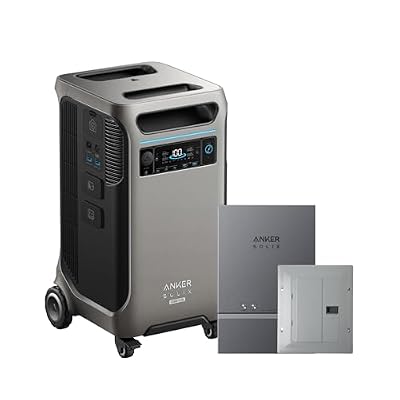
6. Anker SOLIX F3800 Portable Power Station
See current price · Best for: Battery for Well Pumps
- Battery
- 3,840Wh LFP
- Features
- 6,000W, 120/240V, expandable
A well pump uses surprisingly little energy; the hard part is the starting surge and the 240 volts. Anker's SOLIX F3800 addresses both, which is why it leads the battery options here. Anker rates it at 3,840 watt-hours of LFP and 6,000 watts of output with 120/240V split-phase capability, so it can feed a double-pole pump circuit through a compatible transfer switch or Anker's home backup hardware, installed by an electrician. By the runtime math in this guide, a typical household's daily pumping uses well under 1kWh, so the pump barely dents the battery; it is the refrigerator, freezer and everything else that sets how long it lasts. Expansion batteries and solar input stretch an outage into days. Check its published surge rating against your pump maker's sizing table before relying on it for a 1.5 HP motor. Our Anker SOLIX guide covers the rest of the range.
Pros
- 120/240V output in a battery, no fuel or exhaust
- 6,000W continuous gives real headroom for pump starts
- Expandable with extra batteries
- Accepts solar for multi-day outages
- Safe to run indoors or in a garage
Cons
- Very heavy, a wheeled appliance rather than a portable
- Expensive per kilowatt-hour stored
- Large pumps still need checking against its surge spec

7. EcoFlow Delta Pro 3 Portable Power Station
See current price · Best for: Battery Runner-Up
- Battery
- 4,096Wh LFP
- Features
- 4,000W, 120/240V, expandable
EcoFlow's Delta Pro 3 is the other mainstream power station with native 120/240V output. EcoFlow rates it at 4,096 watt-hours of LFP and 4,000 watts of output, expandable with extra batteries, and it connects to a home circuit panel through EcoFlow's transfer hardware or a compatible transfer switch installed by an electrician. For a 1/2 or 3/4 HP submersible pump, that is a quiet, fuel-free way to keep water flowing, with plenty of capacity left for a refrigerator and lights. For a 1 HP pump, the 4,000-watt continuous rating puts more weight on the unit's surge capability and the pump's starting characteristics, so check EcoFlow's published surge figures against your motor maker's generator sizing table, and consider a pump with soft start. Like all battery backup, it shines in outages of a day or two and stretches longer with solar. Our EcoFlow guide compares it with the rest of the lineup.
Pros
- 120/240V output from one unit
- About 4kWh of LFP storage, expandable
- Solar and wall charging for long outages
- Indoor-safe, silent operation
- Works with EcoFlow's home transfer hardware
Cons
- 4,000W continuous is tighter than the F3800 for big pump starts
- Heavy and expensive
- Larger pumps need their surge checked against the published spec
3. Generator for Well Pump Side by Side
| Product | Score | Price | Features | Buy |
|---|---|---|---|---|
| Westinghouse WGen7500DF Dual Fuel Portable Generator Best Overall for Well Pumps | 93 | See current price | 120/240V, dual fuel | Amazon → |
| DuroMax XP13000EH Dual Fuel Portable Generator Best for 1.5 HP and Larger Pumps | 91 | See current price | — | Amazon → |
| Champion 9000-Watt Dual Fuel Portable Generator Best Value Dual Fuel | 88 | See current price | 120/240V, dual fuel, electric start | Amazon → |
| Generac GP8000E Best Gas-Only Pick | 93 | See current price | Open-Frame Portable, 8,000W Running | Amazon → |
| Honda EU7000iS Inverter Generator Quietest 240V Generator | 83 | See current price | 120/240V, inverter | Amazon → |
| Anker SOLIX F3800 Portable Power Station Best Battery for Well Pumps | 90 | See current price | 6,000W, 120/240V, expandable | Amazon → |
| EcoFlow Delta Pro 3 Portable Power Station Best Battery Runner-Up | 93 | See current price | 4,000W, 120/240V, expandable | Amazon → |
4. How Many Watts Does a Well Pump Use? Running and Starting, by HP
How many watts a well pump uses depends mostly on its horsepower, and the answer comes in two numbers. Running watts are what the motor draws once it is up to speed. Starting watts, also called surge or locked-rotor demand, are what it pulls for the fraction of a second it takes to get the motor and water column moving, often two to three times the running figure or more. A generator has to cover the starting number; the running number decides fuel burn and how much else you can power at once.
| Pump size | Approx. running watts | Approx. starting watts | Approx. 240V running amps |
|---|---|---|---|
| 1/2 HP | 1,000-1,200W | 2,000-3,000W | About 4-6 A |
| 3/4 HP | 1,400-1,600W | 3,000-4,500W | About 6-8 A |
| 1 HP | 1,800-2,200W | 4,000-6,000W | About 8-10 A |
| 1.5 HP | 2,400-3,000W | 6,000-7,500W | About 10-13 A |
These are broad planning ranges compiled from typical published pump and generator sizing charts, not specs for your motor. Two pumps of the same horsepower can differ meaningfully depending on the brand, depth, whether the motor is 2-wire or 3-wire, and the service factor. The nameplate on the motor or the label on the control box gives the real full-load and service-factor amps; multiply the running amps by the voltage for a rough running-watt figure.
Submersible motor makers also publish generator sizing tables, and those are the numbers to trust. They typically recommend generators rated well above the pump's running watts, because a generator's voltage sags under a motor start, and a heavily loaded generator can sag far enough to stall the motor. Many of these tables call for a generator in the range of four to five kilowatts or more for a 1 HP pump, and larger again for externally regulated versus internally regulated generators. If your pump maker's table calls for a certain size, buy at least that.
Well pump amp draw also matters for the breaker and wiring. A 240V pump circuit is typically on a double-pole breaker sized by the pump installer, and the starting current is high enough that undersized generators often trip their own output breaker rather than stall. If your generator's 240V outlet trips every time the pump kicks on, the generator is too small for that pump, or other motors are starting at the same moment.
5. 120V vs 240V Pumps and the 240V Power Outlet You Need
Before comparing generators, find out what voltage your pump uses. Deep submersible pumps, which sit down in the well casing, are most often 240 volts. Shallow-well jet pumps, which sit above ground in a basement or pump house, are often dual-voltage and may be wired for either 120V or 240V. The main panel tells you a lot: a well pump on a double-pole breaker, the kind that spans two slots, is a 240V pump. A single-pole breaker means 120V.
A 240V pump needs a generator that produces 240 volts, which in practice means a generator with a 120/240V 30-amp locking outlet, labeled L14-30R, or a 50-amp 14-50R outlet. Every gas generator on this list has one. Many popular small and quiet inverter generators do not; they produce 120 volts only and cannot run a 240V pump at any wattage. That is why small and mid-size units like those in our small generator guide are often the wrong tool for a well.
THE 240V OUTLET
That L14-30R is not a plug for your pump. It feeds a power inlet and transfer switch.
The generator's 240V power outlet connects with a heavy-duty cord to an inlet box on the house, which feeds a transfer switch or interlocked panel. Your pump stays wired to its own circuit; the transfer equipment decides whether that circuit gets grid or generator power.
If your pump is 120V, your options open up: any generator with enough starting watts can run it through a transfer switch, including some 120V-only inverter units, though you still need the surge headroom. A 120V pump draws roughly twice the amps of the same-horsepower 240V pump, so check that the generator's 120V outlets and the transfer switch circuit are rated for it.
Battery systems face the same voltage question. Most portable power stations produce only 120V and cannot run a 240V pump. The Anker SOLIX F3800 and EcoFlow Delta Pro 3 can produce 120/240V from a single unit, which is why they are the only batteries on this list. Some smaller stations can be paired to create 240V with a hub, and our home battery backup guide covers whole-home systems that handle this natively.
6. 2-Wire vs 3-Wire Pumps and Why It Changes the Surge
Submersible pumps come in two common configurations. A 2-wire pump, despite the name, has two power conductors plus a ground, and puts all its starting components inside the motor down in the well. There is no control box at the surface, just a pressure switch. A 3-wire pump has three conductors plus ground and uses a control box at the surface, usually in the basement or pump house, that holds the starting capacitor and relay.
The practical difference for generator sizing is that 2-wire pumps are often harder on generators. Their internal start circuitry tends to pull a higher, longer inrush when the motor starts, and some generator sizing tables call for more capacity for 2-wire motors than for the equivalent 3-wire motor. A 3-wire pump's control box lets the starting components be serviced or upgraded without pulling the pump, which can matter if you later add a soft starter.
You can usually tell which you have by looking near the pressure tank. If there is a gray or tan box labeled with the pump maker's name and the horsepower, often wired between the pressure switch and the well, it is a 3-wire system and that box is the control box. Its label usually lists the horsepower, voltage and amps, which are exactly the numbers you need for generator sizing. No control box usually means a 2-wire pump, and you may need the installer's records for its specs.
If the paperwork is lost, the well driller or pump contractor who installed it usually has records, and a licensed electrician can measure the pump's running current with a clamp meter. Measuring starting current requires a meter that captures inrush, but it is rarely necessary: the horsepower and voltage from the control box, matched to the pump maker's sizing table, is enough to pick a generator.
7. Soft Starters and Constant-Pressure Drives
The starting surge is the reason well pumps need oversized generators, so reducing it lets you use a smaller generator or make a battery system viable. There are two main ways to do that. Soft starters ramp the voltage to the motor over a moment instead of slamming it on, which lowers the inrush. Variable-speed constant-pressure drives, sold by pump makers for both new installations and retrofits, bring the motor up gently and then vary its speed to hold steady pressure.
Some pump lines include soft start built into the motor electronics, and constant-pressure drives from the major submersible pump makers can substantially reduce starting demand, which also tends to make them friendlier to generators and power stations. The catch is compatibility: a soft starter or drive has to be matched to the motor type, voltage and horsepower, and not every pump can take an add-on. This is a job for a pump contractor, not a weekend project.
WORTH ASKING YOUR PUMP PRO
If you are replacing a pump anyway, ask about a soft-start or constant-pressure option.
It can lower the generator size you need, smooth out pressure in the house and reduce wear on the motor. If the pump is fine, ask whether a compatible soft starter can be added at the control box.
A soft starter is not a substitute for a correctly sized generator, though. It lowers the surge; it does not change the running watts, and a generator that is barely adequate on paper is still a poor match. Think of soft start as the tool that makes a battery system or a quiet inverter generator workable with a 1 HP pump, or that lets a mid-size generator start the pump while the refrigerator is also running.
For homeowners considering a battery system, soft start matters even more. Power stations have hard surge limits enforced by their electronics, rather than the gradual voltage sag of a generator engine, so if a pump's inrush exceeds the battery's surge rating, the inverter may simply shut off. Matching the soft-started surge to the battery's published surge specification is the step that makes a power station for home backup work with a well.
8. Transfer Switch, Interlock Kit and Safe Connection
A well pump is hardwired, so you cannot plug it into a generator with an extension cord. The safe ways to connect it are a manual transfer switch, which moves selected circuits between grid and generator, or an interlock kit on the main panel, which physically prevents the main breaker and the generator breaker from being on at the same time. Either one is fed from a power inlet on the outside of the house, which accepts the generator's cord.
Both have to be installed by a licensed electrician, usually with a permit and inspection. The well pump's double-pole breaker must be one of the circuits the transfer switch controls, and the switch and inlet must be rated for the generator's output, typically 30 amps for an L14-30 connection or 50 amps for a 14-50. Your electrician will also choose cord gauge and length so voltage drop does not make pump starts harder.
NEVER BACKFEED
A double-male cord plugged into a dryer outlet can kill a utility worker.
Backfeeding sends generator power out through your meter onto the utility lines, where it can be stepped up to thousands of volts. It also bypasses breakers that protect your wiring. A transfer switch or interlock is the only safe connection.
Placement and carbon monoxide safety are the other half. Every gas generator on this list produces carbon monoxide, which is invisible and can kill in minutes. Run the generator outdoors only, at least 20 feet from the house with the exhaust pointed away from doors, windows and vents, never in a garage, crawlspace or pump house. Install battery-powered CO alarms on every level of the home. Built-in CO shutoffs, which some models have, are a backstop, not permission to run closer.
If you want water automatically and without dragging cords in a storm, a permanent standby generator with an automatic transfer switch is the alternative. It costs much more installed, and our standby generator cost guide covers what to expect, but for a household that loses power often and relies on a well, it can be worth it. Many people start with a portable generator and an interlock and upgrade later.
9. The Pressure Tank: Fewer Starts, Easier on the Generator
The pressure tank is the part of a well system that decides how often the pump starts, and every start is a surge your generator has to absorb. The tank holds a cushion of pressurized water, so small draws such as a glass of water or a hand wash come from the tank instead of starting the pump. A larger tank, or a tank with more drawdown, means fewer, longer pump runs and fewer surges.
A tank that has lost its air charge, often called waterlogged, makes the pump short-cycle: it turns on and off every few seconds whenever a tap runs. On grid power that wears out the pump and the pressure switch; on a generator it means a constant stream of starting surges, flickering lights, and possibly a tripped generator breaker. If you notice the pump clicking on and off rapidly, have the tank checked before an outage, not during one.
Checking the tank's air precharge is a simple maintenance task: with the pump off and the tank drained, the precharge is commonly set a couple of psi below the pressure switch's cut-in pressure. Your pump contractor or the tank manual gives the exact figure. A healthy tank is one of the cheapest ways to make any generator or battery backup more reliable with a well.
The tank also shows why battery backup works better for wells than people expect. A typical household might run its pump for well under an hour a day in total. Even a 1 HP pump drawing around 2,000 watts for half an hour uses only about a kilowatt-hour. Energy is rarely the problem; surge and voltage are. Once a battery can start the pump, the refrigerator and freezer usually decide how long it lasts.
10. Comparison Table: Surge, 240V Outlets and Best Pump Size
Here is how the picks line up on the specs that decide whether a well pump will start. Ratings are manufacturers' published figures on gasoline where applicable; propane ratings are lower. The pump-size column is a planning guide only. Always match the generator to your pump maker's sizing table, and remember that other motors starting at the same moment add to the surge.
| Product | Starting / running | 240V connection | Fuel | Comfortable pump size |
|---|---|---|---|---|
| Westinghouse WGen7500DF | 9,500 / 7,500W | L14-30R | Gas or propane | 1/2 to 1 HP |
| DuroMax XP13000EH | 13,000 / 10,500W | 14-50R and L14-30R | Gas or propane | Up to 1.5 HP and beyond |
| Champion 9000-Watt Dual Fuel | 9,000W starting | L14-30R | Gas or propane | 1/2 to 1 HP |
| Generac GP8000E | 10,000 / 8,000W | L14-30R | Gasoline | 1/2 to 1 HP |
| Honda EU7000iS | 7,000 / 5,500W | L14-30R | Gasoline | 1/2 to 3/4 HP; 1 HP alone |
| Anker SOLIX F3800 | 6,000W output | 120/240V split phase | Battery + solar | 1/2 to 1 HP; check surge |
| EcoFlow Delta Pro 3 | 4,000W output | 120/240V | Battery + solar | 1/2 to 3/4 HP; check surge |
The gas generators split into two groups. The 7,500-to-10,000-watt dual fuel and gas units handle the most common pumps and leave room for a fridge, freezer and lights, which covers most households. The DuroMax is the step up for larger pumps or for running much of the house as well. The Honda trades headroom for quiet and is the best fit for smaller pumps and close neighbors. For general shopping beyond wells, our best gas generator guide compares more models.
The two batteries are a different kind of purchase. They cost more per watt of starting capacity, but they are silent, need no fuel and can run indoors, and with solar they can carry a well through a multi-day outage without a gas can. If the pump is 1/2 or 3/4 HP, or has soft start, they are a realistic, fuel-free alternative. Our main portable power station guide explains why most smaller stations cannot do this job, and the Anker SOLIX and EcoFlow roundups cover each brand's full range.
11. Which Generator for Your Well Pump
For a typical 1/2 to 1 HP, 240V submersible pump, buy the Westinghouse WGen7500DF. It has the starting watts, the L14-30R outlet and dual fuel flexibility, and it leaves room for the kitchen and lights. If the budget is tighter, the Champion 9000-Watt Dual Fuel is the value alternative; if you want a gas-only unit with a big service network, the Generac GP8000E has a little more starting headroom.
For a 1.5 HP pump, a deep well with a 1 HP pump on a 2-wire motor, or a household that wants the well and most of the house on one generator, buy the DuroMax XP13000EH. Its extra surge margin is what makes pump starts reliable while other motors are running. If noise is the priority and your pump is 3/4 HP or smaller, the Honda EU7000iS is the quiet choice that still produces 240 volts.
If you want silent, fuel-free backup, choose the Anker SOLIX F3800 for its 6,000-watt output and headroom, or the EcoFlow Delta Pro 3 for 1/2 to 3/4 HP pumps. Check each one's surge rating against your pump maker's table, and ask your pump contractor about soft start if the numbers are close.
Whatever you choose, the generator is only half the purchase. Budget for a licensed electrician to install an inlet and a transfer switch or interlock that includes the well pump circuit, a properly rated cord, CO alarms in the house, and a pressure tank check. Then test the whole setup on a calm day before the storm, with the pump starting under generator power, so the first real outage is uneventful.
12. Common Mistakes to Avoid
Buying a 120V-only generator for a 240V pump
Many quiet inverter and small portable generators produce only 120 volts, and no amount of wattage will run a 240V submersible pump from them. Check your panel for a double-pole pump breaker, which signals 240V, then buy a generator with a 120/240V L14-30R or 14-50R outlet and confirm the transfer equipment matches it.
Sizing from running watts instead of starting watts
A 1 HP pump may run on around 2,000 watts but need two to three times that to start. A generator sized for running watts will bog down, trip its breaker or stall the motor. Match your pump maker's generator sizing table, and add margin for other motors.
Backfeeding through a dryer outlet
A double-male cord into a dryer or range outlet sends generator power onto the utility lines, endangering line workers and bypassing your breakers. It is illegal in most places. Have a licensed electrician install an inlet with a transfer switch or interlock kit that includes the pump circuit.
Ignoring a waterlogged pressure tank
A tank that has lost its air charge makes the pump short-cycle every time a tap runs, which means a constant stream of starting surges on the generator. Have the tank's precharge checked and the bladder inspected before storm season, when it is a small repair rather than an emergency.
Running the generator too close to the house
Generators produce carbon monoxide that can build up indoors quickly. Never run one in a garage, pump house, crawlspace or near windows. Keep it at least 20 feet away with the exhaust pointed away, and install battery CO alarms on every level of the home.
13. Frequently Asked Questions
How many watts does a well pump use?
Running watts depend on horsepower: roughly 1,000 to 1,200 watts for a 1/2 HP pump, 1,400 to 1,600 for 3/4 HP, 1,800 to 2,200 for 1 HP and 2,400 to 3,000 for 1.5 HP. Starting watts are typically two to three times higher. These are planning ranges; your pump's nameplate amps and its maker's sizing table give the real figure.
What size generator do I need for a 1 HP well pump?
For a typical 1 HP, 240V submersible pump, plan on a generator in the 7,500-to-10,000-watt class with a 120/240V outlet, so the pump can start with other loads on. Pump makers' sizing tables often call for several kilowatts of generator capacity for a 1 HP motor alone. Larger margins help with 2-wire pumps.
How many amps does a well pump draw?
At 240 volts, a 1/2 HP pump typically draws around 4 to 6 amps running, a 3/4 HP pump around 6 to 8, a 1 HP pump around 8 to 10 and a 1.5 HP pump around 10 to 13. Starting current is several times higher for a moment. The control box or motor nameplate lists the exact full-load amps for your pump.
Can an inverter generator run a well pump?
Only if it produces the right voltage and enough starting watts. Most small inverter generators are 120V only and cannot run a 240V pump. Larger 120/240V inverter models such as the Honda EU7000iS can run a 1/2 to 3/4 HP pump comfortably and a 1 HP pump started on its own, with a transfer switch.
Can a portable power station run a well pump?
A few can. It needs native 240V output for most submersible pumps and enough surge capacity for the pump's start. The Anker SOLIX F3800 and EcoFlow Delta Pro 3 produce 120/240V. Check their published surge ratings against your pump maker's table, and consider soft start for 1 HP and larger pumps. Most smaller stations cannot do this job.
Do I need a transfer switch for a well pump generator?
Yes, or an interlock kit with a power inlet. A well pump is hardwired on a 240V double-pole circuit, so the only safe way to power it from a generator is through transfer equipment installed by a licensed electrician. Never backfeed through a dryer outlet with a double-male cord, which can electrocute utility workers.
What is the difference between a 2-wire and 3-wire well pump?
A 2-wire pump has its starting components inside the motor in the well, with no surface control box. A 3-wire pump uses a control box near the pressure tank that holds the start capacitor and relay. 2-wire pumps often have a harsher starting surge, so generator sizing tables may call for a larger generator for them.
Related Guides
Home & Portable Generators
Best Home Generator for Power Outages
The Generac Guardian 22kW leads 7 outage generators; essentials alone need about 3,500 to 5,000 running watts, and a sump or well pump pushes that higher.
Home Battery Backup
Best Home Battery Backup
The Tesla Powerwall 3, rated 11.5kW, leads 7 home battery backup systems; most homes need 10 to 30kWh of storage, from installed walls or expandable stations.
Home & Portable Generators
Best Gas Generator
The Generac GP8000E leads 6 gas generators; an 8,000-watt open frame at half load burns roughly 14 to 19 gallons a day, so each pick comes with a fuel plan.
The Bottom Line
Size a well pump generator from the pump's starting watts and voltage, not its running watts. For most 1/2 to 1 HP, 240V submersible pumps, the Westinghouse WGen7500DF is the sensible pick; larger pumps need the DuroMax XP13000EH's extra surge.
Want silent, fuel-free water? The Anker SOLIX F3800 and EcoFlow Delta Pro 3 produce 240V. Whichever you buy, budget for a licensed electrician, a transfer switch or interlock, CO alarms and a healthy pressure tank.