Portable Power Stations
Best Portable Power Station for Home Backup
We research every product against its spec sheet, manuals and owner reports. When you buy through our links we may earn a commission, at no cost to you. How we score · Disclosure
The best portable power station for home backup for most people in 2026 is the EcoFlow Delta Pro 3. The best-rounded battery backup for houses that want selected circuits covered silently, with room to scale.
Start with the list of things that must keep running when the grid goes down, then pick the battery that can carry them. Six battery generators, from 1kWh grab-and-go units to 4kWh, 240V systems that wire into your panel.
Most people shop for home backup the wrong way round. They pick a battery generator by its headline capacity, carry it home, and only during the first real outage discover that the furnace blower is hardwired, the well pump needs 240 volts, and the sump pump's starting surge trips the inverter the moment the fridge kicks on. The fix is to plan backwards: write down what must keep running, work out when and how hard each load pulls, decide how the battery will reach those loads, and only then choose the box.
Our top picks at a glance



Quick answer
the EcoFlow Delta Pro 3 Portable Power Station is our #1 pick (best overall for home backup). The best-rounded battery backup for houses that want selected circuits covered silently, with room to scale.
On this page
- 1. The best portable power stations for home backup right now
- 2. Portable Power Station for Home Backup Side by Side
- 3. Step One: Your Critical-Load List
- 4. Essential-Circuit Worked Examples
- 5. Connecting to the House Safely
- 6. UPS Switchover and Medical Devices
- 7. 240V Well Pumps
- 8. Multi-Day Outage Strategy
- 9. Winter Outages and Cold Charging
- 10. Power Station vs. Standby Generator
- 11. Which One to Buy
- 12. Common Mistakes to Avoid
- 13. Frequently Asked Questions
1. The best portable power stations for home backup right now

1. EcoFlow Delta Pro 3 Portable Power Station
See current price · Best for: Battery Runner-Up
- Battery
- 4,096Wh LFP
- Features
- 4,000W, 120/240V, expandable
If you want one battery generator to sit in the garage and quietly take over a set of house circuits when the lights go out, the Delta Pro 3 is the most complete answer. EcoFlow rates its LFP battery at 4,096Wh, the size where backup planning stops being a juggling act: by the runtime rule (Wh x 0.85 / W) it supplies an average 135W essentials load of fridge, sump pump, internet, CPAP, lights and charging for roughly 25 hours, and a fridge on its own for more than two days. The 4,000W inverter is specified to carry a refrigerator, a gas furnace blower and a sump pump at the same time, and the 240V output brings many well pumps and other split-phase circuits within reach. What makes it a backup system rather than a big battery is the path into the house: feed it through a transfer switch, an interlock and inlet, or EcoFlow's smart home panel, and the chosen circuits run from the battery with no cords across the floor. Add EcoFlow's extra batteries as outages get longer and pair it with solar so a sunny day puts energy back. The downsides are mass and money: it is a wheeled unit, and once you add panel hardware, installation and solar you are spending a meaningful fraction of a standby generator.
Pros
- 4,096Wh of LFP storage covers a day of essentials
- 120V and 240V output from one unit
- Expandable with add-on batteries for multi-day outages
- Designed to work with EcoFlow's smart panel or a transfer switch
Cons
- About 114 pounds, so it lives on its wheels
- The full system with panel and solar is a large investment
- Panel connection needs a licensed electrician
2. Anker SOLIX F3800 Portable Power Station
See current price · Best for: Battery for Well Pumps
- Battery
- 3,840Wh LFP
- Features
- 6,000W, 120/240V, expandable
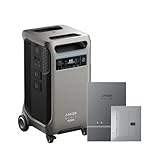
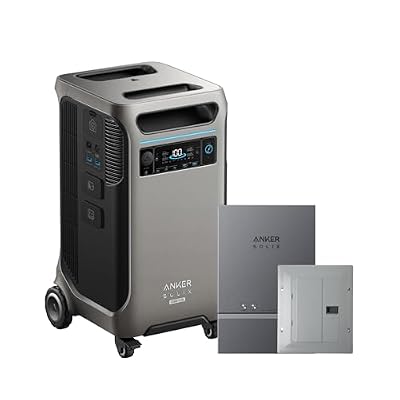
Storage decides how long a battery lasts; output decides whether the hardest load on your list will start at all. For rural houses on a well, that hardest load is usually a 240V submersible pump whose starting surge can be several times its running draw, arriving at the same moment the fridge compressor might also kick on. Anker rates the SOLIX F3800 at 6,000W with native 120/240V output, the most margin for exactly that problem among these picks, which is why it leads for well-pump homes even though its 3,840Wh battery is a little smaller than EcoFlow's. Planning-wise it behaves like the Delta Pro 3: a wheeled unit that stays in the garage or utility room, connected to the house through Anker's panel or a transfer switch, expandable with add-on batteries and rechargeable from solar or a generator. Confirm your pump's voltage, horsepower and starting current with your well installer before you buy, and ask about a soft-start kit, because reducing the surge makes any battery's job easier.
Pros
- 6,000W output, the most headroom on this list
- Native 120/240V for well pumps and split-phase loads
- Expandable with Anker's add-on batteries
- Ties into Anker's home panel or a standard transfer switch
Cons
- The heaviest pick at roughly 132 pounds
- Slightly less storage than the Delta Pro 3
- More output than a 120V-only household will use

3. Jackery Explorer 2000 v2 Portable Power Station
See current price · Best for: Plug-In Overnight Backup
- Battery
- 2kWh LFP
- Features
- 2,200W, 120V, Plug-In
Many households do not need a panel-connected system at all. If your outages are typically a stormy night rather than a week, and your critical loads all plug into ordinary outlets, a 2kWh unit you can carry from the kitchen to the bedroom is the most practical backup there is. Jackery lists the Explorer 2000 v2 at 2,042Wh and 2,200W. By the runtime rule, that capacity supplies a fridge, router, CPAP and lights averaging about 105W for roughly 16 hours, a full night and most of the next day, and the inverter has enough headroom for a fridge start-up with everything else running, or a quick microwave meal. The limits are clear and worth respecting: it is 120V only, it cannot be expanded, and anything hardwired, such as a furnace blower or many sump pumps, still needs a proper inlet and transfer switch to reach it. If you suspect you will want 240V or more storage later, the Delta Pro 3 or F3800 is the better long-term buy. If not, this is the sweet spot of simplicity and runtime.
Pros
- 2,042Wh carries a fridge, CPAP and internet overnight
- 2,200W output starts most 120V appliances
- About 40 pounds, so one person can move it between rooms
- No installation needed for plug-in use
Cons
- 120V only, so no well pumps or 240V circuits
- Not expandable with add-on batteries
- Hardwired loads still need a transfer switch or inlet

4. EcoFlow Delta 3 Plus Portable Power Station
See current price · Best for: Expandable Starter
- Battery
- 1kWh LFP
- Features
- 1,800W, 120V, Expandable
The Delta 3 Plus is the right buy for someone who wants to start small and build toward real backup. EcoFlow rates it at 1,024Wh and 1,800W. On its own, that battery covers a fridge for roughly 13 hours or an essentials set for about eight, which bridges the majority of outages, since most last hours rather than days. The inverter is enough to start a refrigerator compressor and handle a typical 1/3 HP sump pump, though not both starting at once with a lot else running. The reason to choose it over a fixed 1kWh unit is the upgrade path: add one of EcoFlow's extra batteries and capacity roughly doubles without buying a second inverter, and in the meantime it serves as a camping unit and a desk UPS. If you already know you need 240V, skip straight to the Delta Pro 3; if you are not sure yet, this is a sensible first step.
Pros
- Starts at 1,024Wh and grows with add-on batteries
- 1,800W output handles a fridge start and a sump pump
- Fast UPS-style switchover for routers and computers
- About 28 pounds, so it doubles as a camping unit
Cons
- 120V only
- 1kWh alone lasts under a day with a fridge
- Heavier than the Jackery 1000 v2

5. Jackery Explorer 1000 v2 Portable Power Station
See current price · Best for: Easiest to Live With
- Battery
- 1kWh LFP
- Features
- 1,500W, Light
For apartments, condos and anyone whose outage plan is to keep the fridge cold and the Wi-Fi on until the power comes back, the Explorer 1000 v2 delivers the essentials at the lowest cost among these picks. Jackery lists it at 1,070Wh, 1,500W continuous and 3,000W surge. By the runtime rule it runs a fridge for about 14 hours, or the router alone for well over a day, and the surge rating gives a fridge compressor plenty of room to start. It is not a house system: at 1,500W continuous it cannot run a sump pump and a microwave together, it has no 240V option, and when you outgrow it you buy a second unit rather than an add-on battery. But as a light, simple bridge that also goes camping, it is hard to beat for the money.
Pros
- 1,070Wh of LFP storage in about 24 pounds
- 3,000W surge rating helps with compressor starts
- Simple to use: plug in and go
- Frequently discounted
Cons
- 1,500W continuous limits what runs at once
- Not expandable
- Short-outage bridge, not whole-home backup

6. Bluetti Elite 100 V2 Portable Power Station
See current price · Best for: Compact
- Battery
- 1kWh LFP
- Features
- 1,800W, Compact
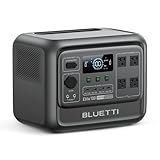
Some backup jobs are about one room. A CPAP by the bed, a home-office desk that cannot drop a video call, a chest freezer in the basement: these need a reliable 1kWh unit that is easy to tuck away and switches over without a hiccup. The Elite 100 V2 fits that role. Bluetti rates it at 1,024Wh and 1,800W, matching the Delta 3 Plus on paper in a slightly lighter case, and it is frequently cheaper. What you give up is growth: there is no add-on battery path and a thinner accessory catalog, so treat it as a dedicated single-purpose backup rather than the seed of a whole-house system. Many households end up with exactly that pairing, a big wheeled unit on the essential circuits and a compact one at the bedside.
Pros
- 1,800W from a compact, roughly 25-pound case
- 1,024Wh of LFP storage
- UPS-style switchover suits a bedside CPAP or home office
- Often priced below the EcoFlow and Jackery equivalents
Cons
- Not expandable
- Smaller ecosystem of panels and accessories
- 120V only
2. Portable Power Station for Home Backup Side by Side
| Product | Score | Price | Battery | Features | Buy |
|---|---|---|---|---|---|
| EcoFlow Delta Pro 3 Portable Power Station Best Overall for Home Backup | 93 | See current price | 4,096Wh LFP | 4,000W, 120/240V, expandable | Amazon → |
| Anker SOLIX F3800 Portable Power Station Best for 240V Well Pumps | 90 | See current price | 3,840Wh LFP | 6,000W, 120/240V, expandable | Amazon → |
| Jackery Explorer 2000 v2 Portable Power Station Best Plug-In Overnight Backup | 90 | See current price | 2kWh LFP | 2,200W, 120V, Plug-In | Amazon → |
| EcoFlow Delta 3 Plus Portable Power Station Best Expandable Starter | 93 | See current price | 1kWh LFP | 1,800W, 120V, Expandable | Amazon → |
| Jackery Explorer 1000 v2 Portable Power Station Best Value | 93 | See current price | 1kWh LFP | 1,500W, Light | Amazon → |
| Bluetti Elite 100 V2 Portable Power Station Best Compact | 81 | See current price | 1kWh LFP | 1,800W, Compact | Amazon → |
3. Step One: Your Critical-Load List
A critical-load list is a short inventory of everything that must keep working during an outage, with three facts for each item: its running watts, its starting watts if it has a motor, and how many hours a day it actually draws power. Walk through the house with a notepad and be strict. Must means safety, health, property protection or food, not convenience. The list takes half an hour and it is the single most useful thing you can do before spending money on any backup at all.
Most lists fall into four tiers. Tier one is life and health: CPAP or BiPAP machines, oxygen concentrators, refrigerated medication, and in cold climates the heat source. Tier two is property protection: the sump pump in a wet basement, the well pump if you have no city water, and heat to stop pipes freezing. Tier three is food: the refrigerator and any freezer. Tier four is communication and comfort: internet, phones, a few lights, a fan. Size your backup for tiers one to three first, then see what is left for tier four.
| Critical load | Running watts | Starting watts | Hardwired? | Typical daily energy |
|---|---|---|---|---|
| Refrigerator | 100 - 250 | 600 - 1,200 | No | 1 - 2 kWh |
| Chest freezer | 80 - 150 | Moderate | No | 0.6 - 1.2 kWh |
| Gas furnace blower | Roughly 300 - 700, motor-dependent | Higher on older motors | Usually | Several kWh in a cold snap |
| Sump pump (1/3 HP) | 600 - 800 | 1,300+ | Sometimes | Often a few hundred Wh |
| Well pump (240V) | Often 1,000+ | Several times running | Yes | Modest; driven by water use |
| Internet (modem + router) | 15 - 25 | None | No | 0.4 - 0.6 kWh |
| CPAP (no heated humidifier) | 30 - 60 | None | No | 0.25 - 0.5 kWh per night |
| LED lighting | 20 - 60 | None | Partly | 0.1 - 0.3 kWh |
| Phone and laptop charging | 10 - 100 | None | No | 0.1 - 0.2 kWh |
The figures are typical ranges; your appliances may differ. The best source is the nameplate sticker on each appliance, or a plug-in energy meter left on the fridge and freezer for a full day. For hardwired equipment, the nameplate on the motor or the furnace's data label gives the amps; multiply by the voltage for an approximate wattage. If you cannot find a figure, an electrician or HVAC technician can measure the starting current with a clamp meter in a few minutes, and that one number can save you from buying the wrong inverter.
Two columns in that table drive the purchase. The hardwired column tells you whether you need a panel connection, which affects which unit you buy and what the installation costs. The starting watts column tells you how much inverter headroom you need: add the running watts of everything that might be on together, then add the single largest starting surge on top. That sum must fit under the power station's continuous and surge ratings, or the inverter will shut down at exactly the moment you need it.
Be honest about the loads you are leaving off, too. Central air conditioning, electric resistance heat, an electric water heater and an electric range each draw thousands of watts for hours, and none of them belong on a battery plan. A damp basement is a gray area: a basement dehumidifier pulls a few hundred watts and is worth running in short bursts during a long summer outage, but it is a tier-four load that should only get energy left over once the fridge and pumps are covered.
STAGGER THE MOTORS
You control more of the surge than you think.
You cannot control when a fridge compressor cycles on, but you can control when you start a microwave, a well pump or a dehumidifier. Avoid running two large motor loads at the same moment and you can often get away with a smaller inverter than the worst-case sum suggests.
4. Essential-Circuit Worked Examples
The three households below use the runtime rule from our main power station guide: runtime in hours is roughly capacity in Wh times 0.85, divided by the average load in watts. The 0.85 covers inverter losses and the reserve the battery management system holds back. For daily energy, we add each load's watts multiplied by its hours, then divide by 0.85 to get the battery capacity actually needed.
Example 1: Summer Storm, Suburban House with a Basement
The risk here is a thunderstorm that knocks out power while rain is still falling, so the sump pump matters as much as the fridge. The daily list: refrigerator 1,500Wh; sump pump, a 1/3 HP unit at about 800W running for ten seconds every five minutes during heavy inflow, which works out to roughly 650Wh across a wet day; internet 20W around the clock, 480Wh; CPAP 40W for eight hours, 320Wh; LED lights 200Wh; phone charging 100Wh. That totals about 3,250Wh a day, or roughly 3,820Wh of battery once losses are included.
Output: fridge running 200W, internet 20W, CPAP 40W, lights 60W, plus the sump pump's 800W running and a starting surge of 1,300W or more. Worst case, with the fridge compressor starting at the same instant, you are looking at 2,500 to 3,000W for a moment. A 4kWh unit with 4,000W or more of output handles this for about one full day, and a 2kWh unit gets through roughly half a day, enough for a typical storm outage but tight if the power stays off overnight and the rain continues. If the basement floods regularly, a dedicated battery backup sump pump is worth considering so the pump never depends on the power station at all.
Example 2: Winter Outage, Gas Furnace
A gas furnace still needs electricity: the blower, the igniter, the inducer fan and the control board all stop without it. In a cold snap the blower may run for ten hours a day or more. Using a 400W blower as a middle-of-the-range figure, that is 4,000Wh a day on its own. Add the fridge at 1,200Wh, since it works less in a cool house, internet 480Wh, CPAP 320Wh, lights 300Wh in the longer evenings and charging 100Wh, and the total is about 6,400Wh, or roughly 7,500Wh of battery a day.
That is nearly double what a 4kWh unit holds. In practice it means one of three things: a base unit plus one or more add-on batteries; a plan to recharge from a generator once a day, because winter sun is weak; or turning the thermostat down to the low 60s, which can shorten blower run time substantially. The furnace is hardwired, so this household needs a transfer switch, interlock or smart panel regardless of which battery it buys. Newer furnaces with variable-speed blower motors draw considerably less than older ones, so measure yours rather than assuming.
Example 3: Rural House on a 240V Well
Here energy is not the hard part; output is. A family rationing water to around 100 gallons a day with a pump moving about 10 gallons a minute runs the pump for perhaps ten minutes a day. At roughly 1,200W running, that is only about 200Wh. But the starting surge of a 240V submersible pump can be several times its running draw, and it arrives without warning whenever the pressure tank drops. Add a fridge at 1,500Wh, a chest freezer at 900Wh, internet 480Wh and lights and charging 300Wh, and the daily total is around 3,400Wh, or about 4,000Wh of battery.
A 4kWh class unit therefore lasts about a day, but only a model with native 240V output and plenty of surge capacity can start the pump reliably. That points to the Anker SOLIX F3800 first and the EcoFlow Delta Pro 3 second, connected through a transfer switch that includes the well-pump circuit. Confirm the pump's starting current before buying; it is the number that decides whether this plan works.
What These Examples Mean in Hours
| Load set (average draw) | 1,024 Wh | 1,070 Wh | 2,042 Wh | 3,840 Wh | 4,096 Wh |
|---|---|---|---|---|---|
| Fridge only (~65W) | ~13 hrs | ~14 hrs | ~27 hrs | ~50 hrs | ~54 hrs |
| Fridge + internet + CPAP + lights (~105W) | ~8 hrs | ~9 hrs | ~16 hrs | ~31 hrs | ~33 hrs |
| Summer storm set with sump (~135W) | ~6 hrs | ~7 hrs | ~13 hrs | ~24 hrs | ~26 hrs |
| Winter set with furnace blower (~265W) | ~3 hrs | ~3 hrs | ~7 hrs | ~12 hrs | ~13 hrs |
The pattern is the honest picture of battery backup. A 1kWh unit is a bridge measured in hours. A 2kWh unit covers a night. A 4kWh unit covers about a day of summer essentials and half a winter day with a furnace. Anything beyond that requires more batteries, a way to recharge, or both, which is where the multi-day strategy below comes in.
5. Connecting to the House Safely
Plug-in loads are easy: run a heavy-duty extension cord from the power station to the fridge, or put the station right next to it. Because a battery produces no exhaust, it can sit in the kitchen. Hardwired loads, meaning furnaces, many sump pumps, well pumps and lighting circuits, are different. There are three safe ways to reach them, and one dangerous one.
NEVER BACKFEED
A double-ended cord into a wall outlet can kill a line worker.
Plugging a power station into a wall outlet with a so-called suicide cord sends power backward into your panel and, unless the main breaker is off, out onto the utility lines. It also bypasses the breaker protection on the circuit and leaves live, exposed prongs on the other end of the cord. It is illegal in most jurisdictions and never worth it.
Manual Transfer Switch
A manual transfer switch is a small subpanel mounted next to your main panel. An electrician moves a handful of circuits, typically six to ten, into it, and each one gets a switch that selects grid or backup. A power inlet box on the outside wall or in the garage accepts a cord from the power station. During an outage you plug in, flip the selected circuits to backup, and those circuits run from the battery while the grid side is physically disconnected. It is simple, foolproof, and forces you to decide in advance which circuits matter, which is exactly the planning this guide recommends.
Panel Interlock Kit
An interlock is a sliding plate fitted to the main panel that makes it mechanically impossible to turn on the main breaker and a backfeed breaker at the same time. With an inlet box wired to that backfeed breaker, the whole panel can be powered from backup once the main is off. It is often the lower-cost option and lets you choose circuits on the fly, but that flexibility is also its risk with a battery: switch on the water heater or the range by mistake and you will drain or trip the station in minutes. Treat the interlock as a whole-panel connection that you manage by turning off every non-essential breaker first.
Manufacturer Smart Panels
EcoFlow and Anker both sell home panels designed for their large units. These sit alongside your main panel, switch selected circuits automatically when the grid fails, and let you monitor and shed loads from an app. They are the most seamless option, since the house changes over without anyone going to the garage, and the most expensive, and they tie you to one brand's ecosystem. Whichever connection you choose, it is a job for a licensed electrician with a permit, and your utility may need to be told.
| Connection | Circuit choice | Changeover | Relative cost | Best for |
|---|---|---|---|---|
| Direct plug-in | Plug-in appliances only | Manual, cords | None | Fridge, CPAP, internet |
| Manual transfer switch | Fixed set chosen in advance | Manual, at the switch | Moderate | Most battery backup plans |
| Interlock + inlet | Any circuit in the panel | Manual, at the main panel | Lowest installed | Disciplined owners, generator + battery homes |
| Brand smart panel | Selected circuits, app control | Automatic | Highest | Seamless, hands-off backup |
One practical point is easy to miss: the inlet has to match the station. Large units like the Delta Pro 3 and SOLIX F3800 have a dedicated high-current output intended for an inlet or the maker's panel, while 2kWh and smaller units only have standard household outlets. If you plan to grow into a panel connection later, check which inlet and cord your future unit needs before the electrician installs anything, so you do not pay for the wiring twice.
6. UPS Switchover and Medical Devices
For a CPAP, an oxygen concentrator or a home dialysis setup, the question is not just how long the battery lasts but what happens in the instant the grid drops. Most current power stations offer an uninterruptible power supply mode: the device is plugged into the station, the station is plugged into the wall, and wall power passes through until it fails. Manufacturers typically quote a switchover of roughly 10 to 30 milliseconds, fast enough that most CPAP machines, routers and desktop computers keep running without a reboot.
There are caveats worth taking seriously. This pass-through switchover is not the same as a true online UPS, which runs the load from its inverter at all times and has no switchover gap. Some sensitive equipment is less tolerant than a CPAP, so check the device manual or ask the supplier. And a station sitting permanently on pass-through should be one designed for it; the manufacturers that advertise a UPS function intend it for this use.
Energy planning for medical devices is straightforward but often overlooked. A CPAP without its heated humidifier uses roughly 30 to 60W, so a 1kWh unit covers two or three nights. Turn the humidifier on and consumption can climb steeply. Stationary oxygen concentrators draw considerably more, often several hundred watts continuously, so a 1kWh unit may last only a few hours; size those with care and talk to the equipment provider about backup cylinders.
Register with your utility's medical-needs or priority restoration program if one exists, and keep a written list of each device's wattage taped near the power station so anyone in the house can make the right call at 2 a.m. A compact unit such as the Bluetti Elite 100 V2 or Delta 3 Plus parked permanently at the bedside on pass-through is often the simplest arrangement, leaving the big wheeled unit free for the fridge and the essential circuits.
RUN CPAP FROM DC
Skip the inverter and gain runtime.
Many CPAP makers sell a 12V or DC power adapter. Running the machine from the power station's DC output skips the inverter's conversion losses and can add meaningfully to overnight runtime.
7. 240V Well Pumps
If your water comes from a well, your water is electric. No power means no flushing, no washing and no drinking water once the pressure tank empties. Many deep-well submersible pumps run on 240V split-phase power, which rules out every 120V-only power station regardless of capacity. Shallow-well jet pumps and some smaller submersibles are 120V; the pump's nameplate or your well installer will tell you which you have.
Three numbers matter: the pump's voltage, its running current, and its locked-rotor or starting current. The starting surge is the one that trips inverters, because a battery's inverter cannot momentarily overload the way a large spinning generator can. That is why output, not capacity, is the constraint for well homes, and why the 6,000W SOLIX F3800 leads our picks for them. The Delta Pro 3's 4,000W, 240V output covers many residential pumps as well; check the starting figures against each maker's surge specification before you buy.
Practical strategies help a lot. Ask about a soft-start kit for the pump, which ramps the motor up and can substantially reduce its starting surge. Size the pressure tank generously so the pump cycles less often. During an outage, ration water use and avoid running the pump at the same moment as other motor loads. And make sure the well-pump breaker is one of the circuits wired into your transfer switch, because it is surprisingly common for it to be left off.
If your pump's starting current is beyond what any portable unit can supply, that is not a failure of planning; it is an answer. A large deep-well pump may simply be a job for a fuel generator, and a combined plan, with a generator for the pump and a battery for everything quiet, is common in rural homes. Our guide to the best home generators for power outages covers the units with enough starting capacity for big motors.
8. Multi-Day Outage Strategy
Hurricanes, ice storms and wildfire shutoffs regularly leave homes without power for three days or more. No battery you can reasonably buy stores a week of normal living, so a multi-day plan has three parts: cut consumption, recharge every day, and add storage where it makes sense.
Ration the Big Loads
The refrigerator is the largest flexible load. A closed, full fridge keeps food safe for about four hours without power, and a full freezer for up to two days. Instead of running the fridge continuously, run it for an hour or two, then unplug it for a few hours, and keep the door closed. Depending on the fridge and the kitchen temperature, cycling like this can cut its draw by roughly a third. Move the most perishable food into a cooler, consolidate the freezer, and keep a thermometer in both compartments so you know rather than guess. Turn off the AC inverter when nothing needs it, because even an idle inverter draws power.
Recharge from Solar
Solar is what turns a battery from a countdown into a cycle. Portable panels typically deliver around 60 to 75 percent of their rated wattage in real conditions, and a good day gives roughly four to five peak sun hours. Using 65 percent and 4.5 hours as a middle estimate, 400W of panels puts back about 1,170Wh a day, 800W about 2,340Wh, and 1,200W about 3,500Wh. Pair 1,200W of panels with a 4kWh station and a summer-storm household can, on clear days, run its essentials more or less indefinitely. Cloudy days cut that sharply, so treat solar as a strong supplement rather than a guarantee. Our solar generator guide covers panel bundles and input limits in more detail.
| Panel wattage | Clear day (~65% x 4.5 h) | Covers |
|---|---|---|
| 400W | ~1.2 kWh | Fridge most of the day, or internet + CPAP + lights |
| 800W | ~2.3 kWh | Fridge + internet + CPAP + lights |
| 1,200W | ~3.5 kWh | Summer essentials including a sump pump |
| 1,600W | ~4.7 kWh | A full 4kWh battery refill on a good day |
Recharge from a Generator
The most robust long-outage setup combines a battery and a fuel generator. Run a small inverter generator outdoors for two or three hours in the afternoon to recharge the power station through its AC charging input, then shut it off and let the battery carry the house silently overnight. You burn a fraction of the gasoline that running the generator around the clock would need, you sleep without engine noise, and the battery handles the brief, peaky loads that generators run inefficiently. Always keep the generator outside, at least 20 feet from doors and windows, and never in a garage, even with the door open.
Add Storage Before You Need It
If your outages routinely run past a day, expandability is the feature to pay for. The Delta Pro 3, SOLIX F3800 and Delta 3 Plus all accept their makers' add-on batteries, which add capacity without buying a second inverter. A fixed unit can still be part of a multi-day plan, as a second compact station at the bedside for example, but it cannot grow. Keep a couple of portable chargers for phones as well, so your main battery is not spending its energy on USB charging through the inverter.
A THREE-DAY PLAN
Run, recharge, repeat, and shed.
Day one, run essentials from a full 4kWh battery and cycle the fridge. Day two, deploy solar panels at first light and, if skies are gray, run a generator for two to three hours in the afternoon to top up. Day three, repeat, and shed anything not in tiers one to three. Charge every phone and power bank while the battery is being recharged, not from the inverter at night.
9. Winter Outages and Cold Charging
Winter is the hardest season for battery backup, for four reasons. Heating loads are large. Days are short and solar yields fall. Storms that bring down power lines often bring cloud cover too. And lithium batteries do not like the cold.
LFP cells should not be charged below freezing. Charging them under about 32 degrees F (0 degrees C) can permanently damage the cells, and most units' battery management systems block charging in those temperatures to protect them. Discharging in the cold is permitted, but usable capacity drops. The practical rule is simple: keep the power station indoors in winter, in a heated part of the house. A unit stored in an unheated garage may refuse to charge just when you need it, and you will have to bring it inside and let it warm up first. If your transfer-switch inlet is in the garage, store the station inside and roll it out to plug in.
On the load side, attack the furnace blower first. Lower the thermostat into the low 60s, close off unused rooms, and let the sun in on south-facing windows during the day. Keep the furnace blower as the only heating load on the battery; an electric space heater drains a 1kWh battery in well under an hour and should not be part of a battery plan. Protect pipes in exterior walls by opening cabinet doors and, if needed, letting a tap drip, but on a well, remember every drip costs pump energy.
Finally, plan your recharge around the weather. Winter sun is weak and low; tilting portable panels steeply toward the south helps, but expect much less than summer output. In a long winter outage, a generator recharge is usually the backbone of the plan, with solar as a bonus on clear days.
Between outages, the station needs very little. Keep it at 50 to 80 percent charge for long storage, top it up every few months, and run a short rehearsal each autumn: plug in at the inlet, flip the transfer switch, and confirm the furnace, fridge and pump all start. Ten minutes on a mild October afternoon is far better than finding a tripped breaker or a missing cord during the first ice storm.
10. Power Station vs. Standby Generator
A permanently installed standby generator, running on natural gas or propane, is still the benchmark for whole-house backup. It starts automatically, runs for days on piped gas, and can power central air conditioning and electric ranges. A battery system wins on silence, indoor safety, near-zero maintenance and the ability to work with solar every day, not just in emergencies. The right choice depends on how long your outages last and what you need to run.
| 4kWh battery system | Standby generator | |
|---|---|---|
| Runtime | About a day of essentials per 4kWh; longer with solar or add-on batteries | Days to weeks on natural gas or a large propane tank |
| Loads | Selected circuits; no central AC or electric heat | Whole house, including central AC on larger units |
| Changeover | Instant with a smart panel; manual with a switch | Automatic within seconds |
| Noise and exhaust | Near silent, none | Engine noise, exhaust outdoors |
| Maintenance | Occasional top-up charge, firmware updates | Annual service, oil, exercise cycles |
| Installed cost (broad band) | Several thousand dollars up, more with panel and solar | Typically five figures installed |
| Daily use | Can store solar and shift usage | Emergency only |
For households whose outages are usually under a day, a 4kWh battery with a transfer switch delivers most of what a standby generator does for less money, with no fuel to manage. For homes that see multi-day outages every winter, rely on electric heat, or need central air for health reasons, a standby generator is still the more complete answer, and our standby generator cost guide breaks down what installation involves.
Many owners split the difference: a battery for silent, instant backup on essential circuits, and a portable generator to recharge it when an outage drags on. That hybrid costs less than a standby unit, uses a fraction of the fuel of a generator alone, and keeps the house quiet at night. It also degrades gracefully: if the generator will not start, the battery still covers the first night, and if the battery runs low, the generator refills it.
The deciding question is usually not which technology is better but which outages you actually get. Look back at the last three years. If every outage was a few hours, a 2kWh plug-in unit is enough. If they ran a day, a 4kWh panel-connected system fits. If they ran most of a week in January, start with a generator and add a battery later for quiet nights.
11. Which One to Buy
THE SHORT ANSWER
4kWh, expandable, 120/240V, through a transfer switch.
For real home backup, plan on a 4kWh class, expandable LFP system with 120/240V output wired through a transfer switch, interlock or the maker's smart panel: the EcoFlow Delta Pro 3 for the best all-round system, or the Anker SOLIX F3800 if a 240V well pump is on your list. A 2kWh unit plugged in directly covers a fridge, internet and CPAP overnight. A 1kWh unit is a bridge, not a house backup.
| Battery generator | Capacity | AC output | Voltage | Weight | Backup role |
|---|---|---|---|---|---|
| EcoFlow Delta Pro 3 | 4,096 Wh (expandable) | 4,000 W | 120/240V | ~114 lb | Essential circuits through a panel |
| Anker SOLIX F3800 | 3,840 Wh (expandable) | 6,000 W | 120/240V | ~132 lb | Well pumps and big motor loads |
| Jackery Explorer 2000 v2 | 2,042 Wh | 2,200 W | 120V | ~40 lb | Overnight plug-in backup |
| EcoFlow Delta 3 Plus | 1,024 Wh (expandable) | 1,800 W | 120V | ~28 lb | Starter system that can grow |
| Jackery Explorer 1000 v2 | 1,070 Wh | 1,500 W (3,000 W surge) | 120V | ~24 lb | Low-cost fridge and internet bridge |
| Bluetti Elite 100 V2 | 1,024 Wh | 1,800 W | 120V | ~25 lb | Compact bedside or office backup |
Fridge and internet through short outages on the smallest budget: a 1kWh unit you plug things into directly, the Jackery Explorer 1000 v2 for value or the Bluetti Elite 100 V2 for a compact bedside or office backup. If you are weighing the two big brands at this size, our EcoFlow vs. Jackery comparison goes deeper on how the Explorer 1000 v2 stacks up against the Delta 3 Plus.
Short outages now, real backup later: the EcoFlow Delta 3 Plus, which grows with add-on batteries and doubles as a camping unit. If camping is the bigger use, see our guide to the best power stations for camping, which weighs size and solar input differently. Overnight outages with a CPAP and a fridge and no installation: the Jackery Explorer 2000 v2, moved to wherever it is needed.
Hardwired essentials such as the furnace, sump and lighting circuits, through a transfer switch or smart panel: the EcoFlow Delta Pro 3, expanded with extra batteries and paired with solar if outages run long. A 240V well pump or other large motor: the Anker SOLIX F3800, with the pump's starting current confirmed before you buy and a soft-start kit considered.
Outages that last days every winter: a 4kWh system plus a generator for daily recharging, or a standby generator. A battery alone will not carry a winter furnace for a week, and no amount of careful rationing changes that arithmetic. Buy for the outages you actually have, and plan the connection before the box arrives.
12. Common Mistakes to Avoid
Buying by capacity alone
A big watt-hour number does nothing if the inverter cannot start your hardest load. Add the running watts of everything that might be on together, then the largest single starting surge, and check that sum against both the continuous and surge ratings before you compare capacity at all.
Backfeeding through a wall outlet
A double-ended cord from the station to an outlet energizes your panel and potentially the utility lines, where it can kill a line worker. It also bypasses the circuit's breaker protection. Use a transfer switch, an interlock with an inlet, or the maker's smart panel, installed by a licensed electrician.
Storing the station in a freezing garage
LFP cells should not be charged below about 32 degrees F, and most battery management systems block charging in the cold. A unit parked in an unheated garage may refuse to recharge on the morning you need it. Keep it in a heated room and wheel it to the inlet when an outage starts.
Forgetting the well-pump circuit
It is surprisingly common for the well-pump breaker to be left out of the transfer switch, or for a 120V-only station to be bought for a 240V pump. Check the pump's voltage and starting current on the nameplate, and confirm the circuit is wired in before the first outage arrives.
Charging phones through the inverter all night
Every USB charge routed through the AC inverter loses energy to conversion and keeps an idle inverter drawing power. Charge phones and power banks while the station itself is recharging, use its DC ports when you can, and keep a separate portable charger so the main battery stays on critical loads.
13. Frequently Asked Questions
Can a portable power station back up my house?
It can back up the parts that matter most. A 4kWh class unit such as the EcoFlow Delta Pro 3 or Anker SOLIX F3800, connected through a transfer switch, interlock or smart panel, can run a fridge, freezer, furnace blower, sump pump, internet, lights and medical devices for roughly a day, longer with solar or add-on batteries. It will not sensibly run central air, electric heat or an electric range.
How big a battery do I need for home backup?
Add up the daily energy of everything on your critical-load list, then divide by 0.85 for losses. A fridge, internet, CPAP and lights typically need about 2,500Wh a day, so roughly 3,000Wh of battery. A sump pump in a storm pushes that toward 4,000Wh, and a furnace blower in cold weather toward 7,000Wh. As a rule of thumb, 1kWh is an hours-long bridge, 2kWh covers a night and 4kWh covers about a day.
Is a battery generator better than a gas generator for home backup?
Each wins in different situations. A battery generator is silent, produces no carbon monoxide, needs almost no maintenance and recharges from solar, which suits short outages, medical devices and apartments. A gas generator stores far more energy in a can of fuel, so it is better for long outages and heavy loads. For multi-day outages the strongest setup is both: a generator recharges the battery in the afternoon, and the battery runs the house overnight.
Do I need a transfer switch for a power station?
Not for plug-in appliances: a fridge, CPAP, router or lamp can plug straight into the station or into a heavy-duty extension cord. You do need a transfer switch, a panel interlock with an inlet, or the maker's smart panel for hardwired loads such as a furnace blower, well pump or lighting circuits. Never backfeed through a wall outlet, and have a licensed electrician install the connection, with a permit where required.
Can a power station run a 240V well pump?
Only a unit with native 240V split-phase output and enough surge capacity to start the motor. Among these picks, the Anker SOLIX F3800 at 6,000W and the EcoFlow Delta Pro 3 at 4,000W both offer 120/240V. The deciding number is the pump's starting current, which can be several times its running draw. Get it from the nameplate or your well installer, consider a soft-start kit, and wire the pump circuit into your transfer switch.
Can I use a power station as a UPS for a CPAP machine?
Yes, in most cases. Many current stations have a UPS or pass-through mode that switches to battery within about 10 to 30 milliseconds by the manufacturers' figures, which is fast enough for most CPAP machines; check your device manual if unsure. Without the heated humidifier a CPAP uses about 30 to 60W, so a 1kWh unit lasts two or three nights, and a DC adapter from the CPAP maker stretches that further.
Can I keep a power station in my garage for winter backup?
It is better kept indoors in a heated space. LFP batteries should not be charged below about 32 degrees F, and most units block charging in the cold, so a station stored in a freezing garage may refuse to recharge just when you need it. If your transfer-switch inlet is in the garage, store the unit inside and wheel it out when an outage starts. For storage, keep it at 50 to 80 percent and top it up every few months.
Related Guides
Portable Power Stations
Best Portable Power Station
The EcoFlow DELTA 2 LFP tops 7 portable power stations; a 1,000Wh unit runs a typical fridge about 6 to 14 hours, and LiFePO4 is rated for 3,000+ cycles.
Solar Generators & Panels
Best Solar Generator
The EcoFlow Delta 3 Plus tops 7 solar generators; plan on about 1 watt of panel per 3 watt-hours of battery to refill a station on a typical sunny day.
Guides
EcoFlow vs Jackery
EcoFlow wins for home backup with add-on batteries and 1,800 W on the Delta 3 Plus; Jackery's Explorer 1000 v2 packs 1,070 Wh into about 24 lb for camping.
The Bottom Line
Home backup with a battery works when it is planned around loads rather than capacity. Write the critical-load list, find the largest starting surge, decide how the battery reaches hardwired circuits, and only then pick the unit. For most houses that means a 4kWh, expandable 120/240V system on a transfer switch; for overnight plug-in backup, a 2kWh unit is enough.
If your outages run for days, plan the recharge as carefully as the battery: solar on clear days, a small generator outdoors when skies are gray, and storage you can add before you need it.