Fuel Transfer Pumps
Best Fuel Transfer Pump
We research every product against its spec sheet, manuals and owner reports. When you buy through our links we may earn a commission, at no cost to you. How we score · Disclosure
The best fuel transfer pump for most people in 2026 is the Fill-Rite FR1210G 12V Fuel Transfer Pump. The default 12V pump for drums and transfer tanks that hold gasoline as well as diesel.
Lifting a full five-gallon can to a generator tank in the dark is how fuel gets spilled on a hot engine. A transfer pump fixes that, but only if it is rated for the fuel you are moving. Five pumps, sorted by fuel, power source and job.
The single most important line on a fuel transfer pump is not the flow rate. It is the list of fuels the maker says it is built for. Plenty of cheap 12V pumps are diesel-only, and running gasoline through one is a fire risk, not a shortcut.
Our top picks at a glance


Quick answer
the Fill-Rite FR1210G 12V Fuel Transfer Pump is our #1 pick (best overall fuel pump). The default 12V pump for drums and transfer tanks that hold gasoline as well as diesel.
On this page
- 1. The best fuel transfer pumps right now
- 2. Fuel Transfer Pump Side by Side
- 3. Why Use a Fuel Transfer Pump at All
- 4. The Five Pumps Compared
- 5. Gasoline vs Diesel: Read the Rating First
- 6. 12V, Battery or Hand Pump
- 7. Static Electricity, Bonding and Grounding
- 8. Approved Containers and Safe Storage
- 9. Refueling a Generator Safely
- 10. Ethanol, Fuel Stabilizer and Shelf Life
- 11. Which One to Buy
- 12. Common Mistakes to Avoid
- 13. Frequently Asked Questions
1. The best fuel transfer pumps right now
1. Fill-Rite FR1210G 12V Fuel Transfer Pump
See current price · Best for: Overall Fuel Pump
- Features
- 12V DC drum/tank pump, 13 GPM rated, hose and manual nozzle
Fill-Rite has been making fuel transfer pumps for decades, and the FR1210G is its long-running 12V DC drum and tank pump. Fill-Rite rates it at 13 gallons per minute and lists it for gasoline, diesel and kerosene, which is the main reason it tops this list: many 12V pumps at lower prices are diesel-only. It comes as a kit with a discharge hose, a manual nozzle and a telescoping suction pipe, and it mounts to a standard drum bung or transfer tank opening. Power comes from a 12V battery through the supplied cable; connect it with the switch off and away from the fuel opening. Like most 12V pumps it has a duty cycle, so check the manual and let it cool between long runs. Bond and ground drums as Fill-Rite instructs when pumping gasoline. For a farm, shop or anyone refueling equipment from bulk storage, it is the pump to buy.
Pros
- Fill-Rite lists it for gasoline, diesel and kerosene
- 13 GPM rated flow fills tanks quickly
- Includes discharge hose, manual nozzle and suction pipe
- Mounts on a standard drum bung or tank
- Well-known fuel-equipment brand with parts support
Cons
- Needs a 12V battery and careful wiring
- Has a duty cycle limit, check the manual
- Overkill for anyone with only a few gas cans

2. GPI M-150S 12V Fuel Transfer Pump
See current price · Best for: Transfer Tanks
- Features
- 12V DC tank pump, 15 GPM rated, hose and nozzle
GPI, Great Plains Industries, is the other big name in 12V fuel pumps, and the M-150S is its mainstream tank pump. GPI sells it as a 15 gallons-per-minute pump and markets it for both gasoline and diesel, which puts it in the same class as the Fill-Rite FR1210G with a little more rated flow. It is a common fit on pickup-bed transfer tanks used to refuel equipment in the field, and it ships with a discharge hose and nozzle. As with any 12V pump, wire it with the supplied cable and fuse, respect its duty cycle and bond or ground the tank as GPI's manual describes when pumping gasoline. Confirm the exact variant's fuel approvals on its label, since GPI sells several versions with different nozzles and options. For a contractor or farmer refueling machines from a truck, it is a dependable, widely supported choice.
Pros
- GPI sells it as a 15 GPM pump
- Built for gasoline and diesel per GPI
- Common choice for pickup-bed transfer tanks
- Includes hose and nozzle
- Established US fuel-equipment maker
Cons
- Needs a 12V battery and fused wiring
- Duty cycle limits continuous use
- More pump than a homeowner with cans needs
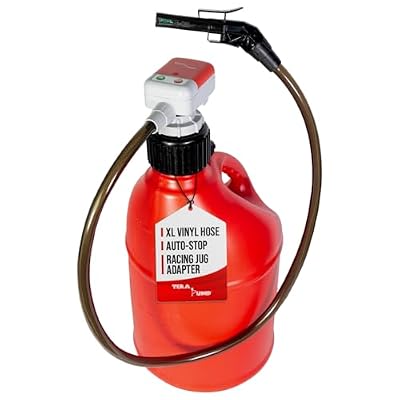
3. TERA PUMP TRFA01 Battery Powered Fuel Transfer Pump
See current price · Best for: Generators and Cans
- Features
- Handheld battery pump for gas cans
TERA PUMP's TRFA01 is a handheld battery operated transfer pump built for the job most homeowners face: moving fuel from a five-gallon can into a generator, mower, outboard or ATV without lifting the can. The pump tube goes into the can, a hose runs to the target tank, and the batteries in the handle drive a small impeller. TERA PUMP markets it for gasoline, diesel and kerosene; check the current listing and manual for the exact fuels and any ethanol limits before use. Flow is modest by drum-pump standards, which is actually an advantage when the target is a narrow generator fill neck. Owners commonly use it during outages to refuel generators quickly and cleanly. Use it only with the generator shut off and cool, with the can on the ground outdoors. For anyone who only handles cans, it does the job without the expense or wiring of a 12V pump.
Pros
- Runs on household batteries, no wiring
- Lets the can stay on the ground while you fill
- Controllable flow for small generator tanks
- TERA PUMP markets it for gasoline, diesel and kerosene
- Inexpensive and easy to store
Cons
- Slow compared with 12V drum pumps
- Not suited to drums or large tanks
- Batteries need replacing or recharging
4. GPI M-180S-EF 12V Fuel Transfer Pump
See current price · Best for: High-Flow Pump
- Features
- 12V DC tank pump, 18 GPM rated, high flow
The GPI M-180S-EF is the high-flow member of GPI's 12V M-series, sold as an 18 gallons-per-minute pump for transfer tanks and drums. It is aimed at farms, construction sites and fleets where big diesel equipment has large tanks and waiting on a slower pump costs real time. Because it draws more current than the smaller pumps, wiring and battery condition matter more: use the supplied cable and fuse, run it from a healthy battery, and observe the duty cycle in GPI's manual. GPI markets the M-series for gasoline and diesel, but compatibility can differ between variants and options, so confirm the exact model's approved fuels and ethanol limits on its label before pumping gasoline. Bond and ground tanks as instructed. For a homeowner with a generator, this is far more pump than needed; for anyone filling a tractor or skid steer every day, it is the one to consider.
Pros
- GPI sells it as an 18 GPM pump
- Fastest rated flow of the picks
- Suits high-volume diesel equipment
- Established maker with parts support
- Mounts on transfer tanks and drums
Cons
- Check the variant's approvals before using gasoline
- Highest current draw of the 12V picks
- More pump than most homeowners need

5. Fill-Rite FR112 Rotary Hand Pump
See current price · Best for: Hand Pump
- Features
- Manual rotary drum pump, no power needed
The Fill-Rite FR112 is a manual rotary hand pump that threads into a standard drum bung and moves fuel with each turn of its crank. It has no motor and no wiring, so it works whether or not a 12V battery is handy and keeps electrical parts out of the vapor zone entirely. That makes it a durable primary pump for a drum of diesel or kerosene in a barn or shop, and a sensible backup to a 12V pump for when the battery is flat. It is slower and more tiring than any electric pump, which matters when filling large tanks, and it has no auto-stop, so watch the receiving tank closely. Fill-Rite sells several variants; confirm on the label that the one you buy is approved for the fuel you plan to pump, especially gasoline, and bond and ground the drum as the manual describes.
Pros
- Needs no battery or wiring
- Nothing electrical near the vapor
- Mounts in a standard drum bung
- Simple, durable design
- Works when every battery is dead
Cons
- Slow and tiring for large volumes
- Confirm the variant's fuel approvals for gasoline
- No auto-stop nozzle
2. Fuel Transfer Pump Side by Side
| Product | Score | Price | Features | Buy |
|---|---|---|---|---|
| Fill-Rite FR1210G 12V Fuel Transfer Pump Best Overall Fuel Pump | 93 | See current price | 12V DC drum/tank pump, 13 GPM rated, hose and manual nozzle | Amazon → |
| GPI M-150S 12V Fuel Transfer Pump Best for Transfer Tanks | 89 | See current price | 12V DC tank pump, 15 GPM rated, hose and nozzle | Amazon → |
| TERA PUMP TRFA01 Battery Powered Fuel Transfer Pump Best for Generators and Cans | 85 | See current price | Handheld battery pump for gas cans | Amazon → |
| GPI M-180S-EF 12V Fuel Transfer Pump Best High-Flow Pump | 82 | See current price | 12V DC tank pump, 18 GPM rated, high flow | Amazon → |
| Fill-Rite FR112 Rotary Hand Pump Best Hand Pump | 78 | See current price | Manual rotary drum pump, no power needed | Amazon → |
3. Why Use a Fuel Transfer Pump at All
A full five-gallon can of gasoline weighs around 30 pounds. Tipping that into a generator's fill neck, a tractor tank or a boat's deck fill is awkward even in daylight, and the classic result is a splash of fuel over a warm engine or down the side of the machine. A portable fuel pump lets the can stay on the ground while a hose and nozzle do the work. Less lifting means less spilling, and less spilling means less fire risk and less fuel soaking into the ground.
The second reason is volume. Anyone refueling equipment from a 55-gallon drum or a pickup-bed transfer tank cannot tip it at all. A drum or tank pump is the only sensible way to get diesel into a skid steer, kerosene into a heater tank or gasoline into a fleet of mowers. This is where 12V pumps and rotary hand pumps earn their place, and where flow rate starts to matter.
The third is the power outage. When the grid is down for days, a generator becomes the most fuel-hungry thing you own, and refueling it every several hours from heavy cans gets old fast. A battery operated transfer pump with an auto-stop nozzle turns that into a one-hand job. If you have not chosen the generator yet, start with our guide to the best home generator for power outages, then come back for the pump.
What a fuel pump should never be is improvised. Water pumps, including cordless tool transfer pumps, are not designed for flammable vapors, and their makers say so. Mouth siphoning is dangerous; swallowing or inhaling gasoline can cause serious lung injury. Everything in this guide is a pump the maker sells specifically for fuel, and the first job is to check it is rated for the specific fuel you have.
There are three broad categories: 12V DC tank and drum pumps that run from a vehicle or equipment battery, battery-powered handheld pumps that run on disposable or rechargeable cells for cans, and hand pumps that need no power at all. Each suits a different job, and most households only need one.
4. The Five Pumps Compared
The table shows the type, power source and the job each pump suits. Flow figures appear only where the maker's number is well established. The fuel column summarizes what the manufacturer markets the pump for; confirm the exact variant on its label before pumping gasoline.
| Model | Type | Power | Rated flow | Fuels (per maker) | Best for |
|---|---|---|---|---|---|
| Fill-Rite FR1210G | 12V drum / tank pump | 12V DC battery | 13 GPM | Gasoline, diesel, kerosene | Drums and transfer tanks |
| GPI M-150S | 12V tank pump | 12V DC battery | 15 GPM | Gasoline and diesel | Pickup transfer tanks |
| GPI M-180S-EF | 12V tank pump | 12V DC battery | 18 GPM | Gasoline and diesel; check variant | High-volume diesel equipment |
| TERA PUMP TRFA01 | Handheld can pump | Disposable batteries | Low, can-sized | Gasoline, diesel, kerosene | Generators, mowers, boats |
| Fill-Rite FR112 | Rotary hand pump | None, manual | Manual | Check variant label | Drums with no power nearby |
The three 12V pumps are the serious tools. They mount on a drum bung or a transfer tank, come with a discharge hose and nozzle, and move fuel in minutes rather than the half hour a can pump might take for the same volume. They need a 12V battery and proper wiring, and they suit people who refuel equipment regularly from bulk storage.
The TERA PUMP is the homeowner's pick. It sits in a gas can, runs on batteries and moves fuel into a generator, mower or outboard tank without lifting the can. It is slow by drum-pump standards but quick enough for the job it is built for, and it is the most useful fuel pump for most people who only ever handle five-gallon cans.
The Fill-Rite FR112 rotary hand pump is the no-power fallback. It is slower and more tiring than the electric pumps, but it never needs charging and has nothing electrical near the vapor. For a farm or shop with drums and no convenient 12V source, it is still a sensible tool.
5. Gasoline vs Diesel: Read the Rating First
Gasoline and diesel behave very differently. Gasoline gives off flammable vapor at temperatures far below freezing, so the air around an open gas can or a running pump can ignite from a spark. Diesel's flash point is much higher, so at ordinary temperatures it is far harder to ignite. That difference is why many inexpensive 12V transfer pumps are rated for diesel, kerosene and oils only: their motors and switches are not designed for gasoline vapor.
A pump built for gasoline is designed so its motor, switch and wiring do not provide an ignition source in a vapor-laden environment, and its seals and housing are made from materials that tolerate gasoline. Pumps from established fuel-equipment makers like Fill-Rite and GPI state which fuels each model is approved for. Some carry a UL listing for specific fuels; look for that on the label of the exact model you are buying rather than assuming a whole product family is covered.
If a listing says diesel only, believe it. A diesel pump used for gasoline can fail in two ways: seals swell or degrade and start leaking, and a brushed motor can spark inside a cloud of vapor. Neither is a theoretical risk. Many of the cheapest 12V pumps sold online are diesel-only, often with that restriction mentioned once in small print, so read the specification before you buy, not after.
Diesel users also have choices that gasoline users do not. Because diesel is less volatile, a larger range of pumps is available for it, including high-flow pumps for farm and construction use. If you only move diesel and kerosene, a diesel-rated pump is fine and often cheaper. If you move gasoline even occasionally, buy a pump rated for gasoline and use it for both, keeping in mind that mixing fuels in the same hose leaves residue.
Never use one pump for both fuel and drinking water or other liquids. A fuel pump is a fuel pump for its whole life.
6. 12V, Battery or Hand Pump
Fuel transfer pumps that run on 12V DC are the workhorses. They clip or wire to a vehicle battery, an equipment battery or a dedicated deep-cycle battery, and they move fuel fast: Fill-Rite rates the FR1210G at 13 gallons per minute and GPI sells the M-150S and M-180S as 15 and 18 GPM pumps. At those rates a generator tank fills in seconds, which is more than most homeowners need and exactly what equipment owners with a transfer tank want.
A 12V pump draws a meaningful current, so wiring matters. Use the cable and fuse the maker supplies or specifies, connect to the battery only with the switch off, and make the final connection away from the fuel opening so any spark at the clamp happens where there is no vapor. Most 12V pumps also have a duty cycle, a maximum continuous run time before they need to cool; check the manual and respect it. A healthy car battery handles a pump easily, but a tired one may not.
Battery powered transfer pumps, like the TERA PUMP TRFA01, are a different animal. They are sized for gas cans, use household batteries and move fuel slowly enough that you can watch the tank fill. That slow, controllable flow is an advantage when the target is a small generator or mower tank with a narrow neck. They are the right tool for most homeowners and the wrong one for anyone filling equipment from a 55-gallon drum.
Hand pumps need no power at all. A rotary hand pump such as the Fill-Rite FR112 mounts in a drum bung and moves fuel with each turn of the crank. A simple squeeze-bulb or shaker siphon is the cheapest option for cans. Both are slower and more tiring, but they have no motor near the vapor and they always work, which is why many farms and shops keep one as a backup even after buying an electric pump.
A practical rule: if you move fewer than a few cans a week, a battery can pump or a siphon is enough. If you refuel equipment from drums or a truck-bed tank, buy a 12V pump from an established fuel-equipment maker. If you want something that will work when every battery on the property is dead, add a hand pump.
7. Static Electricity, Bonding and Grounding
Fuel flowing through a hose generates static electricity, and a static spark is enough to ignite gasoline vapor. This is not rare: fire safety organizations have long warned about fires that start when a portable gas can is filled while sitting in a pickup bed or on a carpeted trunk floor, because the can is insulated from the ground and charge builds up with nowhere to go.
The basic rule for filling portable containers is to place them on the ground, not in a vehicle or truck bed, before filling. Keep the nozzle in contact with the can's opening while fuel flows so any charge can equalize. Fill slowly, do not overfill, and do not get back into a vehicle mid-fill where you can pick up a static charge from the seat. Touch a metal part of the vehicle away from the nozzle before handling fuel.
When pumping from a metal drum or tank into another metal container, the two should be bonded, meaning connected by a conductive wire so they share the same electrical potential, and a stationary drum is usually grounded as well. Fill-Rite and GPI sell pumps with grounding provisions and some include static-wire hoses for exactly this reason. Follow the bonding and grounding instructions in the pump manual; they are not optional for gasoline.
Plastic containers and plastic hoses are trickier because they do not conduct. The practical approach for homeowners is the same as at a gas station: container on the ground, nozzle in contact with the opening, slow fill, no plastic bed liners, no carpeting, and no filling inside an enclosed space. Do it outdoors, in still air where vapors can disperse, and well away from pilot lights and anything that sparks.
Finally, the obvious one that people still ignore: no smoking, no open flame and no running engines nearby when you handle gasoline. Phones are unlikely ignition sources, but anything that can spark, from a power tool to a light switch in a garage, should be kept away from fuel vapor.
8. Approved Containers and Safe Storage
A fuel pump is only as safe as the container it pulls from. Store gasoline only in containers made for it, marked for gasoline and meeting a recognized safety standard. Consumer portable gasoline containers are commonly made to ASTM F852, and many now include flame mitigation devices in the spout or opening. Never store fuel in milk jugs, water containers or anything not designed for it.
Color coding exists for a reason. Red is the standard for gasoline, yellow for diesel and blue for kerosene in the United States. Keeping each fuel in its own color means you never put gasoline in a kerosene heater or diesel in a gasoline generator, both of which are expensive at best and dangerous at worst. Label your pump and hoses the same way if you use different pumps for different fuels.
Store containers outside living spaces, ideally in a detached shed or garage away from water heaters, furnaces and any other ignition source. Keep caps tight so vapor does not escape and moisture does not get in, and keep quantities modest. Local fire codes and homeowner insurance policies often limit how much gasoline you can store at home; check yours before stockpiling for outages.
Drums and transfer tanks are a step up in both capacity and responsibility. They need proper venting, secure mounting if they are in a vehicle, and placarding or compliance with transport regulations above certain quantities. Anyone setting up bulk fuel storage on a property should check local fire code and, where required, get a permit. The fire marshal's office is a good first call.
Clean fuel matters too. Debris and water in a can or drum end up in the pump and then in your engine. Many 12V pumps include an inlet strainer; check it periodically. If you run diesel equipment, an inline filter on the pump's discharge is cheap insurance against clogged injectors.
9. Refueling a Generator Safely
Never refuel a generator while it is running. Shut it off and let it cool before you open the tank. Gasoline spilled on a hot muffler or exhaust can ignite, and a running engine provides plenty of ignition sources. Generator manuals specify a cooling period; follow yours, and in an outage plan your refueling around it rather than topping up on the fly.
Generators must only ever run outdoors, far from doors, windows and vents, because their exhaust contains carbon monoxide that can kill within minutes. Never run one in a garage, even with the door open, in a basement or in a crawlspace. Keep battery-powered carbon monoxide alarms working inside the home. Our guide to the best gas generator covers placement and CO safety features in more detail.
Refuel in the open, with the pump drawing from a can on the ground and the generator positioned so you can reach the fill neck comfortably. A battery operated transfer pump with an auto-stop nozzle is ideal here: it stops when the tank is full, so you do not overfill and spill onto the engine. Fill to below the neck to leave room for expansion, wipe up any drips, and let vapor clear before restarting.
Keep the generator connected to your home only through a properly installed transfer switch or interlock, installed by a licensed electrician under permit. Never backfeed a generator through a dryer outlet or any other receptacle; it can energize the utility lines and kill a line worker. Our guide to the best generator transfer switch explains the safe options.
If the refueling routine sounds like a chore, it is. For extended outages, a small inverter generator running at a light load burns far less fuel than a large open-frame unit and needs refueling less often. Pair it with a pump, a few approved cans of stabilized fuel and a schedule, and you will spill nothing.
10. Ethanol, Fuel Stabilizer and Shelf Life
Most gasoline sold in the United States contains up to 10 percent ethanol, labeled E10, and some stations also sell E15. Ethanol absorbs moisture from the air, and over time that can lead to phase separation, where a water and ethanol layer settles at the bottom of the tank or can. Small engines like generators, mowers and outboards are particularly sensitive to it.
For pumps, ethanol matters because it affects seals and hoses. Fuel-equipment makers state which ethanol blends each pump is compatible with, typically including E10 and often E15. Higher blends like E85 are a different matter and need a pump specifically rated for them. Do not assume a pump is fine with high-ethanol fuel unless the label says so.
For fuel storage, the answer is fuel stabilizer and rotation. Add stabilizer when you fill cans you intend to store, following the product's directions, and rotate stored fuel into your car or equipment on a regular schedule so nothing sits for too long. Gasoline stored without stabilizer can go stale within months, and stale fuel is a leading cause of generators that will not start in an outage.
Many owners of generators and small engines prefer ethanol-free gasoline where it is available, often sold as recreational or marine fuel, because it stores longer and avoids phase separation. It costs more, but for a generator that sits for most of the year it is often worth it. Pre-mixed canned fuel is another option for two-stroke tools like a chainsaw.
Diesel has its own storage issues: water contamination and microbial growth in tanks. Keep diesel tanks topped up to limit condensation, drain water from the bottom if the tank has a drain, and use a diesel treatment where recommended. A filter on the pump discharge catches most of what you would otherwise feed to the engine.
11. Which One to Buy
If you refuel a generator, mower or outboard from five-gallon cans, buy the TERA PUMP TRFA01. It lets the can stay on the ground, moves fuel at a controllable rate and saves you from the lift-and-pour routine that causes most spills. For the typical homeowner, it is the only fuel pump needed.
If you have a 55-gallon drum or a pickup-bed transfer tank and move gasoline as well as diesel, buy the Fill-Rite FR1210G. It is the established drum pump from one of the best-known names in fuel transfer, comes with hose, nozzle and suction pipe, and Fill-Rite lists it for gasoline, diesel and kerosene. If you want a little more flow for a transfer tank, the GPI M-150S is the equivalent choice.
If you run diesel equipment, a farm or a construction fleet and want the fastest fills, the GPI M-180S-EF is the high-flow pick. Confirm the variant's fuel approvals before using it for gasoline. For a drum with no power nearby, or as a backup that never needs charging, add the Fill-Rite FR112 rotary hand pump.
What is not worth buying: the cheapest 12V pumps from unknown sellers, especially those with vague fuel ratings. Many are diesel-only and some fail quickly even on diesel. If a listing will not say clearly which fuels the pump is approved for, skip it. A pump that leaks or sparks near gasoline is worse than no pump at all.
Whatever you buy, keep the rules the same: approved containers on the ground, generator off and cool before refueling, no smoking or ignition sources, outdoors only, and a pump rated for the fuel you are moving.
12. Common Mistakes to Avoid
Using a diesel-only pump for gasoline
Many inexpensive 12V pumps are rated for diesel, kerosene and oil only. Their motors and seals are not designed for gasoline vapor or chemistry, and using one with gas risks leaks and ignition. Read the fuel list before you buy, and if a listing will not say clearly, choose a different pump.
Filling cans in a truck bed
A plastic bed liner or carpeted trunk insulates the can from the ground, letting static build up while fuel flows. A spark can ignite the vapor. Always place portable containers on the ground before filling, keep the nozzle in contact with the opening, and fill slowly.
Refueling a generator while it runs
Fuel spilled on a hot muffler or exhaust can ignite, and a running engine is full of ignition sources. Shut the generator off, let it cool for the time in its manual, refuel outdoors with a pump from a can on the ground, wipe up drips and let vapor clear before restarting.
Storing fuel in the wrong containers
Milk jugs, water bottles and unlabeled containers are not designed for gasoline and can leak, degrade or be mistaken for something else. Use containers made and marked for the specific fuel, follow the red, yellow and blue color code, and store them away from living spaces and ignition sources.
Using a water pump to move fuel
Cordless tool transfer pumps and RV water pumps are not designed for flammable liquids, and their manuals say so. Sparks from the motor or switch can ignite vapor, and gasoline can attack the seals. Buy a pump the maker specifically approves for the fuel you are moving.
13. Frequently Asked Questions
What is the best fuel transfer pump for a home generator?
For most homeowners refueling from five-gallon cans, a battery powered transfer pump like the TERA PUMP TRFA01 is the best choice. It keeps the can on the ground, moves fuel at a controllable rate and avoids the lift-and-pour spills that cause fires. Always shut the generator off and let it cool before refueling outdoors.
Are 12V fuel transfer pumps safe for gasoline?
Only if the manufacturer specifically approves them for gasoline. Pumps such as the Fill-Rite FR1210G are listed for gasoline, but many cheaper 12V pumps are diesel-only because their motors and seals are not designed for gasoline vapor. Check the exact model's label and manual, and follow its bonding and grounding instructions.
Can I use a battery operated transfer pump for diesel?
Yes, most battery operated and 12V transfer pumps that handle gasoline also handle diesel, and many pumps are diesel-only. Diesel is less volatile, so a wider range of pumps is suitable. Use a separate pump or flush the hose if you switch between fuels, and fit a filter if you are refueling diesel engines.
How do I avoid static sparks when pumping fuel?
Place portable containers on the ground, never in a truck bed or on carpet. Keep the nozzle in contact with the container's opening, fill slowly and do not get back into a vehicle mid-fill. When pumping between metal drums or tanks, bond and ground them as the pump manual describes.
Can I siphon gas from my car into a generator?
Many modern cars have anti-siphon or rollover valves that block a siphon hose, and forcing one in can damage the filler. Never siphon by mouth; swallowing or inhaling gasoline can cause serious lung injury. Keep stabilized fuel in approved cans for outages instead of relying on your car's tank.
What ethanol blends can a fuel transfer pump handle?
It depends on the pump. Most fuel-equipment makers list compatibility with common blends like E10 and often E15. Higher blends like E85 need a pump specifically rated for them. Check the exact model's specification sheet before pumping anything above E10, since seals and hoses can degrade in incompatible fuels.
How long can I store gasoline for a generator?
Untreated gasoline can go stale within a few months, which is a common reason generators fail to start in an outage. Add fuel stabilizer when you fill storage cans, rotate the fuel into a vehicle on a regular schedule, and consider ethanol-free gasoline where available. Check local fire codes on how much fuel you may store.
Related Guides
Home & Portable Generators
Best Home Generator for Power Outages
The Generac Guardian 22kW leads 7 outage generators; essentials alone need about 3,500 to 5,000 running watts, and a sump or well pump pushes that higher.
Home & Portable Generators
Best Gas Generator
The Generac GP8000E leads 6 gas generators; an 8,000-watt open frame at half load burns roughly 14 to 19 gallons a day, so each pick comes with a fuel plan.
Transfer Switches & Inlets
Best Generator Transfer Switch
The Reliance 31406CRK 30-amp kit is the generator transfer switch most homes need for an L14-30 generator; 6 Reliance parts, furnace switch to inlet box.
The Bottom Line
Start with the fuel, not the flow rate. If you refuel a generator or small engines from cans, the TERA PUMP TRFA01 is all the pump you need. For drums and transfer tanks holding gasoline as well as diesel, the Fill-Rite FR1210G is the default, with the GPI M-150S as the equivalent alternative and the GPI M-180S-EF for high-volume diesel work. Keep a Fill-Rite FR112 hand pump as the backup that never needs a battery.
Then follow the rules every time: approved containers on the ground, no smoking or ignition sources, bonding and grounding for drums, a pump rated for the fuel in your hand, and a generator that is off, cool and outdoors before the nozzle goes near it.