Camping & RV Power
Best Portable Power Station for Camping
We research every product against its spec sheet, manuals and owner reports. When you buy through our links we may earn a commission, at no cost to you. How we score · Disclosure
The best portable power station for camping for most people in 2026 is the EcoFlow River 3 Plus. The right first camping power station: light enough to carry, big enough for devices, lights and a CPAP, and expandable when trips get longer.
Most campers buy twice the battery they need and half the charging. Build a daily load budget, run what you can on DC, plan the refill, and the right size becomes obvious. Six models, from a 9-pound power bank to a 2kWh RV unit.
At a campsite there is no grid coming back. The battery you leave the driveway with, plus whatever the car and the sun can put back, is all the electricity you get, so the right power station is the one sized to your daily load and your recharging plan, not the biggest one in the catalog.
Our top picks at a glance



Quick answer
the EcoFlow River 3 Plus Portable Power Station is our #1 pick (best overall for camping). The right first camping power station: light enough to carry, big enough for devices, lights and a CPAP, and expandable when trips get longer.
On this page
- 1. The best portable power stations for camping right now
- 2. Portable Power Station for Camping Side by Side
- 3. Size to the Campsite, Not the Catalog
- 4. Build a Campsite Load Budget
- 5. DC vs. AC: The Free 10 to 15 Percent
- 6. Recharging on the Road and Trail
- 7. Quiet Hours and Generator Bans
- 8. Cold Nights and Hot Cars
- 9. Three Worked Trip Examples
- 10. RV and Van Use
- 11. Which One to Pack
- 12. Common Mistakes to Avoid
- 13. Frequently Asked Questions
1. The best portable power stations for camping right now

1. EcoFlow River 3 Plus Portable Power Station
See current price · Best for: Overall for Camping
- Battery
- 286Wh LFP
- Weight
- ~10 lb
- Features
- 600W, Expandable
The River 3 Plus is the size most tent campers actually need. EcoFlow rates it at 286Wh of LFP storage, which recharges a group's phones several times over, runs LED string lights for many evenings, tops up camera and headlamp batteries, and can power a CPAP through a night or more when it runs from the DC output without the heated humidifier. EcoFlow lists it at around 10 pounds, so it goes wherever a daypack goes, which matters at walk-in sites where the parking lot is a few hundred yards from the tent pad. Its 600W inverter is generous for the capacity: enough for a small blender, a projector, a laptop charger and a drone battery charger at once. What it cannot do is sustain a 12V cooler for a long weekend on its own. Pair it with a 100 to 200W folding panel or EcoFlow's add-on battery, or use it for a cooler only when you can refill it from the car each day. Treat it as the hub for devices and light, and it is hard to fault.
Pros
- About 10 pounds, easy to carry from the car to the tent
- 600W inverter covers small appliances and chargers
- Snap-on extra battery available for longer trips
- LFP cells tolerate years of trip-after-trip cycling
Cons
- 286Wh will not carry a 12V cooler for days without solar
- No kettles, hair dryers or heaters on a 600W inverter
- Modest solar input caps how fast it refills

2. Jackery Explorer 1000 v2 Portable Power Station
See current price · Best for: Easiest to Live With
- Battery
- 1kWh LFP
- Features
- 1,500W, Light
Car campers who drive to a site and stay put for three or four nights hit the limits of a 300Wh unit quickly, usually because of the cooler. The Explorer 1000 v2 is the most comfortable step up. Jackery lists 1,070Wh of LFP capacity, roughly three to four times as much as the small units, yet at about 24 pounds it is one of the lightest 1kWh boxes on the market and a single-hand carry from the trunk to the picnic table. By the usual runtime math that capacity runs a typical 12V compressor cooler for two or three days without any recharging, while also covering lights, phones and a laptop. Jackery rates the inverter at 1,500W continuous and 3,000W surge, which handles a small induction plate on low, a coffee maker or a blender. The trade-off is that the capacity is fixed: if you later want more, you add a panel or a second unit rather than an extension battery.
Pros
- 1,070Wh in about 24 pounds, light for a 1kWh unit
- Enough capacity for a 12V cooler for two to three days on its own
- 3,000W surge rating copes with compressor start-ups
- Simple controls that are easy to use in the dark
Cons
- Not expandable with add-on batteries
- 1,500W continuous rules out the hungriest kettles
- Some charging modes are set through the app

3. EcoFlow Delta 3 Plus Portable Power Station
See current price · Best for: Expandable Starter
- Battery
- 1kWh LFP
- Features
- 1,800W, 120V, Expandable
Overlanding rewards a system that can grow. On a week-long trip with a fridge running around the clock in the back of a truck, you live and die by your recharging plan, and the Delta 3 Plus fits into the widest one. EcoFlow rates it at 1,024Wh with an 1,800W inverter, and it accepts EcoFlow's extra batteries, so you can begin with one box for weekends and add capacity before the long trip. It charges from solar, from the 12V socket while you drive, and from EcoFlow's dedicated alternator charging accessories when you want much faster refills on the move. The 1,800W inverter matters more than it sounds in camp: a compact coffee maker, an electric griddle on a moderate setting or a power tool for a quick repair all fit. The cost is weight. At around 28 pounds it gives up some energy per pound to the Jackery, which is irrelevant when it is strapped into a truck bed and noticeable when you carry it to a riverside site. Between trips it is a capable home outage unit.
Pros
- Expandable with add-on batteries for longer expeditions
- 1,800W inverter handles camp cooking appliances
- Multiple charging paths: wall, car, solar, alternator accessories
- Doubles as home outage backup between trips
Cons
- About 28 pounds, heavier than the Jackery at similar capacity
- Lower watt-hours per pound than other 1kWh picks
- Several settings live in the app
4. Anker SOLIX C300X Portable Power Station
See current price · Best for: Budget
- Battery
- 288Wh LFP
- Weight
- ~9 lb
- Features
- 300W, USB-C Focused
Plenty of campers do not need a portable generator for camping at all; they need a big, rugged power bank. The SOLIX C300X fills that role. Anker lists 288Wh of LFP storage, nearly identical to the River 3 Plus, but the unit is built around USB-C rather than the AC inverter, so phones, tablets, headlamps, camera chargers and most laptops charge directly over DC at high efficiency. For a family of four, that is several days of devices and lights. The 300W AC outlets will handle a laptop brick, a small fan or a string of lights, but not a blender, a kettle or a hair dryer, and running a cooler from it is a one-night proposition without solar. If your trips are about keeping phones, cameras and lamps alive, it is the cheapest sensible LFP unit here.
Pros
- Lightest pick at about 9 pounds
- Strong USB-C output charges laptops and cameras directly
- LFP chemistry at a price close to a large power bank
- Small enough to live in a car or gear bin year-round
Cons
- 300W AC limit rules out most appliances
- Not meant for running a cooler for days
- Not expandable

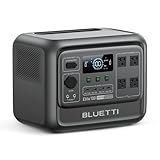
5. Bluetti Elite 100 V2 Portable Power Station
See current price · Best for: Compact
- Battery
- 1kWh LFP
- Features
- 1,800W, Compact
The Elite 100 V2 is the value play in the 1kWh class. On paper it matches the Delta 3 Plus, with Bluetti listing 1,024Wh of LFP storage and an 1,800W inverter, but in a lighter, more compact case closer to the Jackery's weight. For campers who pack a hatchback to the roof, a smaller box is not a trivial advantage. The compromises are in the ecosystem rather than the hardware: no add-on batteries, fewer bundled panels and car accessories, and an app that works without delighting. Any standard folding panel within its input limits will charge it, and the 12V socket runs a cooler just as well as the big brands' do. When it is discounted below the EcoFlow and Jackery, it is the sensible buy.
Pros
- 1,024Wh and 1,800W in about 25 pounds
- Compact footprint for packed trunks and van shelves
- LFP cells with a long cycle rating
- Frequently priced below the EcoFlow and Jackery equivalents
Cons
- Not expandable
- Fewer camping accessories than EcoFlow or Jackery
- App is functional rather than polished

6. Jackery Explorer 2000 v2 Portable Power Station
See current price · Best for: Plug-In Overnight Backup
- Battery
- 2kWh LFP
- Features
- 2,200W, 120V, Plug-In
Once the campsite has a roof and wheels, loads grow: a CPAP every night, a roof vent fan, a TV or laptop in the evening, a coffee maker in the morning, a small microwave now and then. The Explorer 2000 v2 is built for that. Jackery lists 2,042Wh of LFP capacity, enough for a typical boondocking day for a couple, and a 2,200W inverter that runs most countertop appliances one at a time. On the published figures it packs more energy per pound than any other pick here, which matters in a van where every pound counts against payload. It is not a replacement for an RV generator if you want air conditioning, because rooftop units are too hungry for any 2kWh battery to sustain, and at about 40 pounds it stays near the vehicle rather than going down to the lake. Pair it with 400W or more of solar and it can keep pace with moderate RV loads on sunny days.
Pros
- 2,042Wh covers a day or more of RV loads without hookups
- Highest energy per pound here at about 51Wh per pound
- 2,200W runs a coffee maker or microwave in short bursts
- Still a one-person lift at about 40 pounds
Cons
- Too heavy to carry far from the vehicle
- Will not run rooftop air conditioning for long
- Not expandable
2. Portable Power Station for Camping Side by Side
| Product | Score | Price | Battery | Features | Buy |
|---|---|---|---|---|---|
| EcoFlow River 3 Plus Portable Power Station Best Overall for Camping | 93 | See current price | 286Wh LFP | 600W, Expandable | Amazon → |
| Jackery Explorer 1000 v2 Portable Power Station Best for Car Camping | 93 | See current price | 1kWh LFP | 1,500W, Light | Amazon → |
| EcoFlow Delta 3 Plus Portable Power Station Best for Overlanding | 93 | See current price | 1kWh LFP | 1,800W, 120V, Expandable | Amazon → |
| Anker SOLIX C300X Portable Power Station Best Budget | 93 | See current price | 288Wh LFP | 300W, USB-C Focused | Amazon → |
| Bluetti Elite 100 V2 Portable Power Station Best Compact 1kWh | 81 | See current price | 1kWh LFP | 1,800W, Compact | Amazon → |
| Jackery Explorer 2000 v2 Portable Power Station Best for RV and Van Life | 90 | See current price | 2kWh LFP | 2,200W, 120V, Plug-In | Amazon → |
3. Size to the Campsite, Not the Catalog
A power station for camping is a different purchase from one for the house. At home the question is how long you can keep a refrigerator alive until the grid comes back. At a campsite there is no grid coming back. The battery you leave the driveway with, plus whatever you can put back from the car and the sun, is all the electricity you will have until you get home. That makes camping energy a budgeting exercise: what you spend each day has to be matched by what you carry or what you can earn.
The good news is that campsite loads are small. A 12V compressor cooler, LED lights, phones, a headlamp, a camera and a speaker rarely add up to more than a few hundred watt-hours a day. The bad news is that the few big items people bring, such as a CPAP with a heated humidifier, an electric kettle, an e-bike charger or a drone fleet, can each wipe out a small battery in one go. If you are also shopping for outage backup, our main portable power station guide covers the full range, including the large wheeled home units that make no sense at a campsite.
THE SHORT ANSWER
Roughly 300Wh for tents, 1kWh for coolers, 2kWh for rigs.
For tent camping and day trips, a roughly 300Wh LFP unit such as the EcoFlow River 3 Plus covers lights, phones, cameras and a CPAP on DC, and with a 100 to 200W panel it can keep a small 12V cooler going too. For car camping with a cooler for several days, or overlanding, step up to a 1kWh class unit. For RVs and vans, a 2kWh unit runs a CPAP, fans, a TV and a coffee maker without a generator.
The table below adds a column you will not see on most spec sheets: watt-hours per pound. When every item has to be carried from the car to the site, or fitted into a van alongside water and food, energy per pound matters as much as capacity. All figures are the manufacturers' published capacity and approximate listed weight, rounded.
| Power station | Capacity | AC output | Weight | Wh per lb | Best trip |
|---|---|---|---|---|---|
| EcoFlow River 3 Plus | 286Wh (expandable) | 600W | ~10 lb | ~29 | Tent weekends, day trips |
| Jackery Explorer 1000 v2 | 1,070Wh | 1,500W (3,000W surge) | ~24 lb | ~45 | Car camping with a cooler |
| EcoFlow Delta 3 Plus | 1,024Wh (expandable) | 1,800W | ~28 lb | ~37 | Overlanding, growing setups |
| Anker SOLIX C300X | 288Wh | 300W | ~9 lb | ~32 | Budget, devices only |
| Bluetti Elite 100 V2 | 1,024Wh | 1,800W | ~25 lb | ~41 | Compact 1kWh value |
| Jackery Explorer 2000 v2 | 2,042Wh | 2,200W | ~40 lb | ~51 | RV, van and long trips |
A power station's weight scales with its battery, and LFP cells, though safer and longer-lived than the older NMC chemistry, store less energy per pound. That is why even the lightest 1kWh units weigh more than 20 pounds. But weight does not scale perfectly. Small units carry a penalty for their case, inverter, screen and ports, which is why the 286 to 288Wh units sit around 29 to 32Wh per pound while the Explorer 2000 v2 reaches about 51. Two River 3 Plus units would weigh about 20 pounds for 572Wh, while one Explorer 1000 v2 gives you nearly twice that energy in a slightly heavier single box. If your daily budget clearly calls for 1kWh, buy one 1kWh unit rather than stacking small ones.
The calculation flips when you have to carry it. A walk-in tent site, a beach a quarter mile from the lot, or a canoe portage changes the value of every pound. At those sites a 10-pound unit plus a 6 to 10-pound folding panel beats a 24-pound battery, because the panel keeps producing every sunny day while the battery only empties. For truly ultralight trips such as backpacking, bikepacking and paddling, skip power stations altogether and carry a pocket power bank; our portable chargers guide covers banks that weigh a pound or less. Flying rules are strict as well: lithium batteries above 160Wh are generally not allowed on passenger aircraft, so every unit here travels by road.
4. Build a Campsite Load Budget
Before choosing a size, write down everything that will draw power on a typical day, how much power it draws, and for how long. The camping version of this list is different from the home version: no refrigerators or sump pumps, but a lot of small rechargeable batteries and one or two loads that run all day and all night. The figures below are typical ranges drawn from common device ratings, not measurements of any one product, so check the label on your own gear.
| Camp device | Typical draw | Typical daily energy | Best output to use |
|---|---|---|---|
| 12V compressor cooler | 40-60W while running; cycles on and off | ~300-700Wh (heat, size, lid openings) | 12V socket |
| LED lantern / string lights | 5-20W | 25-100Wh per evening | USB or 12V |
| Phones (per phone) | 10-25W charging | 15-20Wh per full charge | USB-C |
| Headlamps and small rechargeables | 5-10W | 5-15Wh | USB |
| Camera batteries | 10-30W charging | 10-40Wh for a few packs | USB-C where supported |
| Drone batteries | 60-100W+ charging | Check Wh on each pack; plan ~15% extra | DC/USB-C car charger |
| Laptop | 45-100W | 50-100Wh per full charge | USB-C |
| CPAP (no heated humidifier) | 30-60W | 250-500Wh per night | 12V DC adapter |
| Bluetooth speaker | 5-20W | 10-30Wh | USB |
| E-bike battery | 100-300W charging | Often ~400-750Wh per full charge | AC (charger brick) |
| Electric kettle | 1,000-1,500W | ~100Wh per liter boiled | AC, large units only |
Three items dominate most budgets. The cooler is the big one, because it runs around the clock; on a hot day in the sun with the lid opening every half hour it can approach the top of that range, and in a shaded spot at night it may barely run. The CPAP is next, and the heated humidifier is the deciding factor: with it switched on, nightly use can climb to several times the dry figure, so most campers switch it off or use a travel setting without heat. The third is anything you are tempted to bring from home that heats water or air. A kettle, a hair dryer and a space heater can each use more energy in fifteen minutes than your phones use in a week.
From List to Battery Size
Add up the daily figures, then adjust for how each device is powered. Loads on the AC outlets lose roughly 15 percent to the inverter, so use the familiar rule, usable energy equals capacity in watt-hours times 0.85, and divide by the load to estimate runtime. Loads on DC outputs lose much less. Multiply the daily total by the number of days you will go without recharging, then subtract whatever you can reliably put back from driving and solar. What is left is the capacity to buy, plus a margin of 20 percent or so for cloudy days and the odd extra charge.
Be honest about the extras. E-bike batteries are the classic budget-breaker: a typical pack holds 400 to 750Wh, and charging it through the inverter and the bike's own charger loses energy at both steps, so one full charge can empty a 1kWh unit that was meant to run the cooler. Drone batteries are similar on a smaller scale. If a load only happens once a trip, plan to do it at a campground hookup or while driving rather than sizing the whole battery around it.
QUICK SANITY CHECK
Three budgets, three answers.
If your daily budget is under 200Wh, a 300Wh unit lasts a weekend with no recharging. If it is 300 to 700Wh because of a cooler, a 300Wh unit needs daily solar or driving to keep up, and a 1kWh unit gives you one to three days of slack. If it is over 1,000Wh, you are in RV territory and should look at 2kWh with solar.
5. DC vs. AC: The Free 10 to 15 Percent
Every power station stores energy as direct current. To feed a household outlet, the inverter has to convert that DC into 120V alternating current, and that conversion costs energy as heat. Then, for many devices, a charger brick converts the AC straight back to low-voltage DC to charge a battery, losing energy a second time. Running devices from the DC outputs skips both steps.
| Device | Wasteful path | Efficient path |
|---|---|---|
| 12V cooler | Cooler's AC adapter in an AC outlet | Cooler's 12V plug in the car socket output |
| CPAP | Standard AC power brick | Manufacturer's 12V DC power cord |
| Laptop | Laptop brick in an AC outlet | USB-C cable direct (if it charges over USB-C) |
| Phones, headlamps, cameras | Wall chargers in AC outlets | USB-A or USB-C ports |
| Drone batteries | AC charging hub | Maker's car charger in the 12V socket |
The saving is typically 10 to 15 percent of whatever those devices use, which on a cooler-heavy trip can be an extra half day of runtime. There is a second, less obvious saving: the inverter draws power just by being switched on, even with nothing plugged in. Over a 24-hour day that idle draw adds up to a meaningful slice of a 300Wh battery. The habit worth building is simple: run everything you can from DC and keep the AC button off unless something actually needs it.
For CPAP users this matters twice. A CPAP on its DC cord without the humidifier is one of the most efficient overnight loads you can run, and many CPAP makers sell the cord as an accessory. Check your machine's manual for the correct adapter and voltage before relying on it, and never assume a medical device will tolerate a power interruption. Test your setup at home for a full night before you depend on it in the backcountry, and bring a fallback plan if the trip is long.
The same logic explains why the Anker SOLIX C300X punches above its 300W AC rating at a campsite. Its strength is the USB-C side, and nearly everything a tent camper charges, phones, headlamps, cameras, most laptops and many drone chargers, can run from USB-C or a 12V car-style plug. A unit with strong DC outputs and a modest inverter is often a better camping tool than one with a big inverter and weak DC ports.
When you do need AC, batch it. Switch the inverter on, run the blender or charge the laptop brick, and switch it off again, rather than leaving it on all evening to power one small lamp. On a 1kWh unit this is a minor efficiency; on a 300Wh unit with a cooler attached, it can be the difference between making it to the morning and waking up to warm milk.
6. Recharging on the Road and Trail
On a multi-day trip, the charging plan matters more than the capacity. There are three realistic sources away from hookups: the car while you drive, solar panels at camp, and campground hookups or a gas generator when available. Most campers end up using two of the three, and the right battery size depends on how much those sources can return each day.
Car Charging While Driving
Every power station on this list can charge from a vehicle's 12V accessory socket. The catch is the socket itself: most are fused at 10 to 15 amps, which limits charging to roughly 100 to 120W. That is useful but slow. An hour of driving puts back around 100Wh, enough to recover a day of phone and light use or a few hours of cooler runtime. A 300Wh unit refills in about three hours of driving; a 1kWh unit needs closer to ten.
That makes the 12V socket a top-up, not a primary source, for anything above about 500Wh. Overlanders who drive daily and run a fridge full time increasingly use a dedicated alternator charger wired to the starter battery, which several brands, EcoFlow among them, now sell. These deliver several hundred watts while the engine runs and can refill a 1kWh unit in a couple of hours of driving. They need proper installation with correct cable sizes and fusing, and they should only charge while the engine is running so the starter battery is never drained. Whatever you use, do not run the power station off the car's socket with the engine off overnight; that is how you end up with a dead starter battery at a trailhead.
Solar on the Trail
Folding panels are the camper's free fuel. The honest numbers: a portable panel delivers about 60 to 75 percent of its rated wattage when well aimed at midday, and a good summer day provides around four to five peak sun hours. Here is what that means for common panel sizes.
| Panel rating | Realistic midday output | Energy on a clear day | What it sustains |
|---|---|---|---|
| 100W | 60-75W | ~250-350Wh | Devices and lights; a cooler in mild weather |
| 200W | 120-150W | ~500-700Wh | Cooler plus devices for a couple |
| 400W | 240-300W | ~1,000-1,400Wh | Overland fridge, laptops, drones; light RV use |
| 600W+ | 360-450W | ~1,500-2,000Wh | RV boondocking with CPAP, fans and TV |
Campsites are rarely ideal solar sites. Tree cover can cut output by half or more, and forest camping in the shade is exactly where people want to pitch a tent in summer. Place the panel in the sun on a long extension lead and leave the power station in the shade; batteries prefer cool, and panels prefer light. Re-aim it two or three times a day to follow the sun, and keep it clear of dust and pollen. In spring and fall the sun is lower and days are shorter, so budget toward the bottom of each range. For a deeper look at matching panels to stations, including input voltage limits, see our best solar generator guide.
Hookups and Generators
If a site has power, use it: a wall charger refills these units in roughly one to two hours. Where generators are allowed, a small inverter generator can refill a large power station in the window the campground permits, and the battery covers quiet hours. Our generator guide explains how to size one if that is part of your plan; just remember that gasoline generators must stay outdoors, well away from tents and RV windows, because of carbon monoxide.
7. Quiet Hours and Generator Bans
One of the best reasons to choose a battery over a portable generator for camping is that the campground may not let you run the generator. Many public campgrounds set generator hours, often a block in the morning and another in the evening, and enforce quiet hours overnight. Some loops, tent-only areas and many backcountry or walk-in sites ban generators entirely.
Federal parks commonly reference a noise limit of about 60 decibels measured at 50 feet, which even many quiet inverter generators struggle to meet under load. Rules vary widely by park and change from season to season, so check the specific campground's regulations before you go rather than assuming last year's rules still apply. Private campgrounds and RV parks set their own policies, and they are often stricter than public land.
A power station sidesteps all of this. Apart from a cooling fan under heavy load, it is silent, produces no exhaust, and can sit inside a tent vestibule or RV without any carbon monoxide risk. You can run a CPAP all night in a generator-free loop, make coffee at 6 a.m. without waking the neighbors, and keep lights on long after generator hours end.
| Campsite factor | Power station | Gas inverter generator |
|---|---|---|
| Quiet hours | Usable 24/7 | Off during quiet hours |
| Generator-free loops | Allowed | Not allowed |
| Inside a tent or RV | Yes, no exhaust | Never: carbon monoxide |
| Fuel to carry | None | Gasoline cans or propane |
| Air conditioning | Short bursts at most | Yes, with a large enough unit |
| Multi-week trips without sun | Struggles | Runs as long as fuel lasts |
That is also why a growing number of RV owners use a battery overnight and run a generator, where allowed, only during the permitted daytime window to recharge it. The hybrid gets the best of both: fuel-based energy for the long haul and silent power for the hours when it matters. If you already own a generator, a power station turns it from an all-night nuisance into a two-hour morning chore.
The generator still wins in two cases. Rooftop air conditioning draws far more than any portable battery can sustain, and a multi-week trip through cloudy country without hookups will outlast any solar setup a car can carry. For everything else, the battery is the better campsite neighbor.
8. Cold Nights and Hot Cars
Cold
Lithium batteries should not be charged below freezing, and most power stations block charging at around 32 degrees F (0 degrees C) to protect the cells. Discharging in the cold is allowed within the manufacturer's range, but usable capacity falls as temperature drops, so a unit that lasts two days in July may last noticeably less on a frosty October trip. In shoulder season, keep the power station inside the tent or the vehicle cabin overnight, off the cold ground, and insulate it with a jacket or sleeping bag stuff sack, with the vents clear. If a unit has been sitting in a freezing truck bed, let it warm up before plugging in a solar panel.
In cold weather you will also be tempted by electric blankets and heaters. A 12V heated blanket at modest settings is manageable on a 1kWh unit, but a 1,500W space heater will drain even the Explorer 2000 v2 in little more than an hour. Warm clothing, a good sleeping bag and a hot water bottle filled from the camp stove remain far better value per watt-hour than anything electric.
Heat
Summer is the bigger risk for most campers. A closed car parked in the sun gets far hotter than the outside air, easily beyond what any battery maker allows. Many units list an upper operating limit somewhere around 104 to 113 degrees F (40 to 45 degrees C); check your manual. High heat shortens battery life and can trigger shutdowns just when the cooler needs power most. Keep the station in shade, out of the trunk on hot days, and never charge it in direct sun; run a long cable to the panel instead.
Coolers work harder in heat too, which is the other reason a summer trip needs a bigger budget than a spring one. A cooler in a sunny spot on a 95-degree afternoon can run close to continuously, pushing daily use to the top of the range in the load table. Shade it, keep it full, and open the lid less often, and the same battery lasts noticeably longer.
Rain and Dust
None of these units is waterproof. Keep them off the ground, under a vestibule or awning, and away from condensation dripping off tent walls. A dry bag or plastic bin with the lid propped for ventilation works in a downpour. Dust is the enemy of cooling fans in desert camping; wipe the vents and keep the unit off sandy ground, ideally on a small folding table or the tailgate.
9. Three Worked Trip Examples
These examples use the daily figures from the load table and the runtime rule above. Your own numbers will differ, and the point is the method rather than the exact totals. Each example starts from the loads, then works out what the battery and the recharging plan have to supply.
1. The Weekend Tent Trip (Two Nights, Two People)
Version A, no electric cooler: two phones charged daily (40Wh), string lights for four hours at 10W (40Wh), headlamps and a camera (30Wh), and a Bluetooth speaker (20Wh). That is about 130Wh a day, almost all on USB, or roughly 260Wh for the weekend. A River 3 Plus or SOLIX C300X does it with no recharging and a little left over for the drive home.
Version B, with a 12V cooler: add a cooler at around 400Wh a day on the 12V socket, and the daily total becomes about 530Wh, or over 1,000Wh for the weekend. Now a 300Wh unit lasts barely half a day on its own. There are three ways to make it work: a 1kWh unit such as the Explorer 1000 v2 covers the full weekend with no charging at all; a River 3 Plus plus a 200W panel in good sun nearly keeps pace day to day; or pre-chill the cooler at home and use block ice to cut its run time. For most car campers who bring a cooler, the 1kWh unit is the stress-free choice.
2. The Week-Long Overland Trip (Seven Days, Two People)
The daily budget: a 12V fridge running full time (about 500Wh), lights (50Wh), phones and a GPS unit (80Wh), a laptop for photos and maps (60Wh), and three drone batteries charged from a car charger (about 175Wh with losses, depending on the packs). Call it roughly 865Wh a day, or about 6kWh over the week, far more than any portable unit carries.
So the trip runs on recharging. Three hours of daily driving on the 12V socket returns about 300Wh. A 200W folding panel at camp adds roughly 500 to 700Wh on a clear day. Together that is around 800 to 1,000Wh a day, roughly break-even with consumption. A 1kWh battery is then the buffer, not the fuel tank: it covers one cloudy day or a rest day without driving. That is why the Delta 3 Plus fits so well. Start with the base unit, add an extra battery for more cloudy-day insurance, or fit an alternator charger so driving days fully replenish the battery. The Explorer 2000 v2 works too, with a two-day buffer instead of one.
3. RV Boondocking (Four Nights, No Hookups)
A couple in a small travel trailer, with the fridge running on propane: CPAP on DC for eight hours (320Wh), a roof vent fan at 30W for eight hours (240Wh), LED lights (100Wh), a TV or laptop for three hours at 60W on AC (about 210Wh after inverter losses), a coffee maker for ten minutes at 1,000W (about 200Wh with losses), and phones and small devices (60Wh). The total is about 1,130Wh a day.
An Explorer 2000 v2 provides about 1,700Wh of usable AC energy at the 0.85 rule, somewhat more for the DC loads, so it covers about a day and a half alone. With 400W of portable solar returning around 1,000 to 1,400Wh on a sunny day, the system roughly breaks even and the four nights work, with the trailer's own house battery handling the water pump and furnace fan. If the forecast is cloudy, swap the coffee maker for a stovetop percolator and the budget drops by almost a fifth. What this setup will not do is run the rooftop air conditioner, which commonly draws 1,300 to 2,000W while running; that remains a job for shore power or a generator.
10. RV and Van Use
A portable power station can do a lot in an RV or camper van, but it helps to understand where it fits alongside the vehicle's own electrical system. Most rigs already have a 12V house battery, a converter that charges it from shore power, and a shore-power inlet. A power station can sit beside that system or feed into it, and the two approaches behave very differently.
As a standalone power source, the station goes on the floor or a shelf and devices plug directly into it. This works in any rig, needs no wiring, and moves with you to the picnic table or the house. Most van-lifers and small-trailer owners start here, and many never need more. It is also the approach that lets the same unit cover outages at home between trips.
Feeding the RV's shore-power inlet is the other route. Some larger stations include an RV-style 30A outlet, and adapters exist for plugging the RV's shore cord into a power station. This powers the RV's 120V outlets, but the rig's converter will also try to charge the house battery from the station, wasting energy, and anything big on the AC circuits, such as the air conditioner, the electric water heater element or an electric fridge mode, can overload the inverter instantly. If you go this route, switch off those loads and the converter at the breaker before connecting.
Mounting and ventilation matter on the move. Secure the unit so it cannot slide or tip under braking, keep its vents clear of bedding and gear, and keep it out of the hottest corner of the vehicle. LFP chemistry is among the most stable lithium types, but any large battery deserves a secured, ventilated spot away from where you sleep with your head against it.
Size honestly. A 1kWh unit is fine for a van with a 12V fridge, lights and devices. Once a CPAP, a TV and a coffee maker are added, a 2kWh unit and a few hundred watts of solar become the realistic minimum. Rooftop air conditioning, electric heat and electric cooking at length are beyond any portable station on this list. If you want those, a built-in lithium house battery with a large inverter, or a quiet generator, is the right tool. Owners who want one battery to serve both the rig and the house should read our home backup power station guide, because that job tends to push the size up.
11. Which One to Pack
For phones, headlamps, cameras and lights for a weekend on a budget, the Anker SOLIX C300X is the pick. It is the camping power bank that charges a whole group's devices over USB-C for several days, and at about 9 pounds it can live in the car all season.
For tent camping and day trips with lights, devices and a CPAP, take the EcoFlow River 3 Plus. Add a 100 to 200W panel or the extra battery if you also want to run a small cooler. For drive-in car camping with a 12V cooler for two to four nights, the Jackery Explorer 1000 v2 is the lightest 1kWh unit here, and the Bluetti Elite 100 V2 is the alternative when it is the better price or the trunk is tighter.
For overlanding and week-long vehicle trips, choose the EcoFlow Delta 3 Plus, paired with solar and ideally an alternator charger, with the option to add a battery later. For RVs, vans and boondocking with a CPAP, fans and a coffee maker, the Jackery Explorer 2000 v2 with 400W or more of solar is the realistic minimum.
Torn between the two biggest brands? Our EcoFlow vs. Jackery breakdown compares the ecosystems head to head, including how the Explorer 1000 v2 and the Delta 3 Plus differ on expansion and charging. And if the same unit also needs to cover outages at home, remember that home backup pushes the size up while camping pushes it down; the portable power station rankings show where each capacity class lands.
Whichever you choose, the habits matter as much as the hardware. Run what you can on DC, keep the inverter off when nothing needs it, keep the battery out of the sun and off the frozen ground, and plan the recharge before the trip rather than at the campsite. A modest battery used that way outlasts a big one used carelessly.
12. Common Mistakes to Avoid
Buying by Capacity Instead of a Load Budget
Most campers buy twice the battery they need and half the charging. Add up what each device actually uses per day, multiply by the days without recharging, and subtract what driving and solar return. That number, plus a 20 percent margin, is the size to buy, not the biggest box that fits the budget.
Running the Cooler and CPAP Through the Inverter
Plugging a 12V cooler's AC adapter or a CPAP's standard brick into the AC outlets throws away 10 to 15 percent of the energy as inverter heat. Use the 12V car-style socket for the cooler and the maker's DC cord for the CPAP, and keep the AC button off unless something needs it.
Charging From the Car Socket With the Engine Off
A power station happily drains a parked vehicle's starter battery through the 12V socket. Leave it connected overnight and you can wake up unable to start the car at a remote trailhead. Only charge from the socket while driving, and use an alternator charger that cuts out when the engine stops.
Leaving the Battery in a Hot Car or Frozen Truck Bed
A closed car in summer sun gets hotter than most units' operating limits, and most units block charging below freezing. Heat shortens battery life and triggers shutdowns, while cold cuts runtime. Keep the station shaded by day and inside the tent or cabin overnight, with its vents clear.
Trusting an Untested CPAP Setup
Assuming the CPAP will run all night on a new power station is a gamble with your sleep. Confirm the correct DC adapter with the CPAP maker, switch off the heated humidifier unless the battery is large, and run the full setup at home for a complete night before relying on it at a remote site.
13. Frequently Asked Questions
What size portable power station do I need for camping?
Size it from a daily load budget. Add up what each device uses per day in watt-hours, multiply by the days without recharging, and subtract what driving and solar can return. Phones, lights and cameras alone need 100 to 200Wh a day, which a 300Wh unit covers for a weekend. A 12V cooler raises that to roughly 400 to 800Wh a day, pointing to a 1kWh unit. RV trips with a CPAP, fans and a coffee maker suit a 2kWh unit with solar.
How long will a power station run a 12V camping cooler?
A 12V compressor cooler draws roughly 40 to 60W while running but cycles on and off, so daily use is typically 300 to 700Wh depending on size, heat, sun and lid openings. From the 12V socket, a 286 to 288Wh unit lasts between half a day and a day, a 1kWh unit roughly two to three days, and a 2kWh unit four days or more. Shade, pre-chilling and a full load all stretch runtime.
Can I run a CPAP from a power station while camping?
Yes, and it is one of the most common reasons campers buy one. A CPAP without its heated humidifier typically draws 30 to 60W, or about 250 to 500Wh over an eight-hour night. The maker's 12V DC cord avoids inverter losses. A 300Wh class unit usually covers one night, a 1kWh unit several. The heated humidifier can multiply use several times over, so test the full setup at home first.
Is a power station better than a portable generator for camping?
For most campers, yes. A battery is silent, produces no exhaust, can be used inside a tent or RV, needs no fuel and is allowed in loops that ban generators or restrict them to set hours. A gas inverter generator still wins for rooftop RV air conditioning or weeks off-grid without reliable sun. Many RV owners combine the two, running the generator in permitted hours to recharge the battery.
Can I charge a power station from my car while driving?
Yes. Every unit in this guide accepts charging from a vehicle's 12V accessory socket. Most sockets are fused at 10 to 15 amps, so charging is limited to roughly 100 to 120W, or about 100Wh per hour of driving. That refills a 300Wh unit in around three hours; a 1kWh unit needs about ten. Dedicated alternator chargers deliver several hundred watts while the engine runs.
How much solar do I need for camping?
A portable panel produces roughly 60 to 75 percent of its rating in good midday sun, and a clear day offers four to five peak sun hours. A 100W panel returns about 250 to 350Wh a day, 200W about 500 to 700Wh, and 400W around 1,000 to 1,400Wh. Use 100W for devices, 200W to sustain a cooler, and 400W or more for overland fridges or RV use. Keep a buffer for shade and cloud.
Can a camping power station charge an e-bike?
Usually, if the e-bike charger's wattage is within the station's AC output. Many e-bike packs hold roughly 400 to 750Wh, and charging through the inverter and the bike's brick loses energy at both steps. A 300Wh unit adds only a partial charge, and a 1kWh unit can fill one mid-size pack but leaves little for the cooler. For regular e-bike charging, use a 2kWh unit with solar or a campground hookup.
Related Guides
Portable Power Stations
Best Portable Power Station
The EcoFlow DELTA 2 LFP tops 7 portable power stations; a 1,000Wh unit runs a typical fridge about 6 to 14 hours, and LiFePO4 is rated for 3,000+ cycles.
Solar Generators & Panels
Best Solar Generator
The EcoFlow Delta 3 Plus tops 7 solar generators; plan on about 1 watt of panel per 3 watt-hours of battery to refill a station on a typical sunny day.
Guides
EcoFlow vs Jackery
EcoFlow wins for home backup with add-on batteries and 1,800 W on the Delta 3 Plus; Jackery's Explorer 1000 v2 packs 1,070 Wh into about 24 lb for camping.
The Bottom Line
Camping power is a budget, not a catalog choice. Write down the daily loads, put the cooler and CPAP on DC, and work out what driving and solar can return before you pick a capacity. For most tent campers that lands on a roughly 300Wh unit like the River 3 Plus; a cooler for several days pushes it to 1kWh, and an RV with a CPAP and coffee maker to 2kWh plus solar.
Keep the battery shaded, out of freezing truck beds and off the car socket with the engine off, and it will outlast many seasons of trips. When you need air conditioning or weeks off-grid without sun, a generator is still the right tool; for everything else, the silent battery is the better campsite neighbor.
More in Camping & RV Power
Camping & RV Power
Best Generator for Camping
The Honda EU2200i leads 7 camping picks; a 1,000-watt inverter runs phones, lights and a 12V fridge, while kettles and hot plates need 2,000 to 2,500 watts.
Camping & RV Power
Best RV Generator
The Honda EU3000iS leads 7 RV generators; plan on about 3,000 running watts to start a 13,500 BTU rooftop AC without a soft starter. Picks for 30 and 50 amp.