Whole-House Surge Protectors
Best Whole House Surge Protector
We research every product against its spec sheet, manuals and owner reports. When you buy through our links we may earn a commission, at no cost to you. How we score · Disclosure
The best whole house surge protector for most people in 2026 is the Siemens FirstSurge Pro FS140 Surge Device. The best all-round choice for most homes, with the headroom to last through years of surges.
A whole-house surge protector clamps spikes at the service panel before they reach every circuit in the house. These six are ranked on type rating, surge capacity, let-through voltage, status indication and how easily they fit common panels.
Most homeowners think of surges as lightning, but the bigger daily threat comes from inside: air conditioners, well pumps, garage door openers and furnace blowers switching on and off, and utility switching on the grid. A panel-mounted surge protective device is a small box costing roughly $60 to $300 that clamps those spikes before they spread through every circuit. For new and replaced services, the electrical code now requires one.
Our top picks at a glance




Quick answer
the Siemens FirstSurge Pro FS140 Surge Device is our #1 pick (best overall). The best all-round choice for most homes, with the headroom to last through years of surges.
On this page
- 1. The best whole house surge protectors right now
- 2. Whole House Surge Protector Side by Side
- 3. Where Household Surges Actually Come From
- 4. Which Homes Benefit Most
- 5. Type 1, Type 2 and Type 3 Devices
- 6. Reading the Spec Sheet
- 7. What the Electrical Code Requires
- 8. Installation and Safety
- 9. Layered Protection Works Best
- 10. What It Costs
- 11. Lifespan and Replacement
- 12. Common Mistakes to Avoid
- 13. Frequently Asked Questions
1. The best whole house surge protectors right now

1. Siemens FirstSurge Pro FS140 Surge Device
See current price · Best for: Most buyers
- Features
- Type 1 or 2, 140 kA, Outdoor-Rated Enclosure
Siemens' FS140 is a high-capacity surge protective device rated by Siemens at 140 kA, listed for Type 1 or Type 2 installation. That flexibility lets an electrician mount it at the meter on the line side or, more commonly, wire it to a double-pole breaker in the panel. The enclosure is rated for indoor and outdoor use, and it is not tied to Siemens panels, so it works with any brand when wired to a breaker. Status LEDs show whether each protection mode is active, and the spec sheet lists protection across all modes for a split-phase service. Check the current spec sheet for its exact voltage protection rating and any surge counter or alarm features, as versions have varied. The housing is bigger than compact units, which can matter on cramped panels, and it costs more than basic devices, typically roughly $120 to $250 at the time of writing. For most homes, the extra capacity means a longer service life and more margin against larger external events.
Pros
- 140 kA surge current rating per Siemens
- Listed for Type 1 or Type 2 installation
- Enclosure suits indoor or outdoor mounting
- Status LEDs show protection state
- Works with any brand of panel when wired to a breaker
Cons
- Larger housing than compact devices
- Costs more than basic units

2. Eaton CHSPT2ULTRA Ultra Surge Protective Device
See current price · Best for: Value
- Features
- Type 2, 108 kA, Panel Mounted
Eaton's CHSPT2ULTRA is a Type 2 surge protective device rated by Eaton at 108 kA, mounted through a panel knockout and wired to a double-pole breaker. It suits most residential load-center installs regardless of brand. Indicator LEDs show the status of each protection mode, and Eaton lists protection across each hot leg to neutral and to ground, plus neutral to ground. Electricians commonly use it as a default whole-house device because its capacity is high for the price, typically roughly $90 to $160 at the time of writing. Eaton also offers a connected-equipment warranty, but read the terms; claims typically depend on proper installation and grounding. The limitation is that it is Type 2 only, so it cannot be installed ahead of the main breaker. For most homes that is not an issue, since load-side installation is the norm. If you want one device that offers strong capacity without paying for the premium tier, this is the one to ask your electrician about.
Pros
- 108 kA surge rating per Eaton
- Compact housing mounts through a panel knockout
- Status LEDs for each protection mode
- Strong value for its capacity
- Connected-equipment warranty, check terms
Cons
- Type 2 only
- Warranty claims require proper install documentation

3. Square D Home Electronics Protective Device HEPD80
See current price · Best for: Smallest Footprint
- Features
- Compact 80 kA Unit, Knockout or Surface Install
Square D's HEPD80 is a compact surge protective device rated at 80 kA by Square D, designed for residential split-phase services. It mounts through a panel knockout or onto a nearby surface and wires to a double-pole breaker, so it fits nearly any panel, not just Square D's own. The small housing helps where space around the panel is tight, and LED indicators show the protection status. The 80 kA rating is plenty for most homes, though it gives less long-term headroom than 108 kA or 140 kA devices in areas with frequent lightning. Owners and electricians commonly mention that the indicator lights are small and can be hard to see, so mount it where you will check them. Price is typically roughly $70 to $130 at the time of writing. If you want a reputable device without paying for the highest capacity, the HEPD80 is a sound choice.
Pros
- 80 kA surge rating per Square D
- Compact housing fits tight spaces
- Mounts through a knockout or on a surface
- LED status indicators
- Works with any panel when wired to a breaker
Cons
- Lower capacity than premium options
- Indicator LEDs are small

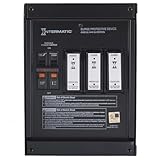
4. Intermatic IG2240-IMSK Surge Protective Device
See current price · Best for: Outdoor Install
- Features
- Type 1 or 2 Listing, Weather-Resistant Box
Intermatic's IG2240-IMSK is a surge protective device listed for Type 1 or Type 2 installation in a weather-resistant enclosure. That makes it a natural choice where the service disconnect is outdoors, which is common in warmer regions and newer homes where the main breaker sits next to the meter. Status indicators show whether protection is active. Intermatic has a long history in outdoor electrical equipment, and the IMSK suffix refers to a mounting kit for flexible installs. Its surge capacity is in the mid-range rather than the top tier, so check the current spec sheet for the exact kA and voltage protection ratings. Installation at or near the meter may require utility approval, and any line-side work must be done by a licensed electrician. Prices are typically roughly $80 to $160 at the time of writing. If your panel is indoors with room for a knockout, the Siemens or Eaton devices offer more capacity for similar money.
Pros
- Listed for Type 1 or Type 2 use
- Weather-resistant enclosure suits outdoor mounting
- Status indicators for protection state
- Good fit near meters and outdoor service equipment
Cons
- Mid-range capacity versus premium devices
- Outdoor mounting may need utility approval at the meter

5. Leviton Panel Protector, Model 51120-1
See current price · Best for: Known Brand
- Voltage
- 120/240 V Split Phase
- Features
- Type 2, Panel Mount
Leviton's 51120-1 is a Type 2 panel protector designed for 120/240-volt single-phase residential services. It mounts through a panel knockout and connects to a double-pole breaker, and it works with any panel brand. LED indicators show whether each protection mode is working. Leviton is a major wiring device maker, and the 51120-1 is stocked widely, which helps when you need one quickly. It also pairs with Leviton's range of receptacle-style and plug-in surge protectors for a layered system. Its capacity sits below premium devices, so it suits typical suburban homes with modest lightning exposure more than rural homes on long overhead lines. Leviton has released several versions over the years, so check the current spec sheet for the exact kA and voltage protection ratings. Price is typically roughly $90 to $170 at the time of writing. It is a reasonable choice if you prefer the Leviton ecosystem or find it readily at your supplier.
Pros
- Designed for 120/240 V residential panels
- Compact unit mounts through a knockout
- LED indicators per protection mode
- Leviton offers a range of matching point-of-use protectors
Cons
- Lower capacity than top picks
- Check spec sheet for exact VPR and kA by version

6. THQLSURGE Plug-In Surge Breaker from GE
See current price · Best for: Easiest Install
- Features
- Plug-In Breaker Format for GE Panels
GE's THQLSURGE packages a surge protector in the shape of a double-pole breaker that plugs into two spaces in compatible GE load centers. There is no knockout, no external housing and no long leads, and the short connection to the bus is good for limiting let-through voltage. A pigtail connects to the neutral bar. For an electrician, it is one of the fastest installs available, and it typically costs roughly $70 to $130 at the time of writing. The constraints are significant. It fits only compatible GE panels, it needs two free breaker spaces, and its surge capacity is lower than external devices like the Siemens FS140 or Eaton CHSPT2ULTRA. Status indication is limited to a small indicator, so check it periodically. Other panel makers sell similar breaker-style devices for their own panels, such as Square D's QO and Homeline versions. If you have a compatible GE panel with room, it is the easiest way to add code-compliant surge protection.
Pros
- Plugs into two breaker spaces like a standard breaker
- No knockout or external housing
- Quick install in compatible GE panels
- Low cost
Cons
- Only fits compatible GE load centers
- Uses two breaker spaces
- Lower capacity than external devices
2. Whole House Surge Protector Side by Side
| Product | Score | Price | Features | Buy |
|---|---|---|---|---|
| Siemens FirstSurge Pro FS140 Surge Device Best Overall | 93 | See current price | Type 1 or 2, 140 kA, Outdoor-Rated Enclosure | Amazon → |
| Eaton CHSPT2ULTRA Ultra Surge Protective Device Best Value | 90 | See current price | Type 2, 108 kA, Panel Mounted | Amazon → |
| Square D Home Electronics Protective Device HEPD80 Smallest Footprint | 87 | See current price | Compact 80 kA Unit, Knockout or Surface Install | Amazon → |
| Intermatic IG2240-IMSK Surge Protective Device Best Outdoor Install | 84 | See current price | Type 1 or 2 Listing, Weather-Resistant Box | Amazon → |
| Leviton Panel Protector, Model 51120-1 Best Known Brand | 81 | See current price | Type 2, Panel Mount | Amazon → |
| THQLSURGE Plug-In Surge Breaker from GE Easiest Install | 78 | See current price | Plug-In Breaker Format for GE Panels | Amazon → |
3. Where Household Surges Actually Come From
A surge is a short spike in voltage, lasting millionths to thousandths of a second, well above the normal 120 or 240 volts. Lightning produces the dramatic ones, but direct strikes are rare. Far more common are nearby strikes that induce surges into overhead lines, and utility switching events such as capacitor banks coming online or a transformer fault elsewhere on the grid. Those external events can send thousands of volts into a service.
Inside the home, motors and compressors are the main source. Every time an air conditioner, heat pump, refrigerator, well pump or furnace blower shuts off, the collapsing magnetic field in its motor kicks a small spike back into the wiring. Each one is modest, often a few hundred volts, but they happen many times a day, year after year. Industry estimates commonly put internally generated surges at the majority of all events in a typical home.
Those small, repeated spikes do not destroy electronics in one blow. They wear down the sensitive components in control boards, power supplies and LED drivers over time, which shows up as appliances failing early with no obvious cause. Modern homes are full of these boards: furnaces, washing machines, ranges, refrigerators, garage door openers, smart thermostats and every LED fixture.
A whole-house surge protector does not make a home lightning-proof. Nothing at the panel can stop a direct strike from damaging a house. What it does is divert the frequent, moderate surges to ground before they spread through every branch circuit, which protects hardwired appliances that cannot be plugged into a surge strip. That is where the value is.
THE HONEST EXPECTATION
A panel surge protector reduces wear and damage from everyday spikes. It does not stop a direct lightning strike.
Think of it as protection for the HVAC board, the range, the washer and the furnace, things you cannot plug into a power strip. Pair it with point-of-use protection for the most sensitive electronics.
4. Which Homes Benefit Most
Every home with modern appliances benefits from panel protection, but some benefit more. Homes served by long overhead lines in rural areas see more induced surges from lightning and utility switching than homes on short underground feeds in a subdivision. Regions with frequent thunderstorms, such as the Southeast and the Gulf Coast, see far more lightning activity than the Pacific Northwest. If you live in one of those situations, choose a device toward the top of the capacity range.
Homes with well pumps, heat pumps, central air, electric vehicle chargers and solar inverters carry more expensive electronics and more internal surge sources. A variable-speed heat pump or a modern inverter-driven mini-split has a control board that can cost several hundred dollars to replace, and the motors themselves generate spikes. Protecting those circuits at the panel is cheap insurance against early failures.
Older homes are a special case. If the panel is a brand with known reliability problems, or the wiring has no equipment ground, a surge protector cannot do its job well, because it relies on a solid path to ground. In that situation, fix the grounding and consider a panel upgrade first, then add the surge device as part of the work. An electrician can tell you in one visit whether the panel and grounding are sound.
Homes that lose power often should think about surges at restoration. When the grid comes back after an outage, voltage can swing as loads return all at once. Some homeowners, especially those with home battery backup or a whole house generator, switch off major appliance breakers during an outage and turn them back on a few minutes after power returns. A panel surge device helps with those swings, and a portable power station or generator plan covers the outage itself.
5. Type 1, Type 2 and Type 3 Devices
Surge protective devices are listed under UL 1449, and the listing assigns a type based on where the device may be installed. A Type 1 device can go ahead of the main breaker, including at the meter or in a meter-main combination, and does not rely on an overcurrent device. It is built to handle larger external surges and is often used where the service is exposed to lightning.
A Type 2 device goes downstream of the main breaker, typically landing on a double-pole breaker inside the panel. This is the most common whole-house protector, and it is what most homeowners install. Many current products are listed as Type 1 and Type 2, so they can be installed either way, which gives an electrician flexibility.
Type 3 devices are point-of-use protectors: plug-in strips and receptacle-style protectors at least 10 meters of wire from the panel. They catch surges generated inside the home and any let-through that passes the panel device. A good protection plan uses a Type 1 or 2 device at the panel and Type 3 devices at the most sensitive electronics.
There is also a format question. Most panel devices are small boxes mounted to the outside of the panel through a knockout, wired to a double-pole breaker. Some, like breaker-style units from panel makers, snap into two breaker slots inside the panel. These are easier to install but limited to panels from that maker, and they consume breaker spaces that may be scarce in a full panel.
| Type | Where it installs | Main job |
|---|---|---|
| Type 1 | Line side of main, meter, or load side | Larger external surges, lightning exposure |
| Type 2 | Load side of main breaker, in or on the panel | Most whole-house protection |
| Type 1 and 2 | Either location | Flexible install, common on current products |
| Type 3 | At outlets, at least 10 m from panel | Sensitive electronics, internal surges |
6. Reading the Spec Sheet
The biggest number on the box is the surge current rating, given in kiloamps, such as 50 kA, 80 kA or 140 kA. It describes the largest single surge the device can absorb, or in some marketing the total across all modes. Higher ratings mean more headroom and generally a longer life, since each surge degrades the internal components slightly. For most homes, anything from about 50 kA up is adequate; higher ratings add longevity and margin.
More useful is the voltage protection rating, or VPR, which is the let-through voltage measured under a standard test surge. Lower is better: a VPR of 600 or 700 volts lets less energy through to equipment than one of 1,200 volts. Compare VPR for the line-to-neutral mode, which matters most for 120-volt equipment. Some brands bury this on the spec sheet, which is a reason to look.
Next, check the nominal discharge current, or In, which is 10 kA or 20 kA for most residential devices. Type 1 devices are tested at 10 or 20 kA; a 20 kA In rating indicates a more robust device. MCOV, the maximum continuous operating voltage, should suit a 120/240-volt split-phase service, which nearly all residential devices do. Also check the short-circuit current rating matches or exceeds what the panel is rated for.
Finally, look at the protection modes and indicators. Good devices protect hot to neutral, hot to ground, neutral to ground and hot to hot. Status LEDs show when protection is still active, and some devices add an audible alarm or a surge counter. Because the internal metal oxide varistors wear out silently, a clear indicator is the only way to know when it is time to replace the unit.
Spec sheet numbers to compare
50-140 kA
Common surge current ratings
600-700 V
Good line-to-neutral VPR
20 kA
Robust nominal discharge
UL 1449
Required listing
7. What the Electrical Code Requires
The 2020 edition of the National Electrical Code added section 230.67, which requires a surge protective device on all services supplying dwelling units. The rule applies to new services and to services being replaced. The device must be a Type 1 or Type 2 SPD, installed in or next to the service equipment, and it must be an integral part of the equipment or located immediately adjacent to it.
Adoption depends on where you live. States and municipalities adopt NEC editions on their own schedules, and some amend sections or delay them. Most US jurisdictions now enforce the 2020 or 2023 code, but a few still run on older editions. If you are upgrading a panel or service, the permit and inspection will almost certainly require an SPD in jurisdictions on the newer codes.
The 2023 NEC kept the requirement and extended it to other sleeping occupancies, such as dormitory units, guest rooms and nursing home patient sleeping rooms. For an existing home with an older panel and no planned service work, the code does not require you to add a surge protector. It is still a good idea, and the installation must meet the code in force when the work is done.
Codes also cover how the device is wired. Manufacturers specify the breaker size, usually a double-pole 20 to 50 amp, and conductor gauge. They also stress short lead lengths: every extra foot of wire between the device and the bus adds let-through voltage. Electricians mount the device as close as possible to the breaker it lands on, keep conductors straight and avoid coiling the excess.
8. Installation and Safety
Installing a panel surge protector means working inside the service panel. Even with the main breaker off, the service conductors and the lugs ahead of the main breaker remain energized by the utility, and contact with them can kill. Panel work also requires a permit in most jurisdictions. For those reasons, this guide recommends hiring a licensed electrician unless you are qualified and permitted to do panel work yourself.
A typical Type 2 install takes an electrician under an hour. The power is shut off at the main breaker, the panel cover removed, a knockout opened close to an available double-pole breaker position, and the device mounted with a short nipple. The line conductors land on the breaker, the neutral on the neutral bar and the ground on the ground bar, all kept as short and straight as possible. The panel is then closed and the device's status lights checked.
Breaker space can be a problem in older or full panels. If there are no open spaces for a double-pole breaker, an electrician may use tandem breakers where the panel listing allows them, or mount a Type 1 device at the meter where the utility permits. Breaker-style surge devices need two adjacent spaces in a compatible panel. Find the panel label before you buy anything.
Good grounding is essential. A surge protector diverts energy to the grounding electrode system, so a poor ground connection reduces its effectiveness. Ask the electrician to confirm the grounding electrode conductor and bonding are sound. Also bond cable TV, satellite and phone lines at the same intergrounding point, so a surge on those lines cannot create a voltage difference across connected equipment. If you plan to label circuits while the panel is open, a circuit breaker finder speeds the job.
9. Layered Protection Works Best
A panel surge protector reduces surges to a level that is still too high for sensitive electronics. Its let-through voltage, typically 600 to 1,000 volts, is far better than the thousands that could otherwise arrive, but computers, televisions and networking gear benefit from a second layer. That is the role of plug-in Type 3 protectors near the equipment.
The two layers complement each other. The panel device handles the large external surges, so the point-of-use strip is not overwhelmed and wears out more slowly. The strip handles internal surges from appliances on the same circuit and anything that slips past the panel. Choose strips with a UL 1449 listing, a low VPR and an indicator light, and replace them every few years or after a major event.
Protect the other entry points too. Coaxial, phone and Ethernet cables can carry surges straight into a television, modem or router. Some panel devices include coax and phone protection modules, and many point-of-use strips include coax and Ethernet pass-throughs. Generators and solar inverters are further entry points that should be grounded and protected per their installation instructions.
If you run a portable generator through a transfer switch or interlock during outages, a surge protector at the panel provides some protection from generator voltage swings, but it is not a substitute for a clean inverter generator for sensitive loads. Our home generator guide covers generator choice and safe connection.
10. What It Costs
The devices themselves are inexpensive. At the time of writing, compact Type 2 units cost roughly $50 to $120, mid-range devices with higher kA ratings and better indication roughly $100 to $200, and premium Type 1 and 2 units with surge counters or outdoor enclosures roughly $150 to $350. Breaker-style devices from panel makers usually fall in the $60 to $150 range.
Installation by a licensed electrician typically adds roughly $150 to $500, depending on local labor rates, the permit fee and how easy the panel is to work in. If the electrician is already on site for another job, adding a surge protector often costs much less. Doing it during a panel upgrade is the cheapest time of all, since the code may require it anyway.
Compare that with what is at risk. A furnace or heat pump control board costs roughly $200 to $600 to replace with labor, a refrigerator main board roughly $150 to $400, and a front-load washer board similar. One saved board pays for the device and install. Many manufacturers also offer connected-equipment warranties, but read the terms carefully, as claims typically require proof of proper installation and grounding.
Homeowner's insurance may cover surge damage to appliances, but deductibles often exceed the cost of a single board, and repeated claims can raise premiums. Treating the surge protector as a way to avoid small claims altogether is the more realistic way to think about its value. A few insurers offer discounts or inspection credits for whole-house protection, so it is worth asking your agent.
| Item | Typical cost (approx.) |
|---|---|
| Compact Type 2 device | $50-$120 |
| Mid-range device, 80-108 kA | $100-$200 |
| Premium Type 1/2 device | $150-$350 |
| Electrician install | $150-$500 |
| HVAC control board replacement | $200-$600 |
| Quality Type 3 power strip | $25-$80 |
11. Lifespan and Replacement
The protective components in most devices, metal oxide varistors, lose a little capacity every time they absorb a surge they absorb. After enough events, they lose the ability to clamp, and the device stops protecting while the house keeps working normally. Manufacturers often suggest a service life in the range of 5 to 10 years, but the real answer depends on how often and how hard your service gets hit.
Check the status lights at least twice a year, for instance when you test smoke alarms. A green light usually means protection is active; a dark or red light means one or more modes have failed. Devices with audible alarms or surge counters make this easier. After a nearby lightning strike or a major utility event, check right away.
Replacement is the same job as installation. The electrician turns off the breaker, disconnects the old device and fits a new one. If you replace an old device, take the chance to upgrade to a higher kA rating or a better VPR, and confirm the breaker and conductor sizes match the new device's instructions.
Some devices have replaceable modules, which can be swapped without removing the whole housing. These cost more up front but simplify service. For most homes, a standard sealed device replaced every several years is simpler and cheaper over time, provided someone actually looks at the indicator lights.
Keep a simple record. Write the install date and model number on a label inside the panel door, next to the circuit directory, and note it again whenever the device is replaced. Insurance adjusters and future electricians both find that useful, and it removes the guesswork about whether a ten-year-old device is still worth trusting. If the house is sold, the next owner will know what protection is in place and when it was last renewed.
If you ever see scorch marks, a bulging housing or a burning smell near the device, switch off its breaker and call an electrician. A device that has absorbed a very large surge can fail short, and the breaker is there to disconnect it safely. That is also why the manufacturer's breaker size matters: an oversized breaker may not trip when it should.
12. Common Mistakes to Avoid
Treating it as lightning-proofing
A panel surge protector diverts common surges but cannot stop a direct lightning strike, which can jump gaps and damage wiring anywhere in the house. Expect it to protect against everyday spikes and nearby strikes. If your area sees frequent lightning, talk to a specialist about a lightning protection system.
Long, coiled lead wires
Every extra foot of wire between the device and the breaker adds let-through voltage and weakens protection. Mount the device right next to the breaker it connects to, trim conductors short and keep them straight. Coiling excess wire inside the panel is a common amateur error that undermines the whole purchase.
Ignoring the indicator lights
Surge protectors fail silently. The house keeps working while the device no longer clamps anything. Check the status lights twice a year and after storms, and replace the unit when an indicator goes out. A device with an audible alarm or surge counter makes this easier.
Skipping point-of-use protection
The panel device lets through several hundred volts, which is still too much for sensitive electronics, and it does nothing about surges generated inside the house on the same circuit. Use UL 1449 listed plug-in protectors for computers, televisions and networking gear as a second layer.
DIY panel work without qualification
Even with the main breaker off, the service lugs remain energized by the utility and can be lethal. Many jurisdictions also require a permit and inspection for panel work. Unless you are qualified and permitted, hire a licensed electrician; the labor cost is small next to the risk.
13. Frequently Asked Questions
Which whole house surge protector is best for most homes?
For most homes, a Type 1 or Type 2 device with a high surge current rating, a low voltage protection rating and clear status indicators is the right choice. The Siemens FS140 and Eaton CHSPT2ULTRA are strong options. If you have a compatible GE panel with free spaces, the breaker-style THQLSURGE is the easiest install.
Are panel surge protectors worth the money?
For most homes, yes. The device and install typically cost roughly $200 to $600 in total, while a single replacement control board for an HVAC system, refrigerator or washer can cost several hundred dollars. Panel protection covers hardwired appliances that cannot be plugged into a strip, and the code requires it on new and replaced services.
What separates a Type 1 from a Type 2 device?
A Type 1 device can be installed ahead of the main breaker, such as at the meter, and is built for larger external surges. A Type 2 device installs downstream of the main breaker, usually on a breaker in the panel. Many current products are listed for both, giving electricians flexibility.
Do I still need plug-in surge strips?
Yes, for sensitive electronics. A panel device reduces surges to several hundred volts, which can still harm computers and televisions, and it does not catch surges generated by appliances on the same circuit. A layered approach, with a panel device plus quality UL 1449 listed strips, gives the best protection.
How long do whole-house surge protectors last?
Many manufacturers suggest roughly 5 to 10 years, but life depends on how many and how large the surges are. Each surge wears the internal components slightly. Check the status lights twice a year and after storms, and replace the device when an indicator shows a failed mode. Note the install date on the panel directory.
Can a homeowner install a panel surge protector?
Installing one means working inside the service panel, where line-side conductors stay energized even with the main breaker off. Many jurisdictions require a permit for panel work. Unless you are qualified and permitted, hire a licensed electrician. A typical install takes under an hour. Expect to pay roughly $150 to $500 for labor.
Does the electrical code require surge protection?
The 2020 and 2023 National Electrical Code require a Type 1 or Type 2 surge protective device on services supplying dwelling units when the service is new or replaced. Adoption varies by jurisdiction, so check with your local building department. Existing services without planned work are not required to add one.
Related Guides
Home & Portable Generators
Best Home Generator for Power Outages
The Generac Guardian 22kW leads 7 outage generators; essentials alone need about 3,500 to 5,000 running watts, and a sump or well pump pushes that higher.
Portable Power Stations
Best Portable Power Station
The EcoFlow DELTA 2 LFP tops 7 portable power stations; a 1,000Wh unit runs a typical fridge about 6 to 14 hours, and LiFePO4 is rated for 3,000+ cycles.
The Bottom Line
For most homes, the Siemens FS140 gives the most headroom and install flexibility, and the Eaton CHSPT2ULTRA delivers high capacity for less. The Square D HEPD80 suits tight spaces, the Intermatic IG2240 suits outdoor service equipment, and the GE THQLSURGE is the easiest fit for compatible GE panels.
Have a licensed electrician install it with short, straight leads and confirm the grounding, then add quality plug-in protectors for your most sensitive electronics. While the panel is open, label every circuit using a circuit breaker finder, so the next emergency shutoff takes seconds.