Power Inverters
Best Power Inverter
We research every product against its spec sheet, manuals and owner reports. When you buy through our links we may earn a commission, at no cost to you. How we score · Disclosure
The best power inverter for most people in 2026 is the Renogy 1000W Pure Sine Wave Inverter. The right size and the right waveform for most people who want household power from a 12V battery.
Six 12V inverters from a glovebox plug-in to a 3,000W work-truck unit, plus the waveform, sizing, cable and fuse rules that decide whether any of them works in your vehicle.
A power inverter is the cheap part of putting household power in a vehicle. The battery, the cable and the fuse behind it decide whether it actually runs your microwave or just beeps and shuts off.
Our top picks at a glance


Quick answer
the Renogy 1000W Pure Sine Wave Inverter is our #1 pick (best overall). The right size and the right waveform for most people who want household power from a 12V battery.
On this page
- 1. The best power inverters right now
- 2. Power Inverter Side by Side
- 3. The Inverters at a Glance
- 4. Pure Sine vs Modified Sine
- 5. Sizing: Continuous Watts vs Surge
- 6. The Cigarette Socket's 150-Watt Ceiling
- 7. Cable Gauge, Fusing and Grounding
- 8. Batteries, Alternators and the Best Inverter for a Truck
- 9. 2,000, 3,000 and 4,000 Watt Inverters
- 10. Inverter or Portable Power Station?
- 11. Which Power Inverter to Buy
- 12. Common Mistakes to Avoid
- 13. Frequently Asked Questions
1. The best power inverters right now

1. Renogy 1000W Pure Sine Wave Inverter
See current price · Best for: Most buyers
- Features
- 12V DC in, 1,000W continuous, pure sine
If you are not sure what size inverter you need, a 1,000W pure sine unit is the safest bet, and Renogy's is the one most people end up with. It is big enough to run a laptop, a TV, a CPAP, a blender, power-tool battery chargers and a small fridge, and it is small enough that the wiring stays manageable: at full load it pulls roughly 100 amps from a 12V battery, which a short run of heavy-gauge cable and a correctly sized fuse handle without drama. The pure sine output means nothing you plug in runs hot or buzzes. Renogy also makes the batteries, solar controllers and DC-DC chargers that usually sit beside an inverter in a van or trailer, which makes it simple to build a matched system. What it will not do is boil water: a 1,000W microwave actually draws closer to 1,500W, so kitchen appliances need the 2,000W class.
Pros
- Pure sine output that is safe for laptops, CPAPs and chargers
- 1,000W covers most van, truck-cab and small-RV loads
- Draws around 100A at full load, which ordinary 4 AWG-class wiring can handle on short runs
- Renogy sells matching batteries, fuses and cables, so the system is easy to piece together
- Widely stocked and frequently discounted
Cons
- Will not run a full-size microwave or a coffee maker
- Cooling fan is audible in a quiet camper at night
- Must be hardwired to a battery; no cigarette-plug option at this size

2. GoWISE Power 2000W Pure Sine Wave Inverter
See current price · Best for: 2000 Watt Inverter
- Features
- 12V DC in, 2,000W continuous, pure sine
The 2,000W class is where an inverter starts running real kitchen and jobsite loads, and GoWISE Power's pure sine model is one of the most widely sold options at that size. GoWISE lists it at 2,000W continuous and 4,000W peak, enough to run a 1,000W-class microwave, a drip coffee maker or a corded circular saw. The catch with any 2,000 watt power inverter on a 12V system is current. At full output it draws in the region of 200 amps, which means cable in the 2/0 range on a short run, a fuse rated for that cable, and a battery bank that can actually deliver that current for minutes at a time. A single small lead-acid battery cannot, and a 100Ah lithium battery with a 100A BMS will shut off. Built around a capable bank, though, it gives you a lot of household capability for the money.
Pros
- 2,000W continuous runs a microwave, coffee maker or circular saw
- Pure sine output for sensitive electronics
- GoWISE lists a 4,000W peak rating for motor starts
- Usually priced well below the RV-industry brands
Cons
- Pulls around 200A at full load, so cabling and fusing become a real project
- Large and heavy enough to need a proper mounting spot
- Idle draw is meaningful; switch it off when not in use

3. Victron Phoenix 12/1200 Inverter
See current price · Best for: Premium for Vans
- Features
- 12V DC in, 1,200VA, pure sine
Victron is the brand van builders and marine electricians reach for when they want something to run for a decade, and the Phoenix 12/1200 is its mainstream 12V inverter. The 1,200VA rating translates to roughly 1,000W of continuous real-world load, so on paper it competes with the Renogy, but the difference is in how it behaves when you are not using much power. Victron designs the Phoenix range for low no-load consumption and adds an ECO mode that drops the inverter into a search state until something is switched on, which matters a great deal if you leave an inverter running around the clock to keep a fridge or router alive. The VE.Direct port lets it report into Victron's monitoring ecosystem. For a weekend truck setup it is overkill. For a full-time van or a boat with a modest battery bank, the efficiency pays back.
Pros
- Very low idle draw, with an ECO search mode that cuts it further
- Built for continuous duty in vans, boats and off-grid cabins
- VE.Direct port links it to Victron monitoring
- Victron's documentation and installer support are excellent
Cons
- Costs noticeably more than budget inverters of similar wattage
- 1,200VA rating works out to roughly 1,000W of real load
- Outlet style and options vary by regional model; check the listing

4. AIMS Power 3000W Pure Sine Inverter
See current price · Best for: Trucks and Work Rigs
- Features
- 12V DC in, 3,000W continuous, pure sine
Contractors who want corded tools off the truck end up in the 3,000W class, and AIMS Power is one of the established names there. Its 3,000W pure sine inverter will run a miter saw, a small air compressor and a battery charger, or a microwave and coffee maker together, which is the jobsite and tailgate list most buyers have in mind. The engineering problem is feeding it. At full output a 3,000W inverter pulls roughly 300 amps from a 12V source, so it needs very short runs of 4/0-class cable, a properly rated fuse at the battery, and an auxiliary battery bank isolated from the truck's starting battery so the engine always cranks. Run it off the starting battery with the engine off and it will kill that battery fast. Installed correctly, with a DC-DC charger or a high-output alternator topping up the bank, it turns a pickup into a mobile workshop.
Pros
- 3,000W continuous handles miter saws, compressors and microwaves together
- Pure sine output for tool chargers and electronics
- AIMS has a long record supplying the work-truck and off-grid market
- Hardwire and outlet options suit service bodies and job trailers
Cons
- Can draw around 300A at full load, which most single batteries cannot supply
- Needs 4/0-class cable and a Class T or ANL fuse sized to the manual
- Idle draw is high enough to flatten a starting battery overnight
5. Go Power! GP-SW2000 Pure Sine Wave Inverter
See current price · Best for: RVs
- Features
- 12V DC in, 2,000W continuous, pure sine
Go Power! is a name many RV builders already use for factory solar and inverter packages, so its GP-SW2000 is a natural choice when you are adding or replacing an inverter in a travel trailer or motorhome. It is a 2,000W pure sine unit, which is the size that lets you run a microwave or a coffee maker from the house batteries without starting the generator. Mounting it near the batteries in a basement bay and running it through an optional remote switch keeps cable runs short while still letting you turn it on from inside. The things to plan for are the same as any 2,000W inverter: about 200 amps at full load, heavy cable, a fuse at the battery, and a bank sized to supply it. If your RV already has lithium house batteries and a lithium-capable charger, this is a tidy way to make that bank useful for AC loads.
Pros
- From a brand that RV manufacturers commonly install at the factory
- 2,000W pure sine runs a microwave or coffee maker from the house batteries
- Fits naturally alongside Go Power! solar and charging gear
- Remote switch available for mounting in a basement bay
Cons
- Usually priced above generic 2,000W inverters
- Same 200A wiring and fusing demands as any 12V 2,000W unit

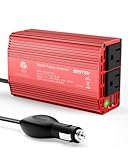
6. BESTEK 300W Power Inverter
See current price · Best for: Plug-In Car Inverter
- Features
- 12V socket plug, 300W, modified sine
Most people searching for a portable inverter want exactly this: something that plugs into the car's 12V socket and runs a laptop on a road trip. BESTEK's 300W unit is the long-running bestseller in that category, with household AC outlets and USB charging ports in a compact case. Understand what the 300W figure means, though. Through a cigarette-lighter plug, the vehicle's socket wiring and fuse cap the real output at roughly 150W in most cars, so the 300W rating only applies if you use the battery clamps where the kit includes them. It is also a modified sine wave inverter, which is fine for laptop power bricks, phone chargers and many small devices but is not what you want for a CPAP, a medical device, some cordless-tool battery chargers or anything with a small motor. For a glovebox power inverter, that is an acceptable trade for the price and convenience.
Pros
- Plugs straight into a 12V accessory socket; no wiring
- AC outlets plus USB charging ports in a cup-holder-friendly case
- Fine for laptops, phones, camera batteries and small chargers
- Inexpensive and easy to keep in a glovebox
Cons
- Modified sine output; not for CPAPs, medical gear or some chargers
- Realistically limited to about 150W through a lighter socket
2. Power Inverter Side by Side
| Product | Score | Price | Features | Buy |
|---|---|---|---|---|
| Renogy 1000W Pure Sine Wave Inverter Best Overall | 93 | See current price | 12V DC in, 1,000W continuous, pure sine | Amazon → |
| GoWISE Power 2000W Pure Sine Wave Inverter Best 2000 Watt Inverter | 90 | See current price | 12V DC in, 2,000W continuous, pure sine | Amazon → |
| Victron Phoenix 12/1200 Inverter Best Premium for Vans | 87 | See current price | 12V DC in, 1,200VA, pure sine | Amazon → |
| AIMS Power 3000W Pure Sine Inverter Best for Trucks and Work Rigs | 84 | See current price | 12V DC in, 3,000W continuous, pure sine | Amazon → |
| Go Power! GP-SW2000 Pure Sine Wave Inverter Best for RVs | 81 | See current price | 12V DC in, 2,000W continuous, pure sine | Amazon → |
| BESTEK 300W Power Inverter Best Plug-In Car Inverter | 78 | See current price | 12V socket plug, 300W, modified sine | Amazon → |
3. The Inverters at a Glance
A power inverter turns the 12V DC stored in a car, truck, RV or boat battery into the 120V AC that comes out of a wall outlet. That sounds like one product, but it is really three. There are plug-in units that live in a cup holder and run a laptop. There are hardwired inverters in the 1,000-2,000W range that turn a van or camper battery bank into usable household power. And there are 3,000W-plus units for work trucks and off-grid systems, where the inverter is the easy part and the battery bank and cabling are the actual project.
We picked six widely sold inverters to cover those three jobs, from a 300W socket plug-in to a 3,000W work-truck unit. These picks are based on manufacturers' published specifications, the documentation that ships with each model, and what the electrical rules say about wiring them, not on our own bench testing. Where we give a current draw or a cable size, it comes from the basic arithmetic in this guide, and the inverter's own manual always takes precedence over our rules of thumb.
| Inverter | Continuous rating | Waveform | Connection | Best for |
|---|---|---|---|---|
| Renogy 1000W Pure Sine | 1,000W | Pure sine | Hardwired to battery | Vans, campers, laptops, CPAP |
| GoWISE Power 2000W Pure Sine | 2,000W (4,000W peak listed) | Pure sine | Hardwired to battery | Microwave, coffee maker, tools |
| Victron Phoenix 12/1200 | 1,200VA (about 1,000W) | Pure sine | Hardwired to battery | Full-time vans and boats |
| AIMS Power 3000W Pure Sine | 3,000W | Pure sine | Hardwired to dedicated bank | Work trucks, job trailers |
| Go Power! GP-SW2000 | 2,000W | Pure sine | Hardwired to house batteries | RV upgrades |
| BESTEK 300W | 300W (about 150W via socket) | Modified sine | 12V accessory socket | Car laptops and chargers |
Two patterns in that table matter more than any brand difference. First, everything except the BESTEK is pure sine. Modified sine inverters are cheaper, but they cause enough trouble with modern electronics that we would only buy one for a glovebox. Second, everything except the BESTEK has to be bolted to a battery with heavy cable and a fuse. If you were hoping to plug a 1,000W inverter into a dashboard socket, that is not possible, and the section on socket limits explains why.
If you do not already have a battery bank, read the section comparing inverters with power stations before you buy anything. For a lot of people who want occasional AC power in a vehicle or during an outage, a self-contained portable power station is simpler, safer and not much more expensive once you price the battery, cable, fuse and charger an inverter needs.
4. Pure Sine vs Modified Sine
Utility power is a smooth sine wave: voltage swings up and down in a rounded curve sixty times a second. A pure sine inverter recreates that curve electronically. A modified sine inverter approximates it with a stepped, blocky waveform that holds at zero, jumps to a fixed voltage, drops back, and flips negative. Both deliver roughly the right amount of energy, which is why a light bulb or a heater cannot tell the difference. Anything that relies on the shape of the wave can.
The devices that object are the ones you would most want to protect. Induction motors in fridges, fans and pumps run hotter and louder on modified sine. Some CPAP machines and their heated humidifiers either refuse to work or misbehave, and most CPAP makers recommend pure sine. Variable-speed tools, some cordless-tool battery chargers, microwaves, audio gear and anything with a dimmer or a timer clock can buzz, run slow, lose time or fail early. Laptop power bricks and phone chargers usually cope, which is why cheap plug-in inverters get away with it.
THE RULE
Buy pure sine unless the inverter is under 300W and only charges phones and laptops.
The price gap between pure and modified sine has shrunk to the point that saving money on the waveform rarely makes sense for anything you will hardwire. Modified sine still has a place as a cheap glovebox inverter.
There is also an efficiency cost to modified sine with some loads. A motor fed a blocky waveform converts part of the extra harmonic content into heat rather than work, so it draws more current from the battery for the same job. On a small battery bank that difference shows up as shorter runtime, which is the opposite of what you were trying to save by buying the cheaper inverter.
Some listings blur the line with phrases like "true sine," "pure sine output," or "sine wave technology" on what turns out to be a modified unit. Look for the words pure sine wave in the model name or specification sheet and, if the manufacturer publishes it, a total harmonic distortion figure of a few percent or less. Every hardwired pick on this list is a pure sine wave inverter by its maker's own specification.
5. Sizing: Continuous Watts vs Surge
Every inverter carries two ratings. Continuous output is what it can deliver indefinitely without overheating. Surge or peak output is what it can supply for a fraction of a second to a few seconds while a motor or compressor starts. Size the continuous rating to the total of everything you will run at the same time, then check that the surge rating covers the biggest motor start. Then add a margin, because an inverter running at its continuous limit runs hot, runs its fan hard and trips on the first warm afternoon.
A practical way to size is to add up your simultaneous loads and multiply by 1.25. Appliance labels list watts or amps; for amps, multiply by 120 to get watts. Pay attention to the difference between what an appliance does and what it draws. A microwave sold as 1,000 watts is rated for cooking power; it typically draws around 1,400-1,600W from the outlet. A coffee maker or toaster is commonly 800-1,500W. A compressor fridge may only run at 100-200W but needs several times that for a moment when it starts.
| Load | Typical running draw | Start-up concern | Smallest sensible inverter |
|---|---|---|---|
| Phone, tablet, camera chargers | 5-30W | None | 150-300W plug-in |
| Laptop | 45-100W | None | 150-300W plug-in |
| CPAP without heated humidifier | 30-60W | None, but needs pure sine | 300W+ pure sine |
| TV and streaming box | 60-150W | None | 300-500W |
| 12V-style compressor fridge on AC | 50-100W | Moderate | 500W+ |
| Household mini or full fridge | 100-250W | High start current | 1,000W pure sine |
| Coffee maker | 800-1,200W | None | 1,500-2,000W |
| Microwave (1,000W cooking) | ~1,400-1,600W | Moderate | 2,000W |
| Circular or miter saw | 1,200-1,800W | High | 2,000-3,000W |
| Small air compressor | 1,000-1,800W | Very high | 3,000W |
The figures above are typical ranges for common appliances, not measurements of particular models, so check your own labels. They make the shape of the decision clear, though. A 1000W inverter covers everything up to a fridge, a 2,000W unit adds kitchen appliances and most saws, and 3,000W is mainly about running a couple of heavy loads together or starting stubborn motors.
Bigger is not free. A larger inverter idles at a higher current, costs more, weighs more, and demands thicker cable and a larger fuse. If you only ever run a laptop and a CPAP, a 2,000W inverter wastes battery every hour it sits switched on. Match the inverter to the loads you actually own rather than the ones you might someday plug in.
6. The Cigarette Socket's 150-Watt Ceiling
Every plug-in inverter box advertises a number like 300W, 400W or 500W, and almost none of them can deliver it through a 12V accessory socket. The socket is wired with light-gauge cable and protected by a fuse, commonly 15 amps and sometimes 10 or 20 amps depending on the vehicle. At 12 volts, with some inverter losses, 150W of AC output draws roughly 13-14 amps from the socket. That is about as much as most sockets can supply continuously without blowing the fuse or heating the plug.
This is why a portable inverter is a laptop and phone device, not a kitchen device. A 150W limit comfortably runs a laptop, a camera battery charger, a small TV or a CPAP without its heated humidifier, if the inverter is pure sine. It will not run a hair dryer, a kettle, a coffee maker or a power tool, no matter what the box says. If the inverter keeps beeping and shutting off, or the socket fuse keeps blowing, you have found the limit.
THE MATH
Watts divided by 12 is roughly the amps your 12V wiring must carry.
Then add about 10-15 percent for inverter losses. 150W is about 13-14A, 1,000W about 95-100A, 2,000W about 190-200A, and 3,000W about 280-300A. Those amps are what the cable and fuse have to be sized for.
Higher-wattage plug-in kits usually include battery clamps for a reason: the clamps bypass the socket wiring and connect straight to the battery terminals. That works for occasional use with the hood up, but clamps are a temporary connection, the included leads are often only good for a few hundred watts, and you are drawing from the starting battery. Anything you plan to use regularly above about 150W should be hardwired.
Some newer trucks and SUVs have factory 120V outlets, usually rated in the range of 150-400W depending on the model, and a few pickups now offer much larger factory onboard power systems. Check your owner's manual before buying an inverter at all. If the factory outlet covers your loads, it is already wired, fused and integrated with the vehicle's charging system.
7. Cable Gauge, Fusing and Grounding
A 12V inverter pulls a lot of current, and current is what melts cable. The inverter's manual specifies a minimum cable size and a fuse rating for its continuous output and the expected cable length, and those numbers are the ones to follow. As a general guide for short runs of a few feet, a 1,000W inverter typically calls for 4 AWG or heavier, 2,000W for around 2/0, and 3,000W for 4/0 or a pair of heavy runs. Longer runs need heavier cable, because voltage drop adds up fast at 12 volts and an inverter that sees low voltage under load will shut down.
Fuse the positive cable as close to the battery as practical. The fuse protects the cable, not the inverter, so its rating must not exceed what the cable can safely carry. A short anywhere along an unfused battery cable can deliver thousands of amps and start a fire in seconds. For lithium banks and big inverters, a Class T fuse is the usual recommendation because of its high interrupt rating; ANL and MRBF fuses are common on smaller systems. Add a battery disconnect switch so you can isolate the inverter for service.
| Inverter size | Approx. DC current at full load | Typical cable on a short run | Fuse |
|---|---|---|---|
| 300W (clamped) | ~30A | Per kit leads; 8 AWG for a hardwire | Per manual |
| 1,000W | ~100A | 4 AWG or heavier | Sized to cable and manual |
| 2,000W | ~200A | About 2/0 | Sized to cable and manual |
| 3,000W | ~300A | About 4/0 | Class T sized to manual |
| 4,000W | ~400A | Multiple heavy runs; consider 24V | Class T sized to manual |
Use fine-strand copper welding or marine battery cable with properly crimped, sealed lugs, not crimp-on hardware-store terminals squeezed with pliers. A poor crimp is a resistor: it gets hot under load and can fail without warning. Keep the positive and negative runs the same length and routed together, protect them where they pass through metal, and torque the terminals to spec. Bond the inverter's chassis ground lug to the vehicle frame or the system's ground point with the cable size the manual specifies.
NEVER BACKFEED
Do not connect an inverter to your house wiring through an outlet.
A "double-male" cord from an inverter into a wall socket can energize the utility line and electrocute a lineworker, and it bypasses every protective device in the panel. Inverter power reaches a house only through a transfer switch or interlock installed by a licensed electrician. For real home outage coverage, compare a home generator or a home battery backup system.
RV owners have one more trap. Plugging the RV's shore cord into an inverter that is powered from the same house batteries creates a loop: the converter charger tries to recharge the batteries from the inverter, which drains the batteries to feed it. If you power the RV that way, switch off the converter's breaker first. Better still, wire the inverter to dedicated outlets or through a proper transfer switch.
8. Batteries, Alternators and the Best Inverter for a Truck
An inverter is only as useful as the battery behind it. A typical car starting battery holds somewhere around 40-70 amp-hours of lead-acid capacity, and only a fraction of that is usable before it struggles to crank the engine. Run a 1,000W load off it with the engine off and you could flatten it in well under an hour. Run a 100W laptop and you have a few hours at most. That is why serious inverter setups use a separate deep-cycle battery bank, and why the best power inverter for a truck is usually one wired to an auxiliary battery rather than the starter.
Running the engine helps, but less than many people expect. Alternators are rated at high rpm; at idle many produce a fraction of their nameplate output, and the vehicle's own lights, fans and electronics take their share first. A 2,000W inverter at full load can draw more than many stock alternators deliver at idle, so the battery still drains, just more slowly. If you intend to run big loads from a truck regularly, a high-output alternator or a DC-DC charger feeding an isolated house battery is part of the build.
Lithium iron phosphate batteries have changed the math for vans and trucks. They deliver most of their rated capacity, hold voltage under heavy load so the inverter does not trip on low voltage, and weigh roughly half as much as lead-acid. The limit to watch is the battery's BMS: a 100Ah lithium battery with a 100A continuous BMS cannot feed a 2,000W inverter at full load and will shut off.
Whatever battery you use, set the inverter's low-voltage cutoff to protect it. Many inverters shut down around 10.5V by default, which is too deep for lead-acid batteries you want to last. If the inverter shares a battery with the engine, use a battery isolator or a low-voltage disconnect so you never strand the truck. On lithium, follow the battery maker's recommended cutoff voltage, which is usually set by the BMS anyway.
Finally, remember the idle draw. A large inverter left switched on with nothing plugged in still consumes current to keep its electronics alive, and the bigger the inverter, the more it tends to use. Check the no-load current on the specification sheet. Over a weekend of camping, an idling 3,000W inverter can use a surprising share of a small battery, which is the case for the Victron's low-consumption design and for simply switching inverters off when you are done.
9. 2,000, 3,000 and 4,000 Watt Inverters
The 2000 watt power inverter is the most popular size for RVs and work trucks because it crosses the kitchen threshold: microwave, coffee maker, toaster, induction plate and most corded saws all fit under it, one at a time. It is also the size where the wiring stops being trivial. Two hundred amps of DC needs cable roughly as thick as a thumb, a proper fuse, and a bank that can supply that current without the BMS or voltage sag cutting it off. Budget for all of that, not just the inverter.
At 3,000W you are mainly buying the ability to run two big loads together, or to start a compressor, table saw or larger pump that a 2,000W unit struggles with. You are also buying a 300-amp DC circuit, which on 12V means 4/0 cable, very short runs and a battery bank of several hundred amp-hours of lithium if you want more than a few minutes at full output. For a work rig that runs tools in bursts, that is a reasonable trade. For an RV that occasionally runs a microwave, it is overkill.
A 4000 watt power inverter on a 12V system is where we suggest stopping and rethinking. At full load it draws on the order of 400 amps, which pushes cable, fusing, battery current limits and heat to the edge of what is practical in a vehicle. Most van and off-grid designers move to a 24V or 48V battery bank at this size, because doubling the voltage halves the current and lets cable, fuses and the inverter itself shrink. If you genuinely need 4,000W, design the system around a higher battery voltage from the start.
At these sizes, it is also worth looking at inverter chargers, which combine the inverter with a shore-power battery charger and an automatic transfer switch. They are the standard in larger RVs and off-grid cabins because the transfer from shore or generator power to batteries happens automatically and safely. They cost more and need more careful installation, often by a professional, but they solve the RV shore-cord loop problem described above and remove a lot of manual switching.
If what you really want is to run a house during a blackout, a big inverter on a vehicle battery is the wrong tool. An idling truck is an inefficient generator, a 12V system cannot store enough energy for a fridge, furnace and lights for a day, and connecting it to the house safely needs the same transfer equipment as a generator. Look at a small home generator or a dedicated battery system instead.
10. Inverter or Portable Power Station?
A portable power station is an inverter, a lithium battery, a battery management system, a charger and a solar controller in one sealed box with outlets on the front. A bare inverter is just the first of those parts. Which one makes sense depends almost entirely on whether you already have a suitable battery and whether the power needs to live permanently in the vehicle.
If you own a van, RV or boat with a decent house battery bank, an inverter is the cheaper and more integrated way to add AC power. The battery already exists, it is already charged by the alternator, shore power or solar, and an inverter wired into it can feed fixed outlets wherever you need them. It also scales: a 2,000W inverter on a 300Ah lithium bank gives you far more capacity than a carry-size power station at a lower cost per watt-hour.
If you do not have a battery bank, a power station is usually the better buy. By the time you price a quality lithium battery, a 1,000W pure sine inverter, heavy cable, a fuse, a disconnect, a charger and an afternoon of installation, you are close to the price of a 1kWh power station that needs none of it. The power station also comes out of the vehicle and into the house during an outage, which a hardwired inverter does not. Our camping power station picks and EcoFlow vs Jackery comparison cover the most common choices.
There is a middle path that many truck owners land on: a power station in the cab or bed, charged from the 12V socket or a dedicated DC charging cable while driving and from solar at camp. You give up the very high outputs of a 3,000W inverter, but you avoid modifying the vehicle's electrical system and you get a battery you can carry into the house. For a lot of weekend users, that is the cleanest answer of all.
11. Which Power Inverter to Buy
For a car or a truck you do not want to modify, buy the BESTEK 300W and accept the 150W socket limit. It will run laptops, phone chargers and camera batteries on a road trip and costs very little. If the load you care about is a CPAP or anything with a motor, skip the modified sine plug-in and look at a small power station or a hardwired pure sine inverter instead.
For a van, a camper or a small RV with one or two house batteries, the Renogy 1000W pure sine is the best power inverter for most people. It covers laptops, TVs, CPAPs, chargers, blenders and a small fridge, and its wiring is manageable on a typical 100-200Ah lithium bank. If the inverter will run around the clock in a full-time build or a boat, spend more on the Victron Phoenix 12/1200 for its low idle draw and long service record.
For an RV or a camper that needs to run a microwave or coffee maker from the house batteries, step up to a 2,000W pure sine unit. The Go Power! GP-SW2000 is the natural pick for an RV battery bay, and the GoWISE Power 2000W is the value alternative with the same basic capability. Either needs about 200 amps of supply, so make sure the bank and BMS can deliver it before you buy.
For a work truck that runs saws and compressors, the AIMS Power 3000W pure sine on an isolated auxiliary battery bank, charged by a DC-DC charger or a high-output alternator, is the setup that holds up. If you find yourself pricing a 4,000W inverter, redesign around a 24V or 48V bank, or consider whether a compact inverter generator would do the heavy work more cheaply. And for occasional AC power without a battery bank, a portable power station is simpler than any inverter on this list.
12. Common Mistakes to Avoid
Trusting the wattage on a plug-in inverter box
A 300W or 500W plug-in inverter can only deliver what the vehicle's accessory socket allows, which is roughly 150W in most cars. Above that, the socket fuse blows or the inverter shuts down. If your load is bigger than a laptop and a phone charger, plan on hardwiring the inverter to the battery with proper cable and a fuse.
Undersizing cable or skipping the fuse
A 2,000W inverter draws about 200 amps at 12V. Thin cable overheats, drops voltage and makes the inverter trip on low voltage, and an unfused cable can start a fire if it shorts. Use the gauge in the manual, fit a fuse sized to the cable as close to the battery as practical, and crimp lugs properly.
Running a big inverter off the starting battery
A starting battery is built to deliver a short burst for cranking, not hours of deep discharge. Run a 1,000W load from it with the engine off and you can be stranded within the hour. Put serious inverters on a separate deep-cycle bank with an isolator or DC-DC charger, so the engine battery is never drained.
Buying modified sine for sensitive loads
Modified sine inverters save money but can make CPAPs fault, fridges run hot, tool chargers misbehave and audio gear hum. Unless the inverter is a small plug-in for laptops and phones, buy pure sine. The price difference is small compared with replacing a CPAP or a fridge compressor that ran hot for a season.
Feeding a house through an outlet
Plugging an inverter into a wall outlet with a double-male cord can energize the utility line and endanger lineworkers, and it bypasses every breaker in the panel. Inverter power only belongs on house circuits through a transfer switch or interlock installed by a licensed electrician. For outage power, a generator or home battery system is the right tool.
13. Frequently Asked Questions
What size power inverter do I need?
Add up the watts of everything you will run at the same time, multiply by about 1.25 for headroom, and check that the surge rating covers your largest motor start. Laptops and phone chargers need 150-300W. A CPAP, TV and small fridge fit a 1000W inverter. A microwave or coffee maker needs about 2,000W, and running heavy tools together pushes you toward 3,000W.
Is pure sine wave really necessary?
For anything you hardwire, yes. Pure sine output matches utility power, so motors, CPAPs, variable-speed tools, chargers and audio equipment behave as they do at home. Modified sine is acceptable for laptop power bricks, phone chargers and resistive loads like incandescent bulbs. Since the price gap has narrowed, most buyers are better off spending a little more for pure sine.
Can I run a 1000W inverter from my car's cigarette lighter?
No. The accessory socket is usually fused at 10-20 amps and wired with light cable, which limits a plug-in inverter to roughly 150W of continuous AC output. A 1,000W inverter draws around 100 amps at full load and must be connected directly to the battery with heavy cable and a fuse close to the battery, as its manual specifies.
How long will a battery run a power inverter?
Divide the battery's usable watt-hours by the load in watts, then allow about 10-15 percent for inverter losses. A 100Ah lithium battery stores about 1,280Wh, nearly all of it usable, so a 100W load runs for roughly 11 hours. A similar lead-acid battery gives you about half that if you want it to last. Idle draw also eats into runtime.
What is the best power inverter for a truck?
It depends on the job. For laptops and chargers, a plug-in like the BESTEK 300W is enough. For tools and a microwave, a 2,000-3,000W pure sine inverter such as the AIMS Power 3000W, wired to a separate auxiliary battery bank charged by a DC-DC charger or high-output alternator, is the dependable setup. Never rely on the starting battery for big loads.
Can I use a power inverter to run my house during an outage?
Not safely through an outlet. Connecting an inverter to house wiring requires a transfer switch or interlock installed by a licensed electrician, and a vehicle battery cannot store enough energy to run a fridge, furnace and lights for long anyway. For outages, a home generator, a large portable power station or a dedicated home battery backup system is the better choice.
Should I buy a 4000 watt power inverter for 12V?
Usually not. At 12V a 4,000W inverter draws around 400 amps at full load, which needs very heavy cable, a large Class T fuse and a battery bank able to supply that current. Most system designers switch to a 24V or 48V battery bank at this size to halve or quarter the current, and inverter chargers become the more practical choice.
Related Guides
Portable Power Stations
Best Portable Power Station
The EcoFlow DELTA 2 LFP tops 7 portable power stations; a 1,000Wh unit runs a typical fridge about 6 to 14 hours, and LiFePO4 is rated for 3,000+ cycles.
Camping & RV Power
Best Generator for Camping
The Honda EU2200i leads 7 camping picks; a 1,000-watt inverter runs phones, lights and a 12V fridge, while kettles and hot plates need 2,000 to 2,500 watts.
The Bottom Line
For most people adding AC power to a van, camper or small RV, the Renogy 1000W pure sine inverter is the right size and the right waveform. Step up to a 2,000W unit like the Go Power! GP-SW2000 or GoWISE Power 2000W only when you need a microwave or coffee maker, and to the AIMS Power 3000W only for a work truck with its own battery bank.
Whatever you buy, the inverter is the easy part. Wire it with the cable and fuse its manual specifies, keep it off the starting battery for anything big, and never connect it to house wiring without a transfer switch. If you do not already have a battery bank, a portable power station is often the simpler answer.