Solar Generators & Panels
Best Portable Solar Panel
We research every product against its spec sheet, manuals and owner reports. When you buy through our links we may earn a commission, at no cost to you. How we score · Disclosure
The best portable solar panel for most people in 2026 is the EcoFlow 220W Bifacial Portable Solar Panel. The best all-round folding panel: enough watts to matter, a stand that makes aiming easy, and a universal connector.
The panel is the half of a solar generator people get wrong. Here are seven folding and briefcase panels worth buying, and the connector and voltage details that decide whether they will actually charge your station.
A portable solar panel only has to do two things: make as much power as its size allows, and deliver it in a form your power station will accept. Most buying mistakes are about the second part. Match the connector and stay under the voltage limit, and almost any good monocrystalline panel will serve you well.
Our top picks at a glance


Quick answer
the EcoFlow 220W Bifacial Portable Solar Panel is our #1 pick (best overall portable solar panel). The best all-round folding panel: enough watts to matter, a stand that makes aiming easy, and a universal connector.
On this page
- 1. The best portable solar panels right now
- 2. Portable Solar Panel Side by Side
- 3. What Actually Matters in a Portable Solar Panel
- 4. Connectors, Voc and Input Limits
- 5. Portable Solar Panel Comparison
- 6. Series vs Parallel, and Mixing Panels
- 7. Bifacial Panels, Kickstands and Aiming
- 8. IP Ratings, Durability and Cleaning
- 9. How Many Watts Your Station Needs
- 10. Which One to Buy
- 11. Common Mistakes to Avoid
- 12. Frequently Asked Questions
1. The best portable solar panels right now

1. EcoFlow 220W Bifacial Portable Solar Panel
See current price · Best for: Overall Portable Solar Panel
- Features
- 220W front, bifacial, MC4 output, kickstand case
EcoFlow’s 220W bifacial panel is the folding panel we would recommend to most power station owners, whatever the brand. EcoFlow rates the front at 220W and the rear side for additional output from light reflected off the ground, and the carry case unfolds into a kickstand you can set to face the sun, which is where most of the real-world gain in portable solar comes from. Output is on MC4 connectors, the industry standard, and EcoFlow supplies a cable to its own XT60 input; other stations need their own MC4 adapter, which most include. At 220W it is the size that makes a meaningful dent in a 1kWh battery in a day without becoming too heavy for one person to carry and set up. The caveat is the bifacial claim: on dark soil or asphalt the back side adds little, and over sand, snow or a white tarp it adds more. Treat it as a bonus, not the headline.
Pros
- Bifacial design harvests reflected light from the back side
- Protective carry case doubles as an adjustable kickstand
- MC4 output works with most stations via adapter cables
- Pairs natively with EcoFlow stations through an XT60 cable
- Strong water-resistance rating per EcoFlow
Cons
- Bifacial gains depend heavily on the ground surface
- Heavier and bulkier than a 100W single panel
- Two of them in series can exceed small stations’ voltage limits

2. Jackery SolarSaga 100W Solar Panel
See current price · Best for: Jackery Owners
- Features
- 100W folding panel, built-in kickstands, USB outputs
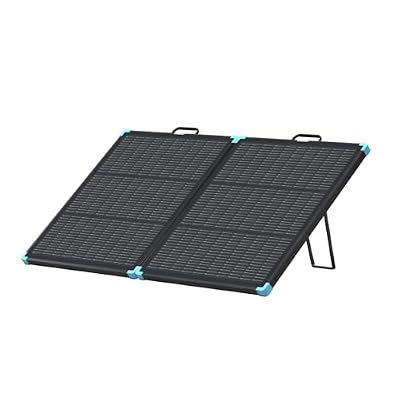
If you own a Jackery Explorer, the SolarSaga 100W is the low-friction choice. Jackery designs the cabling to plug into its stations, with adapters supplied for the different input sockets on older and newer Explorers, so there is very little to get wrong. The panel folds in half into a briefcase shape with a handle, has kickstands on the back so you can tilt it toward the sun, and adds USB ports for charging a phone straight off the panel. Its limitation is size. One 100W panel is a good match for a station of a few hundred watt-hours, but against a 1kWh-plus Explorer it will only put back a fraction of a charge on a good day; by the sun-hour math in this guide, expect something on the order of 300-400Wh from one panel on a clear summer day. For larger Explorers, buy two and connect them as Jackery’s manual describes, or look at our guide to the best Jackery power stations for bundled kits.
Pros
- Plugs straight into Jackery Explorer stations with the right cable
- Folds in half like a briefcase with a carry handle
- Kickstands built into the back
- Also has USB ports for charging a phone directly
- The most commonly bundled panel with Jackery stations
Cons
- Jackery-specific cabling; other brands usually need an adapter
- Only 100W, so slow for stations above about 500Wh
- Usually costs more per watt than generic MC4 panels

3. Anker SOLIX PS100 Portable Solar Panel
See current price · Best for: Compact 100W Panel
- Features
- 100W folding panel, adjustable kickstand
Anker’s SOLIX PS100 is the compact 100W option for people who want one panel that folds small, sets up quickly and pairs neatly with a SOLIX power station. Anker builds in an adjustable kickstand so the panel can be tilted to suit the sun’s height, which matters most in spring, fall and winter, and lists high-efficiency monocrystalline cells. It is a natural partner for the smaller SOLIX stations, such as the C-series, where 100W of input is a sensible fraction of the battery and a decent day of sun can put back much of a charge. Against larger stations it is better thought of as one panel in a pair. Because Anker has sold several revisions and bundles under the PS100 name, check the listing for the exact output connector and its included cables, especially if your station is from another brand. Our guide to the best Anker SOLIX power stations covers which stations it suits best.
Pros
- Compact folded size for a 100W panel
- Adjustable kickstand for setting the tilt angle
- Designed to pair with Anker SOLIX stations
- Monocrystalline cells with a high claimed efficiency
Cons
- Check the output connector against non-Anker stations before buying
- 100W is slow for big batteries
- Exact ports and ratings vary between listings and versions

4. BLUETTI PV200 Solar Panel
See current price · Best for: Universal 200W Panel
- Features
- 200W folding panel, MC4 output, kickstands
BLUETTI’s PV200 is a good example of why MC4 output matters. It is a 200W folding panel that BLUETTI designs for its own stations, but because the output is the industry-standard MC4 connector, it works with nearly any station that ships with an MC4 adapter cable, which is most of them. BLUETTI lists monocrystalline cells with a high claimed efficiency, and the panel has kickstands on the back for tilting it toward the sun. At 200W, it is the size where a single panel starts to make real progress on a 1kWh battery: by the sun-hour arithmetic, a clear summer day could put back something like 500-800Wh with good aiming. The trade is footprint; unfolded, it needs a patch of ground, a truck bed or a picnic table. If you plan to wire two in series, add up their open-circuit voltage and compare it with your station’s limit first; that is where 200W panels most often catch people out.
Pros
- Standard MC4 output works with almost any station
- Kickstands for angled setup
- Monocrystalline cells with a high claimed efficiency
- A popular, widely sold 200W size
Cons
- Large unfolded footprint
- Heavier than 100W panels, though lighter than glass suitcases
- Check Voc before wiring two in series

5. EcoFlow 400W Portable Solar Panel
See current price · Best for: Most Watts in One Panel
- Features
- 400W folding panel, MC4 output, kickstand case
The EcoFlow 400W is for people who want serious solar input without managing a pile of panels and branch cables. It is one folding panel, rated at 400W, with a case that becomes the kickstand and MC4 output with a cable for EcoFlow’s XT60 input. Paired with a 1-2kWh station such as an EcoFlow Delta, it is the setup most likely to refill the battery in a single good day: the sun-hour math suggests 1.2-1.6kWh from a clear summer day with careful aiming, before losses on cloudier days. Two points before you buy. First, it is big: unfolded, it covers a lot of ground and takes some effort to set up in wind. Second, a panel this size runs at a higher voltage than small 12V-class panels, which is good for efficiency but can exceed the input limit on small stations. Check the open-circuit voltage on the listing against your station’s manual, and do not buy it for a station with a modest solar input rating.
Pros
- One panel and one cable for 400W of rated input
- Case converts into a kickstand
- MC4 output with EcoFlow’s XT60 cable included
- Fewer connections to manage than two 200W panels
Cons
- Very large when unfolded and heavy to carry
- Higher voltage than small stations can accept
- Overkill for anything under about 1kWh
6. Renogy 100W Portable Solar Suitcase
See current price · Best for: 12V Batteries and RVs
- Features
- 100W rigid suitcase, built-in charge controller, battery clips
Renogy’s suitcase is a different kind of portable solar panel, and it is in this list for a different buyer. Two rigid panels hinge together in an aluminum frame with fold-out legs, and a charge controller is mounted on the back, with clips to connect straight to a 12V battery. That makes it a complete solar charging kit for an RV house battery, a trolling-motor battery or a van build, with no separate controller to buy. Renogy’s controllers support common battery chemistries, including lithium on current versions; check the listing for the exact controller and settings it ships with. For a portable power station, the built-in controller is extra hardware between the panel and a station that already has its own, so a fabric folding panel is usually the cleaner choice there. If your setup is built around a lithium RV battery, our guide to the best lithium RV batteries pairs well with this panel.
Pros
- Built-in charge controller charges a 12V battery directly
- Rigid aluminum frame with adjustable legs
- Battery clips included for quick hookups
- Glass-and-aluminum construction is more durable than fabric
Cons
- Heavier and bulkier than fabric folding panels
- The built-in controller is redundant for a power station
- Rigid frame needs more storage space

7. Goal Zero Boulder 100 Briefcase Solar Panel
See current price · Best for: Most Durable Panel
- Features
- 100W rigid briefcase, tempered glass, kickstand
The Boulder 100 Briefcase is the panel you buy when the fabric folders feel too fragile. Goal Zero builds it as two monocrystalline panels behind tempered glass in an aluminum frame, hinged into a briefcase with a handle and a kickstand. It is meant to be thrown in a truck bed, left on a job site or set up on rocky ground without worrying about the panel surface, and Goal Zero designs Boulders to chain together when you need more input for a Yeti station. The cost is weight and price per watt: a glass-and-aluminum 100W panel is noticeably heavier than a fabric 100W folder, and it takes up more room in storage. For backpacking or anything carried far, it is the wrong choice. For a contractor running a Yeti on site, a ranch, or a family that stores its outage kit in a garage where things get knocked around, the durability is worth paying for. Check connector compatibility before pairing it with a non-Goal Zero station.
Pros
- Tempered glass and aluminum frame shrug off rough handling
- Integrated kickstand
- Chainable with additional Boulder panels
- Designed to plug into Goal Zero Yeti stations
Cons
- Heavy for 100W
- Goal Zero connectors may need adapters for other brands
- Costs more per watt than folding panels
2. Portable Solar Panel Side by Side
| Product | Score | Price | Features | Buy |
|---|---|---|---|---|
| EcoFlow 220W Bifacial Portable Solar Panel Best Overall Portable Solar Panel | 93 | See current price | 220W front, bifacial, MC4 output, kickstand case | Amazon → |
| Jackery SolarSaga 100W Solar Panel Best for Jackery Owners | 91 | See current price | 100W folding panel, built-in kickstands, USB outputs | Amazon → |
| Anker SOLIX PS100 Portable Solar Panel Best Compact 100W Panel | 88 | See current price | 100W folding panel, adjustable kickstand | Amazon → |
| BLUETTI PV200 Solar Panel Best Universal 200W Panel | 85 | See current price | 200W folding panel, MC4 output, kickstands | Amazon → |
| EcoFlow 400W Portable Solar Panel Most Watts in One Panel | 83 | See current price | 400W folding panel, MC4 output, kickstand case | Amazon → |
| Renogy 100W Portable Solar Suitcase Best for 12V Batteries and RVs | 81 | See current price | 100W rigid suitcase, built-in charge controller, battery clips | Amazon → |
| Goal Zero Boulder 100 Briefcase Solar Panel Most Durable Panel | 78 | See current price | 100W rigid briefcase, tempered glass, kickstand | Amazon → |
3. What Actually Matters in a Portable Solar Panel
Start with the wattage on the label and then discount it. A panel’s rating is measured under standard test conditions: bright light, a cool cell temperature and a perfect angle. Outside, panels run hot, the sun moves and the air is never perfectly clear, so a portable panel commonly delivers somewhere around 60-80% of its rating at midday in good conditions, and less at other times. That is normal, not a defect, and every brand is subject to it.
Almost every good portable solar panel now uses monocrystalline cells, with manufacturers commonly claiming efficiencies in the low-to-mid 20s percent. Efficiency does not change how many watts a 100W panel makes; it changes how big the panel has to be to make them. Higher efficiency means a smaller, lighter panel for the same rating, which is what you want in something you carry. Treat claims above about 25% for consumer folding panels with skepticism.
Form factor is the next real decision. Fabric folding panels with ETFE or PET surfaces are the lightest per watt and fold flat, but they are more vulnerable to sharp objects and abrasion. Rigid suitcase and briefcase panels behind glass are heavier and bulkier but far tougher. Most power station owners are best served by a fabric folder; people charging 12V batteries in an RV or using panels on job sites often prefer a rigid suitcase.
Then there is the part that decides whether the panel works at all: the connector and the voltage. A panel that will not physically plug into your station, or that produces more voltage than the station accepts, is useless until you buy an adapter or a different panel. That is the subject of the next section, and it is worth reading before you look at the picks.
If you have not picked a power station yet, it is worth doing that first, because the station sets the limits the panel has to fit. Our guide to the best portable power stations covers capacity and inverter sizing, and our solar generator guide pairs specific stations with the panel wattage that refills them. This page focuses on the panel side.
4. Connectors, Voc and Input Limits
Portable panels use a handful of connectors, and stations use a slightly different handful. MC4 is the industry standard: a locking, weather-sealed pair of plugs used on nearly every rooftop and most folding panels. Anderson Powerpole connectors appear on some Goal Zero gear and older Jackery panels. DC8020 is the input on Jackery’s newer Explorer stations, DC7909 (an 8mm barrel) shows up on older Jackery and many other stations, and XT60 is the solar input on EcoFlow’s River and Delta lines.
The practical takeaway is simple: buy a panel with MC4 output, or one made by your station’s brand. MC4 adapters to every common station input are cheap and widely sold, and most stations ship with one in the box. A proprietary panel can be the easiest option within its own brand and the most awkward outside it, which matters if you might switch stations later. Our EcoFlow vs Jackery comparison goes into the ecosystem side of that choice.
Voltage is the limit that can cause damage. Every panel lists an open-circuit voltage, or Voc: the voltage it produces with nothing connected. Every station lists a solar input voltage range. The panel’s Voc must stay below the station’s maximum, with margin, or the station may refuse to charge or, in the worst case, be damaged. Small stations often accept a lower maximum voltage than larger ones, so a panel that is perfect for a 2kWh station can be wrong for a 300Wh one.
Cold weather raises Voc. Solar cells produce higher voltage when they are cold, so a panel that sits comfortably under your limit on a summer afternoon can creep over it on a clear, freezing morning. A rule of thumb is to keep the combined Voc at least 10-20% below the station’s maximum input voltage, more if you charge in winter. The station’s input current limit matters too, but exceeding it with panel watts is usually handled by the station simply capping the input; exceeding voltage is not.
THE CHECK
Panel Voc, times the number in series, must stay well under the station’s max input voltage.
Read the Voc on the panel’s spec label and the solar input range in your station’s manual before you buy. Leave 10-20% headroom for cold mornings. If in doubt, wire in parallel or ask the manufacturer.
5. Portable Solar Panel Comparison
The table lines up the seven picks on the specs that most affect compatibility and handling. Ratings and connectors are manufacturer figures; the daily-output column is our estimate using five peak sun hours and a 60-80% real-world factor, not a measured result. Cloudy days, winter sun and poor aiming will pull every number down.
| Panel | Rated Output | Output Connector | Build | Clear Summer Day (Est.) |
|---|---|---|---|---|
| EcoFlow 220W Bifacial | 220W front, plus rear gain | MC4 (XT60 cable for EcoFlow) | Folding, kickstand case | About 650-900Wh |
| Jackery SolarSaga 100W | 100W | Jackery cabling, adapters for Explorer inputs | Folding briefcase, kickstands | About 300-400Wh |
| Anker SOLIX PS100 | 100W | Check listing for your station | Folding, adjustable kickstand | About 300-400Wh |
| BLUETTI PV200 | 200W | MC4 | Folding, kickstands | About 600-800Wh |
| EcoFlow 400W | 400W | MC4 (XT60 cable for EcoFlow) | Folding, kickstand case | About 1.2-1.6kWh |
| Renogy 100W Suitcase | 100W | Charge controller with battery clips | Rigid aluminum, legs | About 300-400Wh into a 12V battery |
| Goal Zero Boulder 100 | 100W | Goal Zero connectors | Rigid glass briefcase | About 300-400Wh |
The pattern worth noticing is that the four 100W panels land in the same output range regardless of brand, because the physics does not care whose logo is on the case. What separates them is connector compatibility, weight, durability and how easy they are to aim. That should drive your choice far more than a fraction of a percent of claimed efficiency.
The two EcoFlow panels and the BLUETTI are the most universal because they output on MC4. The Jackery, Anker and Goal Zero panels are simplest within their own brand and may need adapters elsewhere. The Renogy is the odd one out: its built-in controller makes it a direct 12V battery charger, which is a strength for an RV and a redundancy for a power station.
If you are building a complete kit around a specific station, the brand-specific roundups are worth a look: our guides to the best EcoFlow power stations, best Jackery power stations and best Anker SOLIX power stations each note which panels each station pairs with and what its solar input accepts.
6. Series vs Parallel, and Mixing Panels
Once you have more than one panel, you have to decide how to connect them. In series, the positive of one panel connects to the negative of the next: voltages add, current stays the same. Two panels with a 24V Voc in series produce about 48V. In parallel, positives join positives through a branch connector: currents add, voltage stays the same. The same two panels in parallel produce about 24V at twice the current.
Series is usually more efficient, because higher voltage means less loss in the cable and stations tend to start charging earlier in the morning once voltage clears their minimum. It is also more vulnerable to shade: shading one panel in a series string drags down the whole string. Parallel tolerates partial shade better but pushes more current, which can exceed a station’s amp limit and runs hotter in thin cables.
The deciding factor is almost always your station’s input range. If two panels in series stay comfortably under its maximum voltage, including the cold-weather margin, series is the default. If they would exceed it, wire them in parallel, or use a station with separate high-voltage and low-voltage inputs if yours has them. Many larger stations have two solar inputs, which lets you run each panel on its own and avoids the question entirely.
Mixing panels is possible but rarely ideal. In series, the string’s current is limited by the weakest panel, so pairing a 100W panel with a 200W panel wastes much of the larger one. In parallel, panels with different voltages pull against each other. The clean approach is to buy matching panels, or to put different panels on separate station inputs. If you are adding to an existing panel, buy the same model where you can.
7. Bifacial Panels, Kickstands and Aiming
A bifacial panel has cells that can collect light from both faces, so it picks up sunlight reflected off the ground behind and beneath it. Manufacturers advertise rear-side gains that sound large, and under ideal conditions, such as fresh snow, white sand or a light-colored tarp, the extra output can be substantial. Over grass, dirt or dark pavement it is modest. A reasonable expectation for portable use is a single-digit to low-teens percentage gain on typical ground.
To get any bifacial benefit, the back of the panel must be exposed to that reflected light. That means propping it up with space underneath, not laying it on the ground or against the side of a vehicle. A light-colored groundsheet under the panel is a cheap way to improve the reflection. If you will mostly lay panels flat on a roof or truck bed, a bifacial panel offers little over a good single-sided one.
Aiming beats almost every other upgrade. A panel facing the sun squarely produces far more than one at a poor angle, and the gap grows in the mornings, the afternoons and the winter months when the sun is low. Kickstands make this easy: tilt the panel more steeply in winter and less in summer, and turn it to follow the sun every couple of hours if you are present. Our camping power station guide covers how this fits into a campsite routine.
Shade is the enemy. A single branch shadow across a few cells can cut a panel’s output far more than its area would suggest, because cells are wired in strings and a shaded cell throttles its string. Set panels clear of trees, vehicles and tent lines, and re-check them as shadows move. Partial shade in the afternoon is the most common reason a solar day underperforms the math.
8. IP Ratings, Durability and Cleaning
Folding panels carry IP ratings that describe dust and water resistance. The first digit covers dust, the second water: a panel rated IP65 resists dust and water jets, IP67 is rated for temporary immersion, and IP68 for longer immersion under conditions the manufacturer specifies. In practice, all of these will survive a passing shower while deployed. None of them are designed to be left out in the rain for weeks, and the junction box and cable connections are often the weakest points.
Fabric folding panels are durable enough for camping and outage use if you treat them reasonably. The cell surface is usually a polymer laminate rather than glass, which resists cracking from flexing but can be scratched or punctured. Avoid standing them on gravel, kneeling on them, or folding them with debris inside. Rigid glass panels like the Renogy and Goal Zero are far tougher against impacts but can crack if dropped on a corner.
Cleaning is simple. Dust, pollen and bird droppings all cut output, sometimes noticeably. Rinse the panel with plain water and wipe with a soft cloth or sponge; mild soap is fine for stubborn spots. Do not use abrasive pads, solvents or a pressure washer, and avoid cleaning a panel that is very hot from the sun, since cold water on a hot panel is an unnecessary stress.
Storage is the other half of longevity. Fold the panel dry, keep it in its case, and store it somewhere it will not be crushed or punctured. Check the cables and connectors before each season; a cracked cable jacket or corroded MC4 contact is more likely to end a panel’s useful life than the cells themselves. Most quality panels carry multi-year warranties; keep the receipt with the panel.
9. How Many Watts Your Station Needs
Size panels to the energy you use, not to the battery’s full capacity. If a station gets drained by 600Wh overnight, the panels need to put back about 600Wh plus losses during the day. Using five peak sun hours and a 60-80% real-world factor, that is roughly 150-200W of panel on a clear summer day and closer to double that in winter or under haze. For most 1kWh stations, 200-400W of panels is the realistic target.
For small stations of 300-500Wh, a single 100W panel is a sensible match and can often put back most of a charge on a good day. Those stations also tend to have lower solar input limits, both in watts and voltage, so a large high-voltage panel may not be usable at all. Check the input range first, then pick the biggest panel that fits under it.
For 2kWh stations and up, a single panel is rarely enough. Two 200W panels or one 400W panel is a better baseline, and outage users who want to run a fridge through a multi-day blackout should think in terms of 400-800W. At that scale, it is worth reading our guide to power stations for home backup alongside this one, and comparing the cost against a fuel generator for longer outages.
Remember that a portable solar power generator is only as good as its weakest half. A big battery with a small panel never refills, and a big panel on a station with a low input limit is wasted. The best results come from matching the two, which is why most brands sell bundles. Bundles are not always the best value, but they guarantee the connector and voltage match.
Rough Sizing Targets
100W
Stations around 300-500Wh
200-400W
Stations around 1kWh
400-800W
Stations of 2kWh and up
10-20%
Voc headroom below max input
10. Which One to Buy
For most power station owners: the EcoFlow 220W Bifacial Portable Solar Panel. It is the right size for a 1kWh station, the kickstand case makes aiming easy, and MC4 output means it works with most stations, not just EcoFlow. Buy two if your station accepts the combined voltage or has two inputs.
For Jackery owners: the Jackery SolarSaga 100W, bought in a pair for anything above about 500Wh. The cabling is the least fiddly option for Explorers. For Anker SOLIX owners or anyone who wants a compact 100W: the Anker SOLIX PS100, after confirming the connector matches your station.
For a universal 200W panel: the BLUETTI PV200. MC4 output means it will follow you to another station brand, and 200W is a meaningful amount of input. For the most watts with the least setup: the EcoFlow 400W, as long as your station’s input voltage range accepts it. It is the closest thing to a single-panel refill for a 1-2kWh battery.
For RVs, boats and 12V batteries: the Renogy 100W Portable Solar Suitcase, which includes the charge controller and clips you need. For job sites, truck beds and rough storage: the Goal Zero Boulder 100 Briefcase, which trades weight for glass-and-aluminum toughness.
What we would not buy: unbranded folding panels with wattage ratings that look implausible for their size, or no published Voc. If a 100W panel folds smaller than a 60W panel from a known brand, the rating is probably optimistic. And if you only need to keep phones charged, none of these are the right tool; a small USB folding panel and a power bank is, covered in our guide to the best solar power banks.
11. Common Mistakes to Avoid
Ignoring the station’s voltage limit
Every station has a maximum solar input voltage, and panel open-circuit voltage adds up in series. Exceeding it can stop charging or damage the input. Add up the Voc of panels in series, compare it with the manual, and leave 10-20% headroom for cold mornings when voltage climbs.
Buying a panel with the wrong connector
A proprietary output that does not match your station means another adapter, or no charging at all. MC4 is the safest choice because adapters to every common station input are cheap and widely available. If you buy a brand-specific panel, confirm the exact cable included for your station model.
Laying the panel flat on the ground
A flat panel loses a large share of its output whenever the sun is not overhead, which is most of the day and all winter. Use the kickstand, angle it toward the sun, and re-aim every couple of hours. A bifacial panel lying flat on the ground gets no rear-side benefit at all.
Pairing a big battery with one small panel
A single 100W panel will not refill a 2kWh station in a day, or even two. Size panels to your daily use: roughly 100W for small stations, 200-400W around 1kWh, and 400W or more for larger units. Otherwise the battery slowly drains through an outage while the panel works flat out.
Leaving folding panels out in the rain
IP ratings describe resistance to rain and splashes, not permanent outdoor exposure. Junction boxes and connectors are common failure points, and fabric panels age faster in constant weather. Bring folding panels in when you are done for the day, fold them dry, and store them in their case away from sharp objects.
12. Frequently Asked Questions
Can I use any solar panel with my portable power station?
Usually, as long as two things match: the connector and the voltage. The panel’s open-circuit voltage, multiplied by the number in series, must stay below the station’s maximum solar input voltage with some headroom. Panels with MC4 output work with most stations through an adapter cable, and most stations include one.
How long does a portable solar panel take to charge a power station?
Divide the battery capacity by the panel’s real output. A 200W panel delivering 60-80% of its rating over five peak sun hours puts back roughly 600-800Wh on a clear summer day, which is most of a 1kWh station. Winter, clouds and poor aiming can halve that or worse, so plan with margin.
Are bifacial solar panels worth it?
They are worth it if you prop them up over light-colored ground, where the back side catches reflected light. Over snow, sand or a white tarp the gain can be significant; over grass or dirt it is modest. If you mostly lay panels flat on a roof or truck bed, a good single-sided panel delivers nearly the same.
Should I connect two solar panels in series or parallel?
Series is usually more efficient and starts charging earlier, but voltages add, so check the combined Voc against your station’s maximum. Parallel keeps voltage the same and adds current, which tolerates partial shade better but can exceed a station’s amp limit. If your station has two solar inputs, running one panel per input avoids the decision.
What does Voc mean on a solar panel?
Voc is the open-circuit voltage: the voltage the panel produces in sunlight with nothing connected. It is the highest voltage the panel will normally present to your station, and it rises in cold weather. Compare it with the station’s maximum solar input voltage, and leave 10-20% headroom for cold, clear mornings.
Can portable solar panels get wet?
Most can handle a rain shower while deployed, and many carry IP65, IP67 or IP68 ratings. That does not make them suitable for permanent outdoor installation. Connectors and junction boxes are the weak points, and fabric surfaces age faster in constant weather. Dry them before folding and store them indoors between uses.
How many watts of solar do I need for a portable power station?
Match panel watts to your daily use. As a rough guide, 100W suits stations of 300-500Wh, 200-400W suits stations around 1kWh, and 400-800W suits stations of 2kWh and above. Double those figures if you need to keep up in winter, and always confirm the station’s solar input watt and voltage limits first.
Related Guides
Portable Power Stations
Best Portable Power Station
The EcoFlow DELTA 2 LFP tops 7 portable power stations; a 1,000Wh unit runs a typical fridge about 6 to 14 hours, and LiFePO4 is rated for 3,000+ cycles.
Solar Generators & Panels
Best Solar Generator
The EcoFlow Delta 3 Plus tops 7 solar generators; plan on about 1 watt of panel per 3 watt-hours of battery to refill a station on a typical sunny day.
Power Banks & Chargers
Best Solar Power Bank
The BigBlue 28W folding panel leads 7 solar power bank picks; a built-in cell makes only a watt or two, so filling a 10,000mAh bank from the sun takes days.
The Bottom Line
The best portable solar panel is the one that plugs into your station and stays under its voltage limit. Get those two right and the rest is about size and handling. For most people that is the EcoFlow 220W Bifacial, with the BLUETTI PV200 as the universal 200W alternative and the EcoFlow 400W for big stations with the input range to match.
Brand-matched panels like the Jackery SolarSaga 100W and Anker SOLIX PS100 are the easy choice inside their ecosystems. For 12V batteries, the Renogy suitcase is the complete kit, and for rough use the Goal Zero Boulder 100 is the toughest. Whatever you buy, aim it, keep it out of shade, and check the Voc before you wire anything in series.